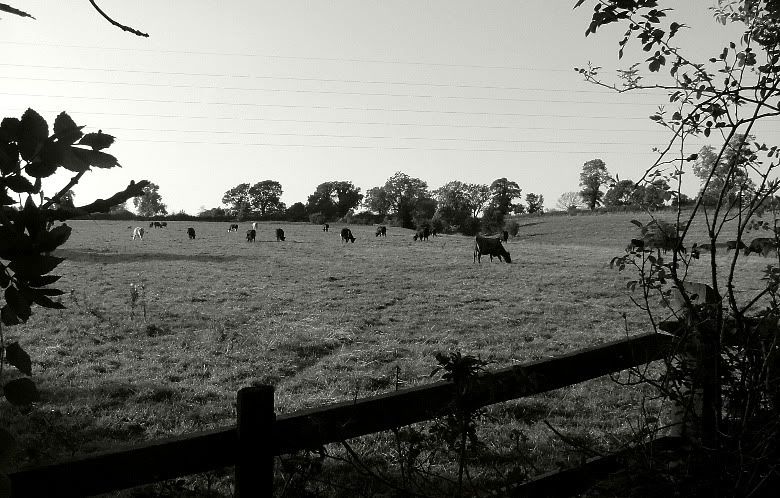
Showing posts with label kings mill reservoir. Show all posts

Tuesday, 15 September 2009

Still around


Busy times again at work, so less birding at the moment. Couldn't miss out on a juv Garganey at Kings Mill Reservoir, picture above. While at work I have been seeing more Buzzards around Hardwick and a couple of passes from Hobbies lured by the clouds of hirundines that hit us in late summer. Not a single Swallow nest was occupied anywhere around the hall this year, some were repaired but remained unused. Big shame that one. A family of Spotted Flycatchers turned up again in the Stableyard. Green Woodpeckers always a delight to see on my way through the estate.


For cuteness sake, here's a dopy Field Vole we found beside a path during a walk in Dovedale last months. The little fella scurried around my boots. Is it any wonder they are the number one prey item for dozens of predators?

Tuesday, 2 September 2008

Bird Storking

A while since my last post and I wonder where to begin this update. No doubt about it, the honour really does belong to the immature Black Stork [lifer #212], literally a big lifer, had in North Yorkshire over the weekend. The location was Cawood, a small town along the Ouse with fields sparse and wide enough to satisfy this most wary of birds. The wait to see it pop up out a ditch was around 2 hours and well worth it, although enormous thanks go to the birder who yelled us back. The girlfriend and I had just quit for the day, accepting the dip, and had walked no further than 30 yards when the shout came, "HEY, IT's THERE!". Never give up hope folks. Anyway a bird like that though shy gets noticed wherever it wanders, the individual possibly first picked up in Ireland, and now has made its way to Spurn. That's a long long way from Hungary - the region the Black Stork really ought to be in. The girlfriend, upon seeing the bird, she simply exclaimed, 'WOW!'.
Peregrine through too on the day also.

In other news, I have lots of shiny new bird kit. We'd actually headed up to N Yorks to check out some RSPB optics at Fairburn Ings, and only made it for the Stork when I realised it was just another 10 miles motoring on the day. I was after new binoculars on my RSPB volunteer/discount card, and settled for a pair of RSPB BGs. £60 more and I could have had the HGs, but I preferred the cheaper model. They feel a touch lighter and seem just as bright to my eyes. Tried the Viking range too, but for the same price they were dimmer and had a definite blue hue. Weird really, Viking manufacture both its own and the RSPB range, so why the difference?

So bins sorted, it was a scope next. The venerable old Kowa has served us well for 10 years, but using the Swarovskis at ABB events has spoilt me, they are simply too good to go without. Fortunately those of us not rolling money the London Camera Exchange have a wide range of fully serviced secondhand optics, and we found an AT-80 plus 20-60 zoom (and a spare 32x eyepiece). Sure it's a ten year old model but still light years ahead of mid-range scopes from Viking, Kowa, Opticron, etc at the same price. Also, forked out a Viking S1 tripod which is a sturdy animal and very easy to use.
Tried out the new set-up on my well neglected local patch today, King's Mill Reservoir, and straight scored a distant Dunlin (we get maybe three through in a year). I'm sure I would have overlooked the wee wader with the old Kowa, so am I happy with the Swarovski? YES, YES and YES again!

Round-up of for the supporting cast in August goes... family group of Spotted Flycatcher at Carburton/Wellbeck watchpoint and hundreds of hirundine gathering nearby, Yellow Wagtail at Hardwick village in Clumber Park, Red-crested Pochard at Carsington. Nice enough to keep my going in a month I've been at work almost non-stop. Glad it wasn't sunny, that would have been awful!

Common Sandpiper (Carsington)

p.s. Stressed? Tried Birdsong radio here or here.

Wednesday, 11 June 2008

Flying Entry

Big update soon about my holiday away in NW Wales, but for now just a few local notes. Seems a while ago now (three weeks) that I scored with Black Tern back on the local patch at King's Mill Reservoir. This year they've been just about everywhere and seen by just about everyone, so I'm glad I got mine!
Lovely, elegant birds in summer plumage, and very graceful they are too hawking for insects at the surface waters. Their dark tones, relative small size, I don't mind admitting it took a minute or two of sifting through the large hirundine flock to pick out our bird.
It scored well with the girlfriend test, she was well impressed.

Last night we had a unsuccessful forray to Budby Common in search of Nightjar. We heard them all right, at least two, probably three chirring after 10pm, that was the extent of it though. What did show were Woodcock, we more than a dozen sightings of them roding above the treelines with that strange croaking and hiccupping display call. Can't say I'm disappointed after that!
We shall return though, possibly for Nottinghamshire Birdwatchers' Nightjar walk on June 20th.

So stories and pictures from Wales next time...

Friday, 25 April 2008

Brief Round-up

Thought I'd give a little rundown of my recent local birding activities...

Pleasley Colliery is doing a fine craft in attracting small numbers of good county species, twos of Yellow Wagtail and Wheatear, the odd Dunlin and Oystercatcher, suitably supported by the cast Lapwings, Redshank, Skylarks and Green Woodpeckers. It's a little gem across them, far more to the old pit workings than meets the eye.

Meanwhile King's Mill had three of its own Yellow Wags, and the Barn Owls maintain their immaculate presence.

At work (Hardwick Hall), I'm seeing Buzzards on and off, and I was thrilled yesterday watching a pair of male Kestrels in aerial combat. With Nuthatches, Chiffchaffs, Willow Warblers, there's a decent crew in the grounds of the hall, and they make for a lovely lunch break.

Thursday, 10 April 2008

Great Greenshanks Batman!

Well folks, I think we can call this spring and the bird life confirms it. Chiffchaffs are everywhere, and those zipping flocks of hirundines can't be argued against. Birds do it once again, this time enriching us with the hope that very soon it'll be so much warmer outside.

I had another fabulous ABB day this week, in mostly fabulous weather, and I'll use that word again, we had some fabulous birds coming in, almost a wader bonanza in Carsington terms. Bird of the day was an unbeatable Greenshank, the site's first for a good long while. Their traditional migration route toward their breeding grounds on the moors and peatland of NW Scotland is coastal, hence the rarity in Derbyshire. Most will winter in Africa, though many also spend the cold months around the SW coast of the UK.
If one thing strikes me when I sight a Greenshank it is their beautiful daintiness, how the bird is almost too delicate. Nearest species we have to stilts, at present.

Other birds for the day included Common Sandpiper, Common Scoter (marine ducks that migrate overland between the Irish Sea and Scandinavian breeding areas at this time of year), Little Ringed Plover, the regulation pair of Little Owl, Wheatear (on the dam - real hot-spot for migrant passerines), and White Wagtail (the continental race of Pied Wagtail - look for birds with pale grey backs and very clean white flanks below the line of the wing). Almost goes without saying the Great Northern Diver remains, and now shows a hint of summer plumage on the back. Hopes are high it will turn fully before it departs - into something like this - handsome or what?

Icing on the cake, and the whole point we do the events at Carsington, was a bumper crop of membership sign-ups for the RSPB. That's win-win for everybody, for birds, for people, forever.

I have news to report that isn't so sportive. My previous entry reported on the return of the King's Mill Barn Owls, which is great, but alas I learn today their territory is imperilled. Already an area of superb hunting habitat south of their nest site has been ploughed up for commerical development, which will doubtless include the construction of a new road. The local RSPB group therefore views the long-term future for Barn Owls at the reservoir in very pessimistic terms.
My hopes rest on remembering how they surprised us by turning up, surprised is in their bizarre choice of nest site, surprised us with their breeding success, and I look forward to them surprising us again. I watched one of the birds sat on a post a yard or two from the railway tracks the other night, and for a heart-stopping moment it scarcely flinched as two trains thundered by it. Again, after all the noise had died down it was a surprise to see it calmly perched with the same simple ease it had been before the trains passed. Blaze is the word that springs to mind.

Got five mintes, why not look at the RSPB's campaigns website?

Monday, 7 April 2008

Early April Update

Thought I'd do a round-up on my recent birding activities...

The girlfriend is besotted with the Derbyshire Dales so we headed westward again and made this time for Monsal Dale. It's April, thus we had four seasons in the day, and good smattering of birds even if we found nothing stellar - Buzzards soared over the valley, while in the wooded glades Great Spotted Woodpeckers were ever so noisy (their calls sound to my ear like miniature crow vocalisations), Treecreepers crept up trees, and Goldcrests rushed through their tiny whistling song.

We walked the Monsal and Brushfield circuit - route here - an easy 10km up and down dale. Brushfield Farm was particularly noticeable for its birdlife, with many dozens of tits and finches attracted to the feeders around the farmyard. This makes up for the quieter stretches and rewards the walk.
In in the next couple of months Redstart should be arriving up there soon, and I could scarcely imagine a more dramatic setting to find them in.

Elsewhere, around the Hardwick and Teversal area large-ish flocks of Fieldfare remain with around 200 going over at a time, with smaller flocks of up to 50 Redwing also scattered around. I kick myself that I missed an Osprey at Pleasley by 30 minutes, but feel vindicated for walking so late in the evening at King's Mill Reservoir for we rediscovered the Barn Owls, a pair back at last year's nest site.
They will never lose their glamour with me, and I feel so lucky to have them 10 minutes walk from the house.

In other news, the RSPB will soon launch its new Birds of Prey campaign. Please take time to read about it (here) and sign the pledge of support to protect these fantastic birds from the illegal persecution that still exists in the countryside today.

Friday, 8 February 2008

Fudge Duck

I forgot to mention the Ferruginous Duck from last week (Fudge Duck for those unwilling to risk the pronunciation). The bird was found on the lake at the old American Adventure Theme Park, near Ilkeston. The site is fenced off these days and patrolled by heavies from a security firm which I'm told erected signs reading "NO BIRDWATCHING". To say the least it wouldn't be on my hit parade of birding destinations, but this duck is special, and a smashing find.

Closely related to Pochard and Tufted Duck (species they closely associate with), Ferruginous Ducks breed chiefly in wetlands north of the Black Sea and winter in north Africa or areas south and west of the Sahara, with smaller populations in France and Spain. Their numbers are crashing as their breeding habitats are drained for farming, so they are set to become an even rarer sight for UK birders. Up to 10 birds a winter reach Britain now, but in the future, who knows?

There is one other thing I should mention; Ferruginous Ducks are popular among wildfowl collections and birds from zoos, bird sanctuaries, etc, do go a-wandering wild in the UK. This means birdwatchers are always likely to discuss the natural origins when an individual turns up. Now this Derbyshire bird arrived in winter, is notably shy, exhibiting all the behaviours of a wild duck, so a 'true' vagrant it is.

They are best identified by their white bottoms as no other wild duck in the UK has anything to confuse it by. Beyond that Ferruginous Duck males like this one have a wonderfully rich colour, a chestnut brown that shines purple in the sun. Even at 200 yards, it was gorgeous. A picture can be seen here.

I bet that duck is still drawing in many a birder, relocated as it has to the smaller waters of Loscoe Dam.

In other news, the home patch I've been neglecting still harbours results. At King's Mill Reservoir a Water Rail was showing well, always smaller than you think, and the electric blue flash Kingfisher shot by me. The only sad news I have to report is the probable loss of a Barn Owl, the lifeless white lump seen lying on the surface of the dual carriageway under which a pair had successfully nested last year. The truth is, this tragedy always seemed likely.

Sunday, 16 December 2007

Doubling Ducks

L-T-D

Seemed like a while since the girlfriend and I had been on a local twitch, leafing through my entries here is was the Rutland Red-necked Grebe in October, so it was due. A quick browse of Birdguides (where would birders like me be without such websites?), came up with a nearby Long-tailed Duck just across the county border in Derbyshire, at a LNR called Williamthorpe Ponds. Upon arrival it turned out to be quite the typical modern local nature reserve, a small pocket of wildlife much surrounded by Acme industrial complexes Ltd.


...when the duck eventually stopped diving.

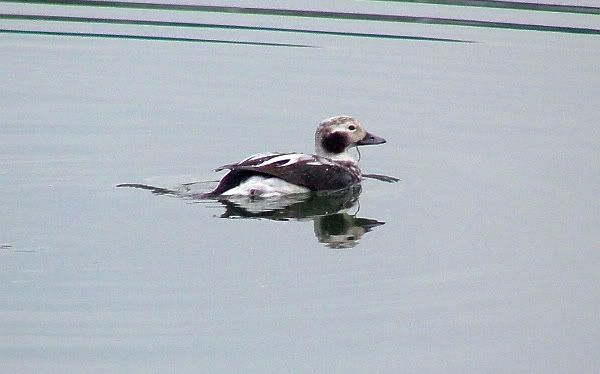
This Long-tailed Duck (#204 for my life list) has been a long stayer, present on site since late November, and true to form there it was, a mucky looking 1st-winter drake, with a tail of diminutive standards. Still cute faced as ducks go though, rather round of head with the facial expression of a sated puppy. These guys ordinarily winter at sea, and are fairly common on our northern coasts, hence the local twitch value of this inland bird here in the East Midlands. Most LTDs seen around the UK will have come from the breeding populations in Iceland and Greenland where they nest on lakes and freshwater marshes, feeding largely on crustaceans, molluscs, and aquatic invertebrates, during which they dive for long periods.
Our bird seems happy where he is, and quite fearless of man. Just a little patience and views within 10 yards would come. A really nice bird.

Bonus!

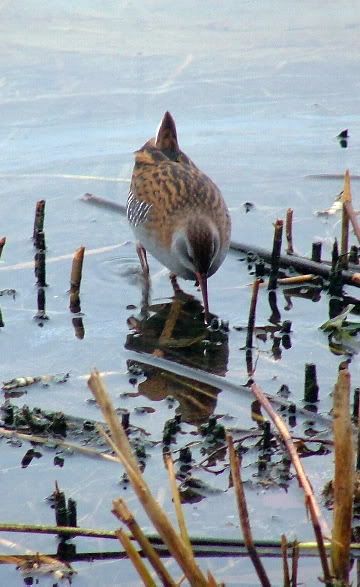
As ever, just being out and about brings its own rewards, this time a wandering Water Rail. Icy days seem to encourage them out of the reeds and this one walked with a couple of yards of us, utterly oblivious. It made for quite the most memorable encounter, and I could hear others squealing in the reeds. Check the video links below.
Other birds around included the regular winter ducks, both common grebes, and I heard a Willow Tit or two.

How cool?

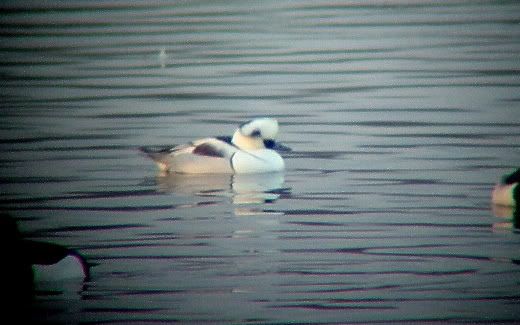
The second scarce winter duck of the day was this gorgeous Smew back at one of my local haunts, Kings Mill Reservoir (you know it well by now if you read my bird blog), a neat stop off on the way home. Apparently only the fourth record for the site (check out the local recorder's website for more info), it drew in many a local birder, and happily a few non-birding passersby.
Winter males are always striking, for me their look harks of Walls vienetta, you know, that fancy white ice cream with the embedded wafers of chocolate. Historically Britain receives more wintering females than drakes, though I'm not so sure that's necessarily true these days, with around 200 mainly finding sites in the south-east, migrating from the lakes and rivers of northern Scandinavia and Russia where they breed. His diet mainly consists of small fish, larvae and invertebrates.

Wednesday, 24 October 2007

Starlings!


Stick with it, eventually they descend into the reeds.

Just a snippet of an entry, a video of the Starling roost at one of my local patches, Kings Mill Reservoir. Perhaps only 250 birds and yet still a display worth getting away from the TV to go watch. Amazing how they all coordinate to form such dynamic flocks. There's some insight from a study (here) in Rome that goes some way to explaining the phenomenon. Lots of techno-babble in there, but the gist seems to be that each individual bird orientates itself against only the handful of other birds around it. Multiply that by a thousand or a million and hey presto, one of the more remarkable behaviours to be found anywhere in the natural world.

Speaking of Starling roosts, I'm at Carsington at the weekend, not only will it be an Aren't Birds Brilliant event, we have Feed The Birds Day too(!). At the end of the day in the autumn/winter months there's a significant roost in a nearby village called Kirk Ireton, of upto 100,000 birds. No news on it yet this year, so perhaps I'll go have a look for myself.

Thursday, 13 September 2007

Carsington, Pleasley and the Green Lagoon

Fields beside Carsington Water

Things are settling down for me at the Carsington ABB events, a routine neatly developing. The vibe was pretty good this week, a quieter day so we could spend more time on each visitor and impress on them all things wonderful about the birds. I didn't stick around to wait for the actual figure, but it's clearly we had a fair number of people signing up not only for the RSPB newsletter, they were going for full membership too. What to say other than, SCORE!

The water level is very low at Carsington which seems at odds with the summer we've had, especially since her sister reservoir at Ogston is absolutely brim full. No complaining from us though, low levels means more exposed mud, and autumn winds permitting a plentiful area for passage waders to feed. That said, the only waders we had on Tuesday were Lapwing and one elusive Green Sandpiper.
Up on the hillside the Little Owls dutifully showed well through a scope, a cosy threesome of eclipse Red-crested Pochard kept in broad view (with at least two more males spread elsewhere), a juvie Common Tern briefly passed through, a pair of Raven showed over distant woodland and a female Shoveller was a blink and you missed it bird for the day list. We ended with 42 species from the Wildlife Centre, which is a about par.
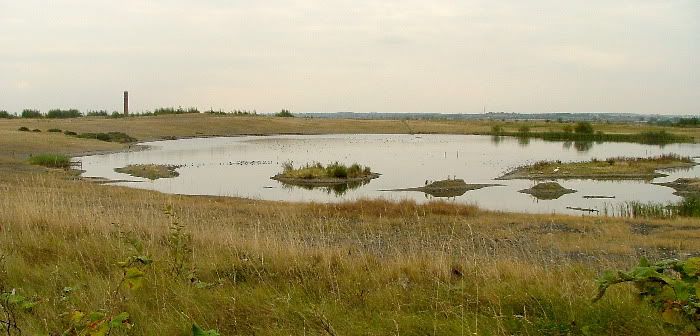

Pleasley Pit

Back at home the local rounds on my bike turned up a Yellow-legged Gull at Pleasley Colliery Nature Reserve. The small lake up there has always been a hotspot for local rarities, although these days with increased visitor numbers - mostly dog-walkers - the nearby birding fraternity seems to have rather turned interests away from it, many grumbling of the constant disturbance. For me it's a pleasant bike ride and at the site I've picked up Ruff, Wheatear, Yellow Wagtail and Little Ringed Plover, so it's clear to my mind it's still worth a regular look, and I think quite under-watched. For the two years I've been visiting I could count on the fingers of one hand how many occasions somebody has been in the members-only bird-hide.
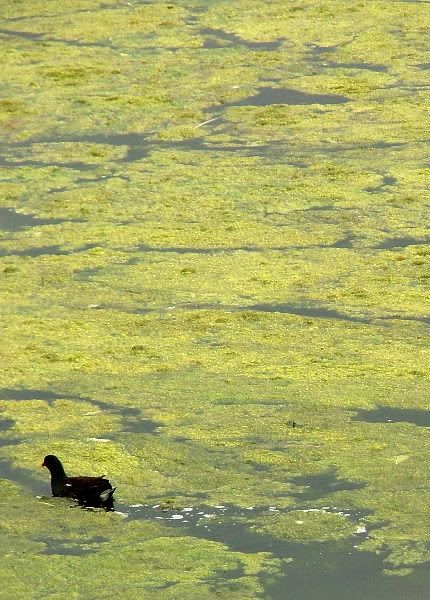


On the other side of town King's Mill Reservoir looks in poor health with another summer bloom of algae. I'll let some minutes from a local council meeting explain the problem:

'Ashfield is not noted for having many large bodies of water, which makes it all the more important that we conserve and protect those few that we have. In Northern Ashfield the past few years have seen a massive problem arising due to repeated seasonal growth of algae, in Kings Mill Reservoir for example, and this problem has repeatedly to be coped with.

The problem arises because of an upset to the very delicate balance between algae, fish, and bacteria in the water. These three denizens of natural water depend upon each other in a triangular relationship which can be upset by pollution.

Algae -- a collection of microscopic plants -- use sunlight to photosynthesise food from nutrients. These nutrients are provided by the bacteria in the water which act upon the waste products from fish, converting them into a form which the algae can use as food. In turn the algae provide food for the fish, and they also serve both the fish and the bacteria by oxygenating the water as a by-product of their photosynthesis.

THE IMBALANCE

What causes the upset is that additional nutrients get into water through pollution, and this causes massive growth of the algae, producing what is often called an algae bloom. This can spread over the surface of the water, and can be made worse by the growth other surface plant life.

It might be thought that this is actually a good thing, for after all it provides more food for the fish, which might therefore be expected to thrive. Such is indeed the immediate effect, but it does not last. The algae grows to such an extent that there is too much of it, with layers of algae growing below other layers. The upper layers of algae shelter the lower layers from sunlight, and the latter cannot therefore photosynthesise their food. They they die. The bacteria in the water then act upon the dead algae, and in the process they use up masses of oxygen from the water.

This de-oxygenation caused by the action of bacteria upon the dead algae obviously results in the death of the fish, which needs that oxygen. The dead fish sink to the bottom, where further bacterial action changes the dead matter into sludge, and further depletes the water of oxygen.

This sludge can, in extreme cases, turn what was once a living pond or lake into actual swampland.'


Periodically new aerating rafts have been placed in areas where road run-off and other sources of pollution reach the reservoir, though clearly that measure just doesn't work well enough. Looks like there are no easy answers to this problem.

For now the bird life can tolerate the algae, although it has been quiet this week. The best bird yesterday was a Snipe for example. Still if you have birds you're never short of action, and the highlight was a meeting of minds between a Cormorant and a Heron...
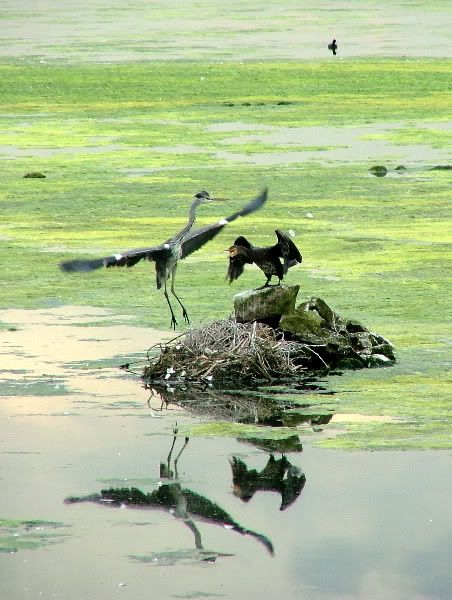
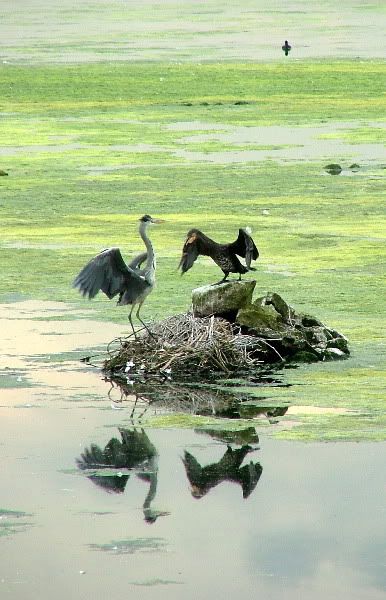
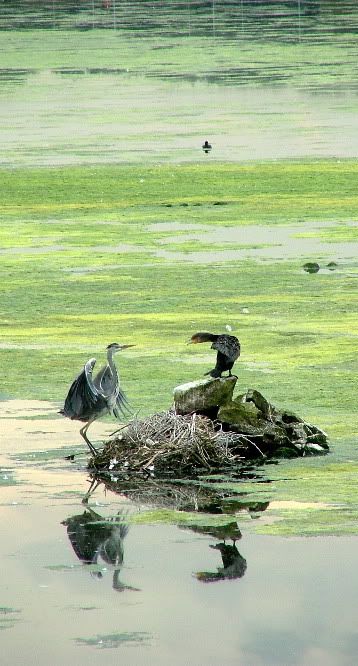
In the end, the Cormorant won.
Sunday, 9 September 2007

Owls of Intrigue

Nipped down at last light to King's Mill Reservoir this evening, wondering what might turn up in the roost. Recently a 1st-year Med Gull has been reported, which poses both a nice tick and an ID challenge in a gull roost of a few hundred BHs. No luck tonight, and none earlier in the week.

What I did find on Friday in good light was a Tawny Owl leaping away from Barn Owl bridge. This was surprising first because obviously Barn Owls are associated with it (since they bred there), and I've never seen Tawny Owl around any manner of concrete or rock artifice - certainly never heard of them roosting in man-made structures. The whole thing is puzzling to say the least.

I'm left to hypothesise that the Tawny was attracted to the activity of the Barn Owls, particularly since I saw a Barn Owl back at the nest site this evening. Some Tawny behavior is still little known, indeed it wasn't until relatively recently it was documented that they caught fish, so who know what else they could get up to?
What I am certain of is that I saw something special.


Tuesday means an ABB event for me at Carsington this week, so expect a post.

Thursday, 6 September 2007

A Regal Reservoir


You can tell the summer is waning when Kingfisher return to the waters of my local reservoir. It has been my experience that they are a regular sight there from late summer until the early Spring, evidently retreating back up (or down) river to nest in quieter banks at that time of year.
Okay, so the video is hardly David Attenborough, nice clear recording of the call though.

In other bird news, I noted a House Martin nest still in occupancy during a walk into town today. This is late, though hardly unheard-of for a species that often only nests successfully once in its lifetime (much as we'd like to imagine the same birds return to the same nests year after year - they don't). It is perhaps because of that that these hirundine will have two or even three broods during a summer, hence the tardy would-be fledglings still up there - probably not the first effort of the year.

Oh and one tip. I hate to be a pedant about this, but to the birder I saw, who was attempting to lurk in the overgrowth whilst wearing the brightest richest most vermillion red t-shirt I ever did see, there are better choices of attire for birdwatching!
I mean comrade, I'd like to think there is a time and place, that said, for your red shirt it really beats me when and where!

Friday, 3 August 2007

Owl-tastic!

Blink and you'll miss it, a 4 second digi-video-scope of one of the King's Mill Barn Owls...


With that graffitied backdrop, you perhaps see what I mean about these being owls with a considerably urban taste in territory.
There were three yesterday often hanging out very close to the busiest road out of town. And showing very well too, in what looked like evening playtime. I called the rest of my family down to watch and just like with the Carsington Little Owls, there was that word again, 'Wow!'.
Aren't Owls Brilliant?

(Video courtesy of the girlfriend, with luck we'll manage something better before the owl family disperses.)

Wednesday, 1 August 2007

The King's Mill Owls

Summery evenings, we hardly knew ye, but now you're back we're determined to enjoy you.


My walk with the girlfriend to King's Mill Reservoir was lovely, and promised the possibility of a Barn Owl (more on that later). Surprising really that so few people were out there with us, it makes you want to knock on front doors and invite folks away from their television. Are you mad, it's beautiful out here?

At the 'res', the bird roosts are already beginning to develop. Up to a couple of hundred Black-headed Gull commuted in late on, and by the reed bed 150+ Coot settled in for the night, with many more elsewhere around the fringes of the water.

Around the hedges an ever moving troop of 20 Long-tailed Tits chattered among each other. I confess I don't actually know that's the collective noun for Long-tailed Tit, I choose it because for me their behaviour always draws comparison with a troop of monkeys searching for fruit in the jungle canopy. Their breeding activities, whereby related non-breeders will help a pair raise their brood, bares more similarity to the forest apes too.

Now a Barn Owl family has drawn whispering attention to King's Mill since breeding was discovered there a couple of months ago. This is the first known record of nesting at the site and according to the reports it's been a great success, with at least 2 juveniles present at the moment. What makes this discovery more thrilling is this territory is relatively urban; you have a averagely large reservoir popular with walkers and water sports enthusiasts bordering on one side, the busy A617 to Newark road on another, and an 'adventure base' for children on yet another, and through all of that dissects a railway line. So this isn't some dirt quiet back road in the wilds of rural Lincolnshire. If only more people knew that Barn Owl could live so close to a large number of people, basically within our conurbation, how much prouder we'd all be of our oft derided and half forgotten district of Nottinghamshire?

Anyway, we watched in the last light of the evening for 5 minutes as an adult swooped along the railway and then off into the wheat field, while in front of us a late calling Reed Warbler sung in a small patch of reed bed near the car park.
That Barn Owl, by the way, is 107 for my carbon neutral list. The girlfriend loved seeing the bird, and it soon put at end to the complaints that I refused to let her stay sat by the ducks!

Speaking of Barn Owl, news today comes from the RSPB that the species has been voted Britain's favourite farmland bird, by the people who wrote in to them or visited their website. Who could possibly fail to agree?

And for more on Barn Owls in Nottinghamshire try reading the diaries of the Rushcliffe Barn Owl Project. Who knows? It may even have been the offspring from their successful efforts that have found a home at King's Mill, though with average young dispersal being around 7-8 miles, I freely admit we'd really be at the high end of their reach.
Wherever they came from, here's to the owls!


Those little monkeys.

Thursday, 5 July 2007

Two and two make Nightjar?


This weather, the wettest month on record, three times the average rainful, I just haven't done very much birding lately. Also helped little that last week I hit a flood damaged path too fast and came off the bike fairly hard, doing a real number on my legs. Haven't really felt like riding since.

During my last circumnavigation of Brierley an elderly gentleman who noted my bins asked whether I'd heard the Nightjar. We don't have Nightjar at the park, so I reasoned he mistook the Grasshopper Warbler's similar reeling call for the much more illustrious species (the warbler has high-pitched grasshopper like call, the Nightar a low chirrrrr, both go on and on). This I attempted to explain yet he was adamant, said he'd even seen them skimming over the lake - probably referring to the Swifts that come in from town. Seems like he put two and two together and came up with Nightjar. Again I tried to explain his mistake to him, still he'd have none of it, and I left wondering whether sometimes it's better to leave chaps like him to enjoy their self-assured ignorance.
Probably not, he's missing out on finding the real thing, which is an amazing thing.

Tomorrow I'm off with the girlfriend to see the Tour de France in London, camping the whole weekend. I think we'll at least get some birding done in the great parks. That leaves just enough time this evening to check out the Barn Owl nest at King's Mill, a secret site I heard about it today on the local birding grapevine. Knew they were about, didn't know where, and I'm told only one of three chicks is yet to fledge.

Tuesday, 17 April 2007

It paid to go late

Poor video even by my standards, what's on there are Little Gull.
Last evening was pleasant enough to go look for the bats again, and that we did. However from the platform we saw half a dozen small gulls circling in the gloom just after sunset. Interesting first of all because practically all of the gulls have now left, in fact I couldn't see any others. Secondly their flight was swift and bouncy, tern-like, and on the wing they snatched morsels from the surface of the water just like terns do. Finally, the dark underwing was confirmation, they were Little Gull.
They did laps of the reservoir for about half an hour and then as the very last light was fading they rose higher in the sky and headed off east. One of my best ever local ticks.

Video - Very Distant Little Gull

Saturday, 14 April 2007

Bat-tastic

Took a late walk to reservoir this week and found a real treat. On the viewing platform between the trees, overlooking the water, just after sunset bats emerge, hundreds of them!
Although the videos are rather on the dark side you can sort of get an idea of what it's like, even so there must have been four or five times more than my dinky little camera capture.
I'm assuming most were Pipistrelle, both on size and the way they didn't hunt especially close to the water surface - like a Daubenton's probably would. High up flew really quite large bats, which often seemed to swoop rather than flutter. These I'm even less sure about on the ID, possibly Noctule since they look so big and kept high. At best, not being much of a bat expert, I'm still guessing.

Video 1 - Kings Mill bats

Video 2 - Kings Mill bats

Video 3 - Kings Mill bats, a big one!

All of this sits next to a very busy dual carriageway, one of the main roads into Mansfield, I couldn't have imagined it.

Wednesday, 4 April 2007

Day of the Nidifiers

It's been marvellous outside day, shorts and shirt-sleeve weather already. The birds are feeling it too. The GCG pair that were displaying a while ago have finally begun nest building, about time too, it's been three weeks since they were weed slapping. Elsewhere on the reservoir the Black Swan appears to have abandoned its latest nest. This was the same bird that raised a clutch last October/November which had to be rescued when only two survivors were left. The rangers were readying themselves to take the eggs this time and make sure the invasive species is discouraged from spreading, thankfully that's not necessary for now. I don't think any of them fancied taking on the job with such mean-spirited swans defending their eggs.

A pair of Shelduck arrived last month. I don't know that they've ever bred but each year we yet a couple of them. That could be ready to change with the way they're prospecting the tern rafts.

At the old pit there was more activity. A second Little Ringed Plover has come in, and a third Redshank, a pair of which mated - the male was on there quite a while!
And the Gadwall have claimed their patch. Over the winter there were two pairs happy to share the lake, today the male of the resident pair was very energetic in seeing off the neighbours. Impressive stuff it was too, like a scrambling Spitfire every time the second pair circled above.

Wednesday, 14 March 2007

As Spring Gets Earlier...

Mild astonishment down at my local reservoir. In the heronry there is a nest with chicks grown enough to be exercising their wings! They look to be at least three weeks old, which considering the incubation period of the eggs mean the parent birds mated and laid in mid-to-late January. Can you believe that? Through the heavy snow and ferocious gales we've had since then, that nest, those eggs and the chicks survived it all. Amazing.

Then, there are the other signs that Spring is arriving, like these courting Great Crested Grebe. Immediately after the pair skulked into some reeds, they like to keep the climax to themselves.

Video - Great Crested Grebe Mating

Thursday, 8 March 2007

Scauped

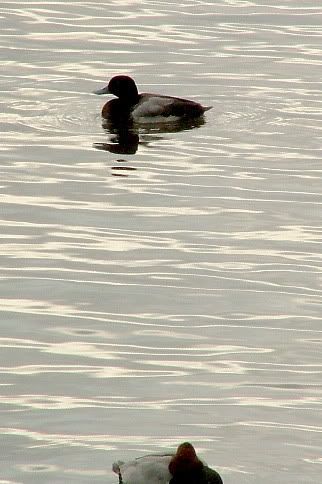
The 1st-winter Scaup that's been hanging around my local reservoir for a couple of months now is really beginning to chill out. First of all it stayed determinedly in the middle, like any self-respecting sea duck should, as far from passersby as possible. Now, now it's happy to roost in the day with the Tufted Duck and Pochard right under the hanging trees of the bank.
I'll be sad to see the bird go. Okay, he's a bit scruffy, still striking though.

Not a bad bird either, to say the reason I went there was to walk my baby niece.


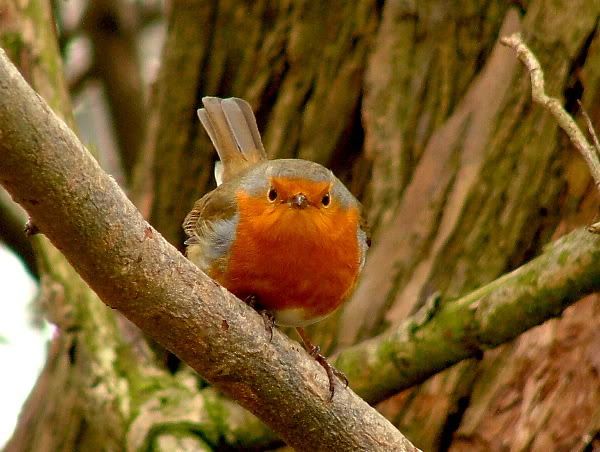
Tetchy Robin.

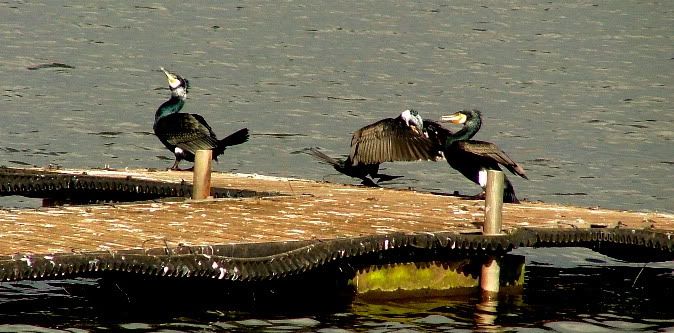
Amorous Cormorants.

Hoped for some early hirundines over the water, House or Sand Martin, none yet though. Probably for the best in retrospect, it's still chilly out there.