Showing posts with label ducks. Show all posts
Showing posts with label ducks. Show all posts
Monday, 20 April 2009
Across the Border
This past Saturday we had some time at the end of the day to head into Notts, so we did the Carburton - Budby Common double bill. Buzzards entertained from the pull-in at Great Lake and a small flock of Mandarins clattered around the trees. Give it a month or so for Honey Buzzards and perhaps last summer's Osprey will return too.
The Nuthatch vid comes from Carburton.
To Budby before sunset, again a little early in the season for the best action there, Tree Pipits with that go-bezerk trill at the end of their song were the big feature, Linnet and Yellowhammer among them. Late May to early June we'll definitely return for the Cuckoos, Woodcock and Nightjars, Woodlark ought to be singing too.


Friday, 8 February 2008
Fudge Duck
I forgot to mention the Ferruginous Duck from last week (Fudge Duck for those unwilling to risk the pronunciation). The bird was found on the lake at the old American Adventure Theme Park, near Ilkeston. The site is fenced off these days and patrolled by heavies from a security firm which I'm told erected signs reading "NO BIRDWATCHING". To say the least it wouldn't be on my hit parade of birding destinations, but this duck is special, and a smashing find.
Closely related to Pochard and Tufted Duck (species they closely associate with), Ferruginous Ducks breed chiefly in wetlands north of the Black Sea and winter in north Africa or areas south and west of the Sahara, with smaller populations in France and Spain. Their numbers are crashing as their breeding habitats are drained for farming, so they are set to become an even rarer sight for UK birders. Up to 10 birds a winter reach Britain now, but in the future, who knows?
There is one other thing I should mention; Ferruginous Ducks are popular among wildfowl collections and birds from zoos, bird sanctuaries, etc, do go a-wandering wild in the UK. This means birdwatchers are always likely to discuss the natural origins when an individual turns up. Now this Derbyshire bird arrived in winter, is notably shy, exhibiting all the behaviours of a wild duck, so a 'true' vagrant it is.
They are best identified by their white bottoms as no other wild duck in the UK has anything to confuse it by. Beyond that Ferruginous Duck males like this one have a wonderfully rich colour, a chestnut brown that shines purple in the sun. Even at 200 yards, it was gorgeous. A picture can be seen here.
I bet that duck is still drawing in many a birder, relocated as it has to the smaller waters of Loscoe Dam.
In other news, the home patch I've been neglecting still harbours results. At King's Mill Reservoir a Water Rail was showing well, always smaller than you think, and the electric blue flash Kingfisher shot by me. The only sad news I have to report is the probable loss of a Barn Owl, the lifeless white lump seen lying on the surface of the dual carriageway under which a pair had successfully nested last year. The truth is, this tragedy always seemed likely.
Closely related to Pochard and Tufted Duck (species they closely associate with), Ferruginous Ducks breed chiefly in wetlands north of the Black Sea and winter in north Africa or areas south and west of the Sahara, with smaller populations in France and Spain. Their numbers are crashing as their breeding habitats are drained for farming, so they are set to become an even rarer sight for UK birders. Up to 10 birds a winter reach Britain now, but in the future, who knows?
There is one other thing I should mention; Ferruginous Ducks are popular among wildfowl collections and birds from zoos, bird sanctuaries, etc, do go a-wandering wild in the UK. This means birdwatchers are always likely to discuss the natural origins when an individual turns up. Now this Derbyshire bird arrived in winter, is notably shy, exhibiting all the behaviours of a wild duck, so a 'true' vagrant it is.
They are best identified by their white bottoms as no other wild duck in the UK has anything to confuse it by. Beyond that Ferruginous Duck males like this one have a wonderfully rich colour, a chestnut brown that shines purple in the sun. Even at 200 yards, it was gorgeous. A picture can be seen here.
I bet that duck is still drawing in many a birder, relocated as it has to the smaller waters of Loscoe Dam.
In other news, the home patch I've been neglecting still harbours results. At King's Mill Reservoir a Water Rail was showing well, always smaller than you think, and the electric blue flash Kingfisher shot by me. The only sad news I have to report is the probable loss of a Barn Owl, the lifeless white lump seen lying on the surface of the dual carriageway under which a pair had successfully nested last year. The truth is, this tragedy always seemed likely.
Sunday, 16 December 2007
Doubling Ducks
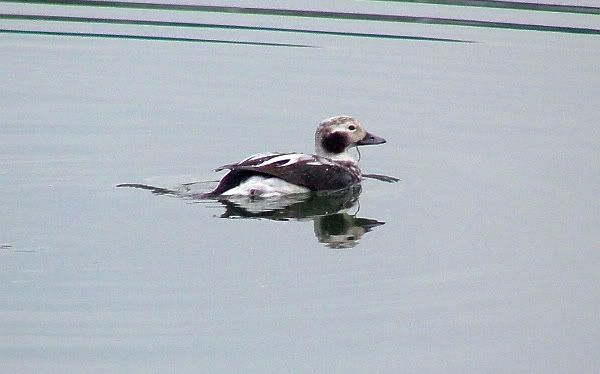 L-T-D
L-T-DSeemed like a while since the girlfriend and I had been on a local twitch, leafing through my entries here is was the Rutland Red-necked Grebe in October, so it was due. A quick browse of Birdguides (where would birders like me be without such websites?), came up with a nearby Long-tailed Duck just across the county border in Derbyshire, at a LNR called Williamthorpe Ponds. Upon arrival it turned out to be quite the typical modern local nature reserve, a small pocket of wildlife much surrounded by Acme industrial complexes Ltd.
...when the duck eventually stopped diving.
This Long-tailed Duck (#204 for my life list) has been a long stayer, present on site since late November, and true to form there it was, a mucky looking 1st-winter drake, with a tail of diminutive standards. Still cute faced as ducks go though, rather round of head with the facial expression of a sated puppy. These guys ordinarily winter at sea, and are fairly common on our northern coasts, hence the local twitch value of this inland bird here in the East Midlands. Most LTDs seen around the UK will have come from the breeding populations in Iceland and Greenland where they nest on lakes and freshwater marshes, feeding largely on crustaceans, molluscs, and aquatic invertebrates, during which they dive for long periods.
Our bird seems happy where he is, and quite fearless of man. Just a little patience and views within 10 yards would come. A really nice bird.
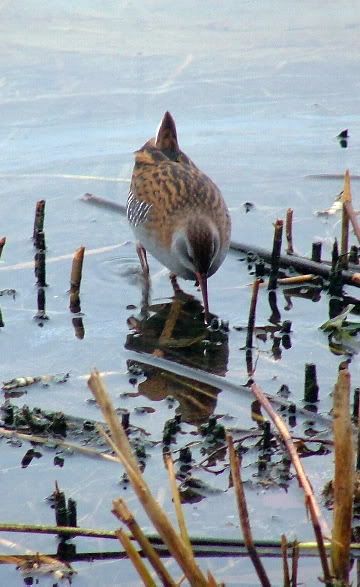 Bonus!
As ever, just being out and about brings its own rewards, this time a wandering Water Rail. Icy days seem to encourage them out of the reeds and this one walked with a couple of yards of us, utterly oblivious. It made for quite the most memorable encounter, and I could hear others squealing in the reeds. Check the video links below.
Other birds around included the regular winter ducks, both common grebes, and I heard a Willow Tit or two.
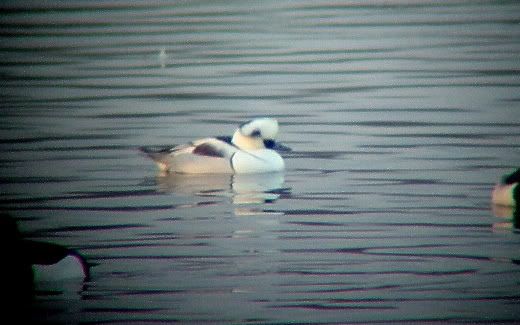 How cool?
The second scarce winter duck of the day was this gorgeous Smew back at one of my local haunts, Kings Mill Reservoir (you know it well by now if you read my bird blog), a neat stop off on the way home. Apparently only the fourth record for the site (check out the local recorder's website for more info), it drew in many a local birder, and happily a few non-birding passersby.
Winter males are always striking, for me their look harks of Walls vienetta, you know, that fancy white ice cream with the embedded wafers of chocolate. Historically Britain receives more wintering females than drakes, though I'm not so sure that's necessarily true these days, with around 200 mainly finding sites in the south-east, migrating from the lakes and rivers of northern Scandinavia and Russia where they breed. His diet mainly consists of small fish, larvae and invertebrates.
 Check out the bouffant hairdo!
Winter males are always striking, for me their look harks of Walls vienetta, you know, that fancy white ice cream with the embedded wafers of chocolate. Historically Britain receives more wintering females than drakes, though I'm not so sure that's necessarily true these days, with around 200 mainly finding sites in the south-east, migrating from the lakes and rivers of northern Scandinavia and Russia where they breed. His diet mainly consists of small fish, larvae and invertebrates.
Check out the bouffant hairdo!Monday, 23 July 2007
More London Birds...
A thumbnail post, click on the pictures for a closer look...
 A Jay in St James' Park, less shy than those at home, this fella was hawking for flying insects from a perch above a crowded path and the muttering of many different languages.
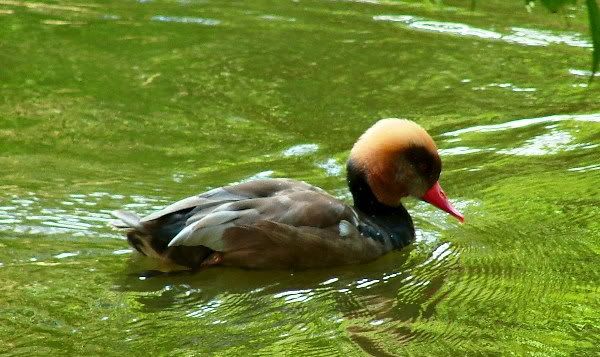 Red-crested Pochard, a semi-exotic, an escaped population of these sustains itself in parts of England. I saw my last 'wild' one in Cambridgeshire.
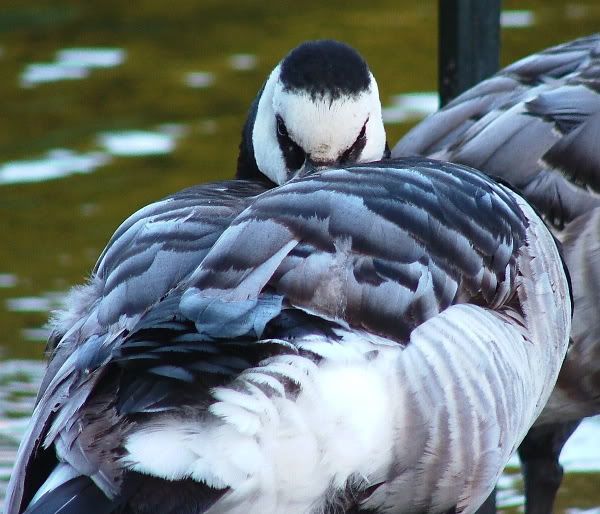 Barnacle Goose, there were also Nene, Snow, Bar-headed and Red-breasted geese to be found.
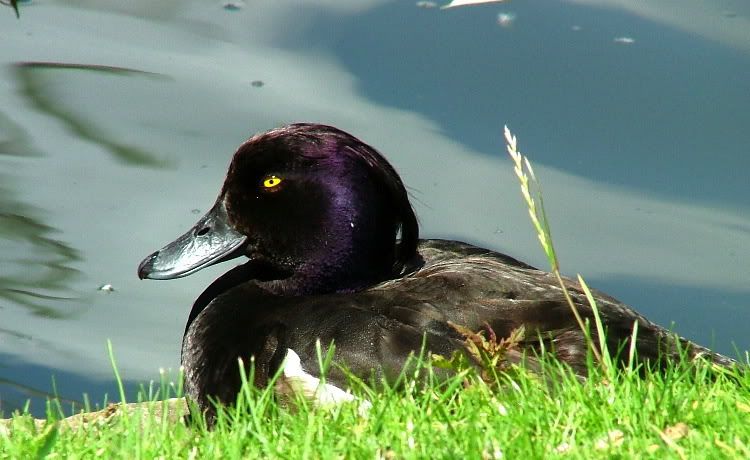 Tufted Duck.
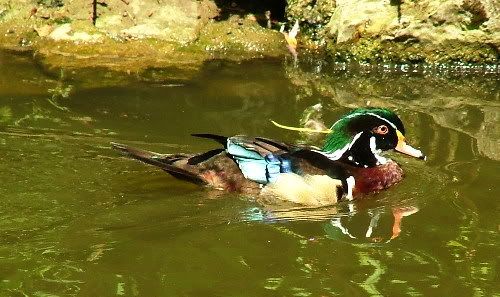 Wood Duck.
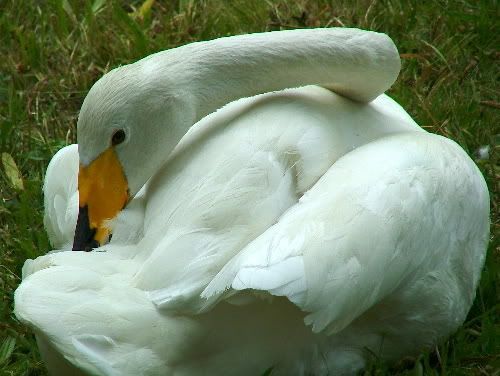 In Regent's Park, some tame and fabulously graceful Whooper Swan.
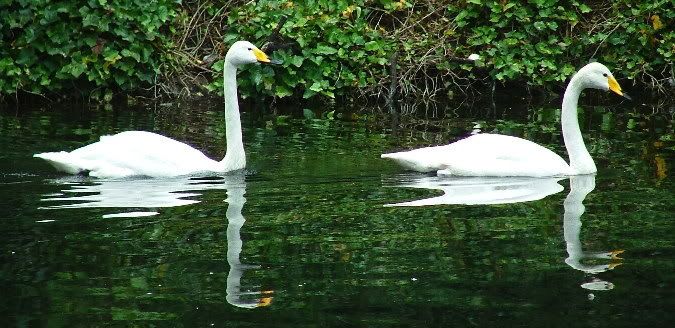
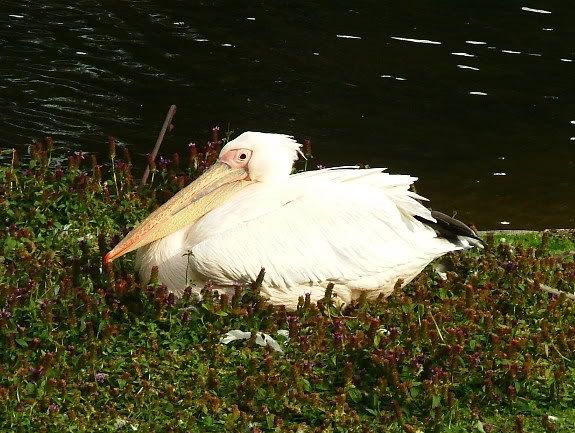 And famously, the St James' Park pelicans.
A Jay in St James' Park, less shy than those at home, this fella was hawking for flying insects from a perch above a crowded path and the muttering of many different languages.Red-crested Pochard, a semi-exotic, an escaped population of these sustains itself in parts of England. I saw my last 'wild' one in Cambridgeshire.Barnacle Goose, there were also Nene, Snow, Bar-headed and Red-breasted geese to be found.Tufted Duck.Wood Duck.In Regent's Park, some tame and fabulously graceful Whooper Swan.And famously, the St James' Park pelicans.So okay, few of these may deserve a place on any serious birding list, they still made a pleasant post-Tour de France afternoon in the park. Merci London!
Subscribe to:
Posts (Atom)


