Showing posts with label rarities. Show all posts

Monday, 27 April 2009

One of those Remember When Moments...

(vid from the girlfriend, check out the birds at beginning and end with the dark bodies and white cheeks)

Birders nationwide will be aware of the big thing that hit us in Derbyshire at the weekend, 11 Whiskered Terns at Willington Gravel Pits (DWT) somewhere by the Trent just south of Derby. Eleven, that's a flock almost three times larger than the previous record and the first of the species for the county since, oh, only 1883! Their usual range dots pockets of south and east Europe, with the BBRC recording an average of something like 2-5 in most years since the 50's of this small elegant smoky coloured marsh tern with the attractive white cheek.

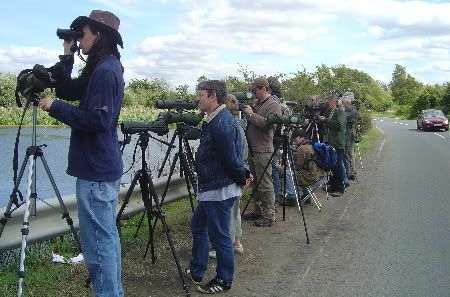
Terns on migration tend not to stick around so we zoomed straight from work down the A38 the day after their arrival when 8 were still knocking around, swooping and nipping insects in the distinctive bouyant flight these birds have. Being a county tick for all Derbys birders and a lifer for many of us in the midlands there was plenty of interest, all of us ever so polite to make sure everybody had time at the front of the small viewing platform and to discuss the unprecedented wow factor of the event. Imagine finding them, reporting them, swearing you've not been on the gin.
They've mostly dispersed now, sightings as far and wide as Cleveland, Rutland and Cambridgeshire are probably our terns.

My confession is that I hadn't done Willington before which makes me a bad birdwatcher because it's quickly becoming the best site in Derbyshire. Equally I let the side down by putting work before these kinda birds, bad birding indeed.

Anyway, cracking site, amazing spectacle. Also had Little Egret, Lesser Whitethroat, first Swifts of the year and reeling Grasshopper Warbler for the evening.

Memorable stuff indeed. That Shrike has a challenger for best personal twitch status.

Back down to Earth there's a very industrious Coal Tit in my garden right now. Cool Tit more like it.

Saturday, 28 March 2009

RNG

(picture courtesy of the girlfriend)

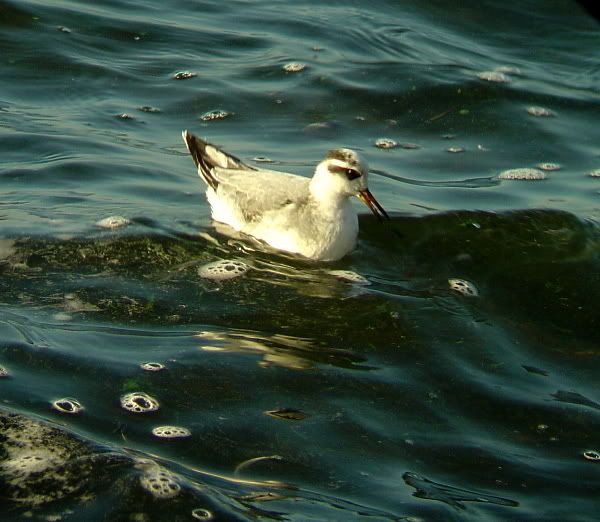
Inspired by some epic photographs on Birdguides we finally took the trip down the A38 to Foremark Reservoir, a bit south of Derby, to catch this long staying Red-necked Grebe that's more or less reached full summer plumage. Real glamour bird this one, a rare specimen of Russian chic and proper little show-off drifting around 20 yards in front of the car park (this beats the pale distant RNGs you usually freeze your bits of for in the mid-winter at Rutland Water).
Also picked up my first Wheatear of '09, hopefully to be met with again in July if all plans for a week on the Isle of Mull come together.

What's missing from this entry? Oh yes, the dodgy digi-video-scope effort...

Monday, 9 February 2009

A most elegant Snowman?


Worst bird video ever? You decide.

What you can see there is a Great White Egret, the ridiculous big yellow bill is the key feature from this view. It's been hanging around some small fishing lakes a bit SW of Derby for the last week or so, which continues the tour of the Midlands this bird has been on for months now, all of this a fair way off from the East Europe it really belongs in.
Haven't my life list to hand, the GWE takes me up to #214 or something like that.

Rubbish view, cold day, stood at the roadside, great bird, and it's all worthwhile.

Oh, as I type there's a 1st-year male Reed Bunting feeding in the snow on my patio, three weeks in and that's #27 for the garden list.

Friday, 28 November 2008

Gone, but never to be forgotten


Last video and final words on the Steppe Grey Shrike, as news came today of only feathers being found in the area the bird had been favouring. I saw a Merlin work the ditches myself while on site, Peregrine and Hen Harrier were around too, among commoner predators, so chances are it was snatched by a raptor. A sad demise for an amazing bird, but what a bird!

(By the way, that certainly wasn't me feeding the bird corned beef!)

Thursday, 27 November 2008

Shrike: A Pose


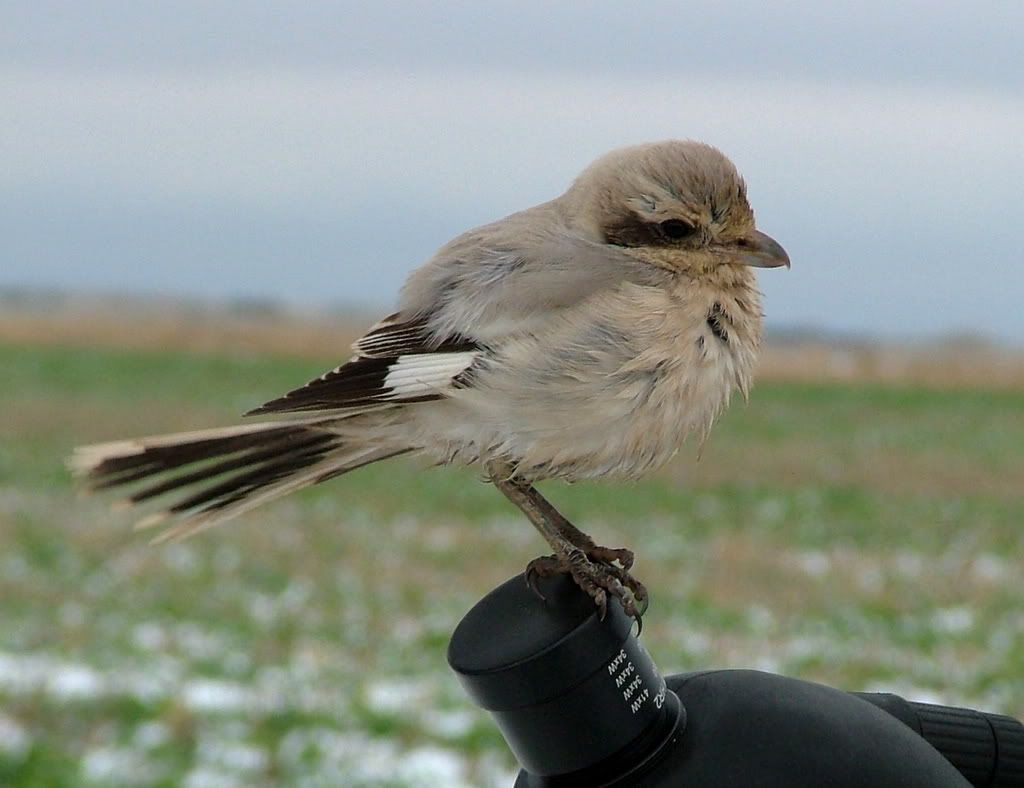
Steppy again, perched on my scope.

No report of the bird today, although midweek birders may have been thin on the ground with the rainy forecast. One theory for why the bird looks so untidy goes that its native habitat are the arid plains of areas like Kazahkstan, leaving this bird naturally unaccustomed to hunting for prey in wet grass. As good a theory as any I suppose, particularly as I read in the Lincolnshire Bird Club forum a list of discoveries found in one of the shrike's pellets:

Remains of at least 11 Pterostichus melanarius (Carabidae – ground beetle family)
Remains of at least 3 Pterostichus niger (Carabidae)
Remains of 1 Ocypus olens (Devil’s coach horse beetle – Staphylinidae/rove beetles)
One aedeagus (male sexual organ) of Catops tristis (Coleoptera – Leiodidae)
Remains of unidentified species of beetle elytra (wing cases)
Miscellaneous heads of non-Coleoptera invertebrates (possibly Diptera)
Heads of two different species of possible Lepidoptera

So beetles basically, which makes sense for a bird smaller than our voracious Great Greys.

Monday, 24 November 2008

Steppe To It

Location, location, location.

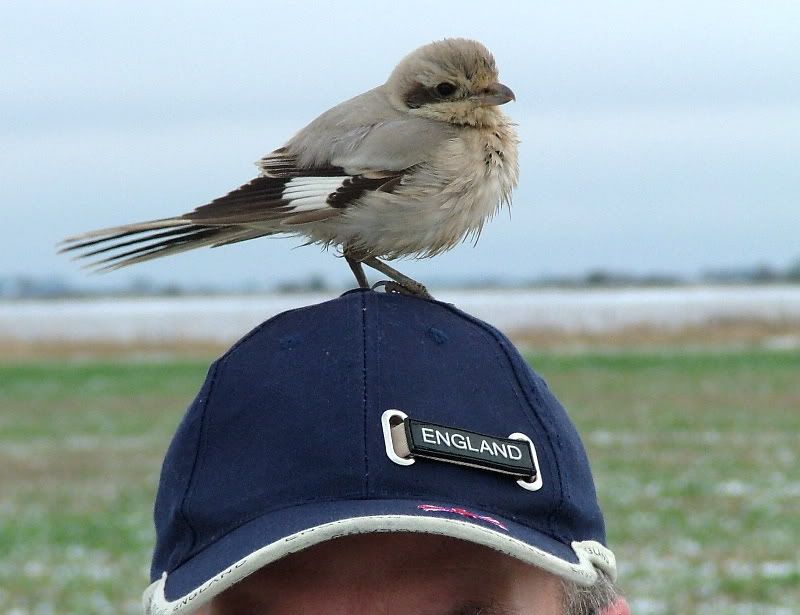
Broke my 50-mile local twitch limit yesterday, but surely worth it for one of the rarest and showiest birds to hit Britain all year. Over the last few years I've had maybe half a dozen Great Grey Shrike sightings, almost always at a range of 100 yards or so, try to comprehend therefore how it felt to have a Steppe Grey Shrike land on my head - I'm still trying myself.
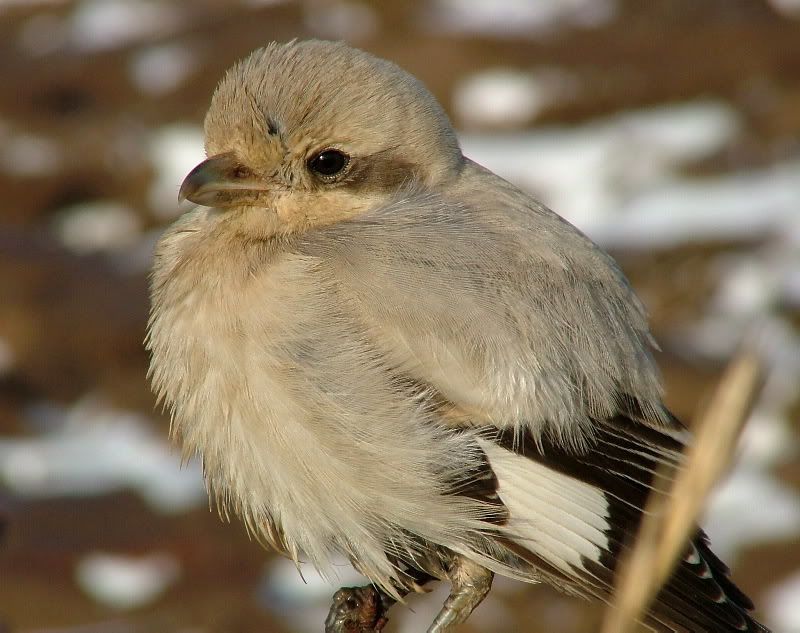
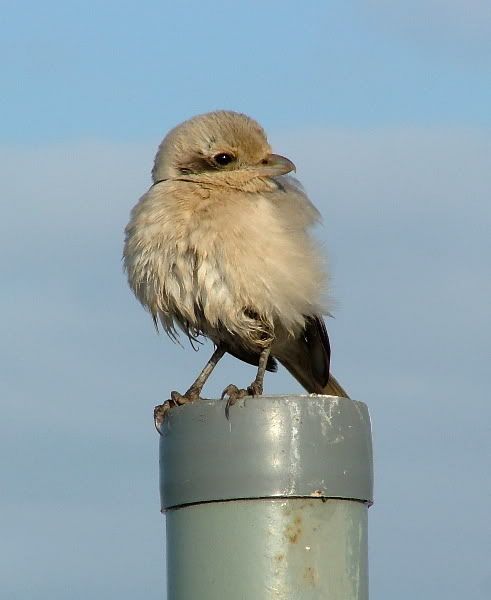
To briefly explain Steppe Grey Shrike is either a different species or different race (in taxonomy terms these birds are rather in the wild west*) to the very similar the Great Greys, just a touch paler in one of two places . We see perhaps 50-100 GGS during the winter in the UK, however the Steppes breed much further east than Greys - from N Iran across to Uzbekistan and should spend their winters in the tropics well east of us. Now human habitation is sparse in these areas so the Steppe Grey Shrike is a bird that should seldom come across mankind and therefore the birds seem to have developed no fear of us. Hence pictures of this one on people's scopes, cameras, cars, heads, etc.
It's only the second or third record of Steppe Grey Shrike in the last ten years, and a real treat still drawing in good crowds into its third week of residence in the Lincs flatlands south of Grimsby. Likelihood is this is probably the most photographed bird.... ever.

In some birding circles concerns raised have been raised over birders and photographers chasing this bird which too high a vigour, but truly it is more a case of the bird following us - maybe it believes we'll stir up worms or beetles. The temptation therefore is to feed it, not something I'd personally want to do - I reason it's been there 3 weeks now and been seen to find its own food which is probably healthier all round than anything people could give it.

Hogging the eyepiece

Also picked up a Grey Pharalope at Covenham Reservoir on that long drive home, another highly confiding thoughie.

Rates as the best birding day the girlfriend and I have ever had. Peregrine, Merlin, tonnes of winter thrushes and Curlews, Brent Geese all fly-overs while we tried not to step on the Steppe, plus a Barn Owl near miss (phew!) on the way back. Videos to post soon.

*technically, the species we're dealing with here appears to be a Southern Grey Shrike

Wednesday, 25 June 2008

Daddy Long-legs

A quick post to wrap up the Wales trip. On the way across we bisected Cheshire, very close to a nature reserve were Black-winged Stilts were still nesting. Didn't expect us to pass that by without taking a look, did you?
This was only the 7th known occurrence of nesting in Britain for this species (found more usually around the Mediterranean coasts), unusually two or possibly three pairs breed in Nottinghamshire in 1945, with a handful of other records since then. Cue the RSPB and their Aren't Birds Brilliant team to watch over the birds and show them to the public. You couldn't miss them...


Ridiculous and beautiful looking birds really, my girlfriend labelled the male bird 'daddy long-legs' and you can easily see why - indeed proportional to body size they have the longest legs of any bird in the world. Not only strange by appearance, the parent bird had the habit of carrying the chick around under its wing, so you'd see the adult stood with two legs poking from its armpit and know where the chick was.
Sadly it was only one chick. The clutch hatched during a stormy night which the rest of the brood failed to survive, and now regrettably I have read that the one chick has been taken by a predator since our visit to the site. Just 1 week away from fully fledgling too.

So for this year, that particular spectacle is over. Let's see if the Stilts pop up anywhere next Spring. Keep an eye out for ridiculous birds, all right?

Maybe you'll find a long-stayer worthy of naming, like Sammy, a remarkable bird that took residence at the RSPB's Titchwell Reserve for 12 years from the mid-90's. Thought at the time to be the most photographed bird in the UK, beat that Kate Moss!

Friday, 8 February 2008

Fudge Duck

I forgot to mention the Ferruginous Duck from last week (Fudge Duck for those unwilling to risk the pronunciation). The bird was found on the lake at the old American Adventure Theme Park, near Ilkeston. The site is fenced off these days and patrolled by heavies from a security firm which I'm told erected signs reading "NO BIRDWATCHING". To say the least it wouldn't be on my hit parade of birding destinations, but this duck is special, and a smashing find.

Closely related to Pochard and Tufted Duck (species they closely associate with), Ferruginous Ducks breed chiefly in wetlands north of the Black Sea and winter in north Africa or areas south and west of the Sahara, with smaller populations in France and Spain. Their numbers are crashing as their breeding habitats are drained for farming, so they are set to become an even rarer sight for UK birders. Up to 10 birds a winter reach Britain now, but in the future, who knows?

There is one other thing I should mention; Ferruginous Ducks are popular among wildfowl collections and birds from zoos, bird sanctuaries, etc, do go a-wandering wild in the UK. This means birdwatchers are always likely to discuss the natural origins when an individual turns up. Now this Derbyshire bird arrived in winter, is notably shy, exhibiting all the behaviours of a wild duck, so a 'true' vagrant it is.

They are best identified by their white bottoms as no other wild duck in the UK has anything to confuse it by. Beyond that Ferruginous Duck males like this one have a wonderfully rich colour, a chestnut brown that shines purple in the sun. Even at 200 yards, it was gorgeous. A picture can be seen here.

I bet that duck is still drawing in many a birder, relocated as it has to the smaller waters of Loscoe Dam.

In other news, the home patch I've been neglecting still harbours results. At King's Mill Reservoir a Water Rail was showing well, always smaller than you think, and the electric blue flash Kingfisher shot by me. The only sad news I have to report is the probable loss of a Barn Owl, the lifeless white lump seen lying on the surface of the dual carriageway under which a pair had successfully nested last year. The truth is, this tragedy always seemed likely.

Saturday, 5 January 2008

Shrike One!

Budby Common

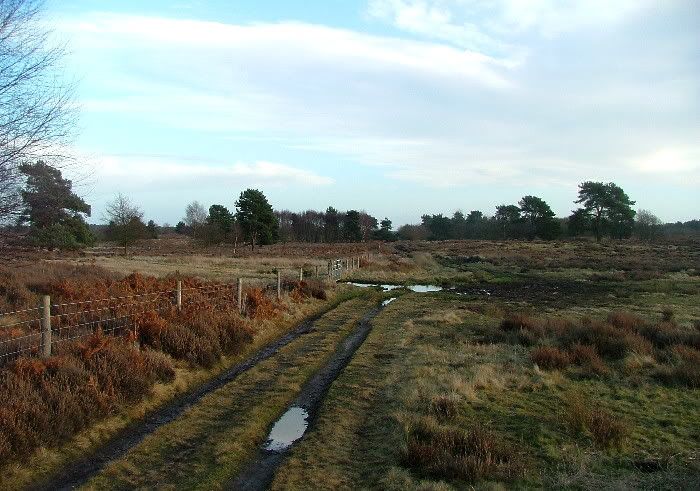
Another successful local rarity tracked down today. Budby Common, an area of sandy heathland immediately north of Sherwood Forest Country Park NNR, has been a traditional site for Great Grey Shrike for years now. This winter has been no different, with at least one being reported since early December. It can go up to a week without apparently being seen, but you can generally be sure there's a shrike out there.

A short walk from Budby village brought us to the heath and almost immediately the GGS showed up, pearching atop a scattering of several small trees. It had obviously read the ID literature because this bird showed textbook behaviour, standing on guard on the highest, most exposed branches and even hovering before swooping down on prey hidden deep in the heather. It was just a completely different story to the aloof Shrike we saw only very at Ogston Reservoir last winter. Perhaps the close proximity of the road at the Derbyshire site influenced the very shy behaviour of that bird.

Back to Budby, and there's a two bird theory among some of the locals, although I'm not so sure myself. We watched our shrike for about an hour and saw it wander quite widely between the two areas it has most commonly been sighted. This movements makes sense as their winter territories can reach 50 ha, and that's pretty damn big.


Here's another murky digi-video-scope for the birdtrail record. Hey it was windy all right? And it's the middle of winter out there!

For a better video try this delightful YouTube offering of a Great Grey Shrike in Israel dispatching a mouse. These birds are hardly the size of a Song Thrush, but ferocious enough to deal with all kinds of prey, birds up to the size of Fieldfare and mammals as large as Stoats! Just a real marauder of bird species, making the black highwayman's mask very fitting plumage.

In Britain the Great Grey Shrike is strictly a winter and passage visitor, most of ours probably coming from Scandinavia or possibly Russia. Perhaps 50 or so are present in the UK each year, with a tendency to turn up practically anywhere there is suitable habitat - including but not exclusive to heathland, peat bogs, the edges of pine woodland, and coastal dunes. Basically wherever they are, it's a top notch species, always special.

Elsewhere on the common were Jay, Green Woodpecker, Meadow Pipit, Kestrel and in adjoining farmland a Skylark warbled and a Buzzard cried as it sailed into woodland. A birder who walked from the Sherwood direction noted a pair of Stonechat.
Otherwise, Budby Common is best in spring/summer, as during a July afternoon you have better than not chances of see Nightjar, Cuckoo, Woodcock, Woodlark and Tree Pipit (blog entry from last year). If you can give it a day, you could scarcely find a more rewarding site in the whole of the East Midlands, and they have ice cream at Sherwood Country Park visitor centre!

Wednesday, 2 January 2008

Derbyshire Does It Again

Happy New Year!
It's be grand old start to 2008 for me. With a little local knowledge and the defiant will to ignore a particularly groggy head and get up early on the Bank Holiday, I scored with 2 lifers yesterday.
Click the image to enlarge and trust me, it's a Hawfinch.
View a real photographer's effort here.

I should be ashamed posting such a poor picture. I swear, if I take a worse bird photograph all year long I should be very surprised. It's a Hawfinch down by Cromford Canal. That's been a traditional location for this impressive and elusive finch for a number of years now, news which has clearly spread as more than a dozen birders where searching for them on New Years Day. Every one of them, I believe, left having had good views too.
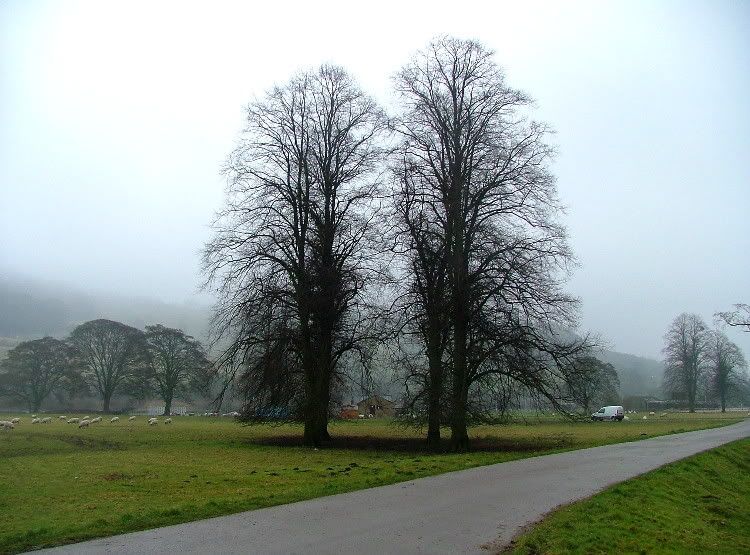

The best spot for them were these tall beech trees nearby the car park, with 3-5 birds staying mainly in the higher branches, though the Hawfinches were occasionally enticed to the ground by the bolder Chaffinches already feeding down there. These sights only occur in winter as you would so well to see Hawfinch come to earth at any other time of the year. Spring, summer and into autumn, they feed high in the canopy and are hidden by foliage.

Overall the conservation status of Hawfinches is very positive in Europe, recent analysis suggesting a boom, indeed an increase of 658% across the continent between 1980 and 2005. Wow!
Yet the news in the UK seems less positive, with a decline in most breeding areas.

The bird itself is unmistakable once you find it, and beyond the obvious - that enormous nutcracking bill, the bulky size and peachy tones, it was the black mask that struck me. There's something almost Dick Whittington about the way it looks.

Elsewhere along the canal, 14 Dabchicks along a couple of miles afforded very close viewing, with one quite bizarrely eager to take the bread visitors were throwing to the ducks. Surely this cannot be healthy for a species evolved to feed on aquatic insects and small fish?

Other bird species along the canal included Jay, Great Spotted Woodpecker, Goldcrest, Nuthatch, Grey Wagtail (around the water treatment works) and Coal Tit. So far as other wildlife goes, Cromford is most famous for Water Vole, and I very clearly remember how easy they were to see chugging along the canal when I was a child. Now in 2008, we only saw a dead one drowned on a steep banked length of the canal (I'll save you the photograph), and I hear that they've dropped in number big time in the last several years. It's very sad for me, because I'm still young and yet I can already say I remember when...

My other lifer of the day was an Iceland Gull at Ogston Reservoir. Again, a traditional site, with upto 15,000 gulls roosting in the winter on those waters, a few of the rarer species are always going to turn up. So with the Black-headed, Lesser and Great Black-backeds, Herrings and Commons, in came a superb 2nd-winter Iceland Gull. A beautiful, largely white bird, with warm brown speckles, gull species just don't get anymore attractive.

A murky video of a gull not from Iceland!

Check out the white wingtips on the bird at the back - always means something a bit special in the UK.


Ironically, Iceland Gulls do not breed in the country that gave them their name. Instead most seen in the UK will originate from Greenland. They rare inland and are most numerous on the coasts of NW Scotland, but a few dozen birds will always turn up on reservoirs in the midlands, just like Ogston.
The girlfriend was tired so we left while more gulls were heading in, apparently Glaucous and Mediterranean Gull arrived later on. However we did see a pair of Pink-footed Geese, associating with the Canadas in the surrounding fields.

So that's two new UK species for me, in one day, within hardly 30 miles of driving. I'm a happy birder!

Video 1 - Dabchick eating bread
Saturday, 29 September 2007

3-in-One Day

I must have been a teenager, ten years or more ago. I really can't remember the time last I encountered 3 birds for my life list on one day. What to say but god bless the man who invented bird sightings websites!

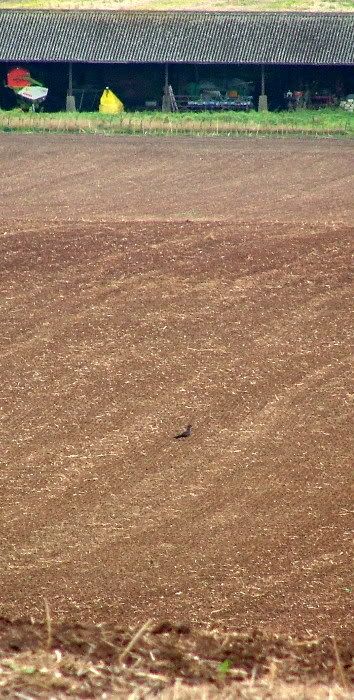
First target today was the long-staying juvie Long-tailed Skua in the south of Nottinghamshire. The bird was found two Mondays ago and still this morning there it was, staunchly quartering the stubble field its made a home of for two weeks, harassed only by the occasional Carrion Crow. Stunning bird too, the skua, in a sort of chocolate duffle coat plumage.


Alas, my photographs were distant.
Video 1 - Video 2

Much closer pictures can be found here, (apparently) taken with the landowners consent. That was the problem with this skua, every birder who traipsed the half mile out there knowing it to be a relatively tame individual had to muster all their self-restraint and hold back from blustering across the field for a better look. It was easy to see how sometimes birdwatchers pose a trespass nuisance, though I was surprised to find on a Saturday morning it just was the girlfriend and me with the bird to ourselves, maybe everybody else had already seen it?
Actually no, after pointing the bird out to a couple of new arrivals, it was time to make haste for Rutland and two more of the day's targets.

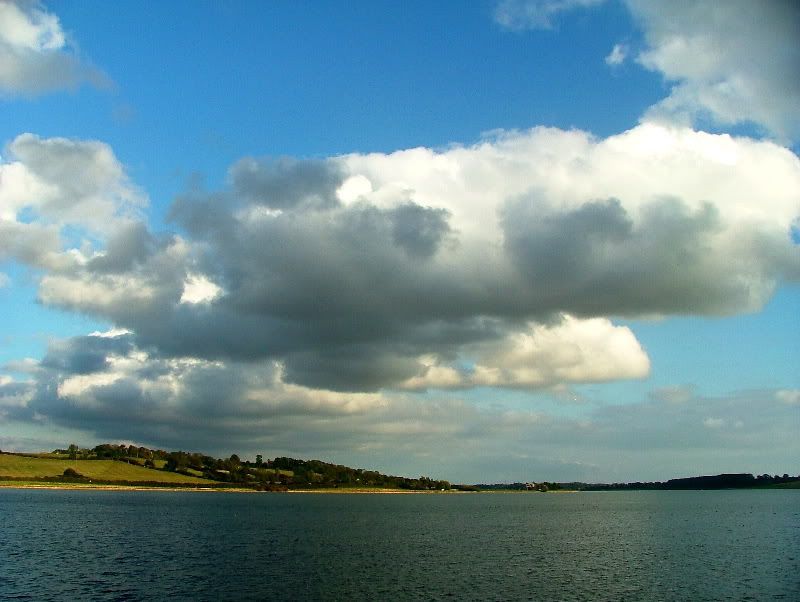
The scene at Rutland Water.

First stop was the Lyndon Reserve, overlooking the Manton Bay area of the reservoir. Out there among the flurry of Commic Terns and Black-headed Gulls, was what we'd come for, a solitary juvenile Sabine's Gull, hawking and nipping up insects from the surface waters. As you can perhaps see here, the grey-white-black pattern of the wings is so very distinctive that you could call it from half a mile off. And here's a thought, it came all the way from Arctic Canada, or even Siberia!


Third target was Red-necked Grebe, which I thought we'd missed after failing to find it in Manton Bay, where two days of reports had it located. Then having retired to pick up some waders at the Egleton Reserve, at 5pm just before turning home there it was, in the far distance from the last hide along, showing just enough plumage information to distinguish from a GCG. It was the broad dusky neck that did it, the Great Crested Grebe always has a pure white throat at all times of year.
So the moral of the story is never lose hope as long as you're still out there!


Other notables for the day; Little Gull, Artic Tern, Curlew and Green Sandpiper, Little Stint, Ruff, Little Egret, Black-necked Grebe, Whinchat.
64 species for the day, I'm sure several easy ticks overlooked in the hunt for the spectacular.

Some thumbnails:

Spot the Skua!

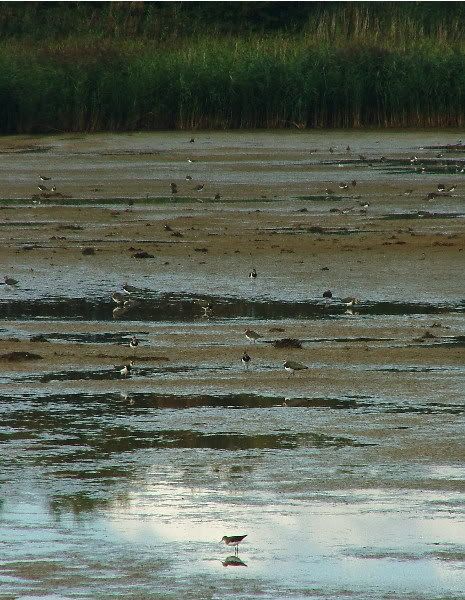
Rutland waders.

Green Sandpipers.

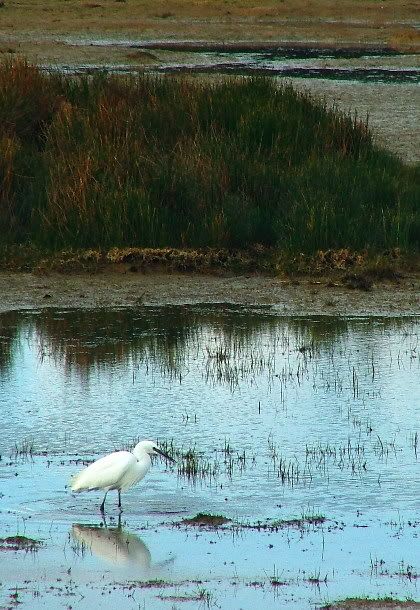
Little Egret.

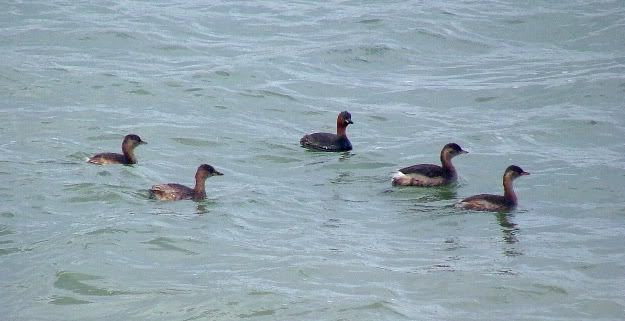
Dabchicks.

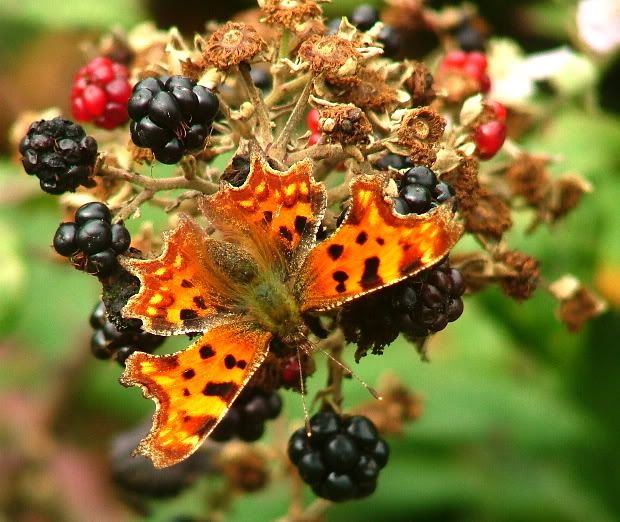
Comma.


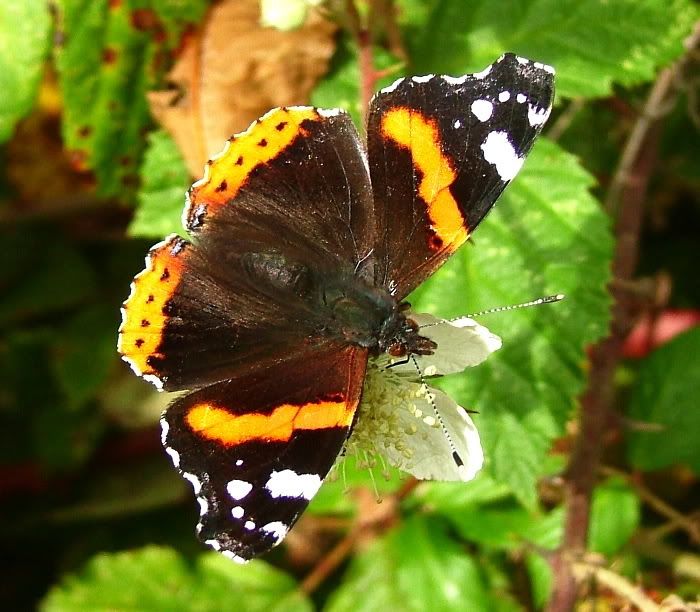
Red Admiral.

Finally, a couple of local spots, an Arctic Tern at Kings Mill Reservoir, one of several that passed through the county that day, and at Pleasley Colliery a Yellow-legged Gull. One of the individuals that roosts at Carsington Water maybe?

Oh, and just nipping out into the garden I heard a flock of Redwing going over. This time of year, pop your ear out at night and you could get them just about anywhere.

Sunday, 29 July 2007

Our Good Night Heron

What makes a twitcher? An hour's drive up the A1 to see one (or two) birds? Not quite, I hope.

The destination was Fairburn Ings RSPB Reserve, near Castleford in West Yorkshire. We had always meant to visit the place, but never before made it out there - until now. For over a week a pair of Night Heron had been showing really well at the site. Being the summer of exotic European herons this was our chance to bag one, and if the photographs at Birdguides.com were anything to go by, they posed a straight forward tick - sitting right out, over open water and in the daylight!

It's in the name; Night Heron. Their activities are normally restricted to the nocturnal hours, whilst in the daytime they roost in trees or reedbeds, and so are not always easily viewed. The natural range of these birds usually stretches no further than the Low Countries and their stronghold remains down in the Mediterranean. Yet, here we have two, an adult in beautiful three tone plumage, and a 1st-summer partner that are slightly muddier, making them one very attractive prospect. The reason they wandered into the UK is that they are migratory herons. Unlike our resident hardy Grey Heron, they retreat from the European winter down to tropical Africa, often as early as July. With that sort of large movement, they do turn up in England - perhaps half a dozen or more per year.

We arrived on site around 1pm, joining the ranks of 15 or so other birders, and we all saw nothing for over three hours. We stood and stared at a patch of reedbed and the trees behind, and nothing. Then an inspired find, through the wind-blown gaps of the reeds somebody had found a small feathery patch. Now you needed to find the perfect angle, almost like looking through the eye of a needle, and you could see small areas of the 1st-year bird. A shoulder here, the behind of the head, if lucky the eye or the beak, all of it 30 yards behind reeds already 50 yards away, where the bird was sitting very low in a willow. As a tick, I didn't mind calling it a disappointment. What I was impressed by was the ability of some of the other birders to pick it out, even knowing exactly where it was, locating a scope was far from easy. Oh yes, these guys are good!

After an hour of peeking at those feathery patches, the girlfriend and I decided to investigate the nearby areas of the reserve. Fairburn Ings is a relatively large area of lake and marshland, that looks a perfectly rich habitat for our breeding waders and wintering ducks. Indeed Lapwing, Oystercatcher and Redshank were in decent number, as was a notably large population of Gadwall. My only gripe was the hide, an uncomfortable metal hut that felt not unlike a prison unit. It had large pillars between the locked-open windows and no room to jam a tripod between the seat and the ledge for anybody without a hide clamp. Just a really poor design in comparison to the traditional wooden bird hide.

Back by the roadside, where unbelievably yobs in cars would yell and beep horns at us as they passed by, we were told the immature heron had flown a short distance. That seemed enough for most twitchers who packed up and left. Only a few more determined if less proficient birders remained, hopeful as we were of seeing something better, and we did. The bird was relocated in a creek, showing very well (with a Kingfisher too), to anybody who stood in eye-line through another break in the willows. That meant one viewer at a time, plus somebody tall enough to look over them, i.e. me.
Happily we managed to make sure everybody got a view, and best of all we had a casual birder who brought his smaller daughter to see the heron. She went 'Wow!'. That probably made the coolest moment of the day for me.

By now it was 8:30pm, over seven hours of waiting for this bird, and the elusive adult did not show at all. I read this morning on the sightings websites of 'not present' reports for the herons today recorded at 10:30am. Now come on boys, have a little patience!