Showing posts with label Nightjar. Show all posts

Tuesday, 9 June 2009

Nightjar!


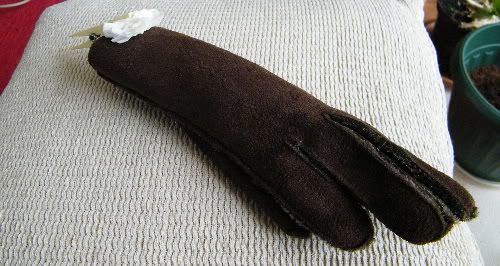
Check out the picture, if it looks like a glove with a tissue pegged to it you're only partially right. What you actually see is our successful Nightjar mimic.

It all began on Saturday night with the Nightjar Walk the delightful rangers at Sherwood Forest Country Park put on at the start of every June. This was our second time on that walk and wow, we had decent views of the Nightjar, Cuckoo, Woodcock and some Tawny fledglings dazzled by our torches at the end of the night. We also got some top tips for a return visit, on how to get our own close encounters with Nightjars (without attracting them with recordings which by the way is illegal). Hence the glove. As they patrol at dusk males see the white spot and in the gloom it looks to them like the markings on a potential rival, and in they come for a closer inspection.
Well, this we tried last night not long after sunset, this time just the girlfriend and me there, and WOW. With the glove sat on a fence post in came the male, we had it circling within 10 feet of us, 10 feet! Wafting by in that strange floating flight action, it seemed to be looking at us looking at it. Better yet when we began to leave in he sailed again and landed on a fencepost not very much further away and sat there chirring. By now it was getting late so we ultimately did head for home, but not without first pegging that tissue to the back of my hat, and wouldn't you know it, another male gave us a couple of passes back out in the middle of the common.

These are magical, half-mythical birds, near impossible to photograph or film during flight so encounters with them tend to be private and personal, related only through story. All of that only makes this odd frog-mouthed, insect voiced, bark feathered bird even more enigmatic.

Here's a video of the chirring from the walk, you'll also hear the ranger trying to attract one in and listen carefully for the hiccup of a roding Woodcock.


I've been birdwatching most of my life and I can't think of a more thrilling encounter than we had last night. I'm still buzzed.

Sad therefore that the Nightjar is declining in number, particularly in the Sherwood Forest/Budby Common area, now they have only two chirring males left these days. Why? Well there is an apparent conflict between local expertise on how the National Nature Reserve should be managed and what the rangers are dictated to do by Natural England's bureaucracy. I don't know the whole story but I hope they sort it all out because these birds are clearly suffering.

Wednesday, 11 June 2008

Flying Entry

Big update soon about my holiday away in NW Wales, but for now just a few local notes. Seems a while ago now (three weeks) that I scored with Black Tern back on the local patch at King's Mill Reservoir. This year they've been just about everywhere and seen by just about everyone, so I'm glad I got mine!
Lovely, elegant birds in summer plumage, and very graceful they are too hawking for insects at the surface waters. Their dark tones, relative small size, I don't mind admitting it took a minute or two of sifting through the large hirundine flock to pick out our bird.
It scored well with the girlfriend test, she was well impressed.

Last night we had a unsuccessful forray to Budby Common in search of Nightjar. We heard them all right, at least two, probably three chirring after 10pm, that was the extent of it though. What did show were Woodcock, we more than a dozen sightings of them roding above the treelines with that strange croaking and hiccupping display call. Can't say I'm disappointed after that!
We shall return though, possibly for Nottinghamshire Birdwatchers' Nightjar walk on June 20th.

So stories and pictures from Wales next time...

Thursday, 5 July 2007

Two and two make Nightjar?


This weather, the wettest month on record, three times the average rainful, I just haven't done very much birding lately. Also helped little that last week I hit a flood damaged path too fast and came off the bike fairly hard, doing a real number on my legs. Haven't really felt like riding since.

During my last circumnavigation of Brierley an elderly gentleman who noted my bins asked whether I'd heard the Nightjar. We don't have Nightjar at the park, so I reasoned he mistook the Grasshopper Warbler's similar reeling call for the much more illustrious species (the warbler has high-pitched grasshopper like call, the Nightar a low chirrrrr, both go on and on). This I attempted to explain yet he was adamant, said he'd even seen them skimming over the lake - probably referring to the Swifts that come in from town. Seems like he put two and two together and came up with Nightjar. Again I tried to explain his mistake to him, still he'd have none of it, and I left wondering whether sometimes it's better to leave chaps like him to enjoy their self-assured ignorance.
Probably not, he's missing out on finding the real thing, which is an amazing thing.

Tomorrow I'm off with the girlfriend to see the Tour de France in London, camping the whole weekend. I think we'll at least get some birding done in the great parks. That leaves just enough time this evening to check out the Barn Owl nest at King's Mill, a secret site I heard about it today on the local birding grapevine. Knew they were about, didn't know where, and I'm told only one of three chicks is yet to fledge.

Monday, 4 June 2007

Sherwood Forest Country Park NNR

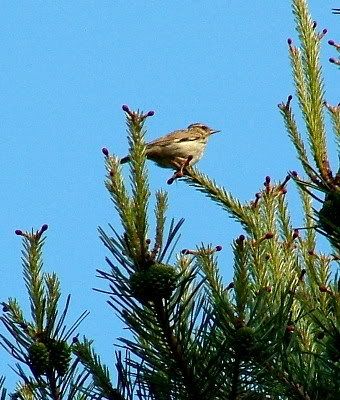
Note the pale-dark-pale leading edge to the wing, classic Woodlark.

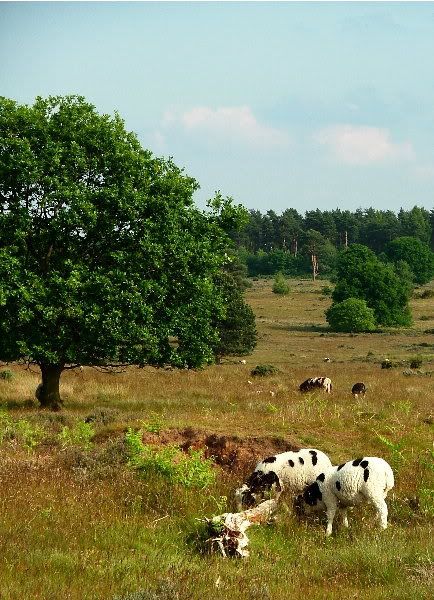
So we found a gem of a place, our only National Nature Reserve in the county - Sherwood Forest Country Park, a spacious mixture of ancient broadleaf woodland, conifer plantations and open heathland, all on the sort of sandy soil favoured by some pretty remarkable birds - not least of all Nightjar.

We began on Friday night with a guided walk led by one of the park rangers. It's a real treat when a chap like that shares specialist knowledge of his working patch - like showing us a Great Spotted Woodpecker nest that would be difficult to find during any regular visit. The walk started at 8:30. Above half a dozen Woodcock were roding throughout, meanwhile Tawny Owl chicks were branching although well hidden in the foliage, and from one of the plantations a Long-eared Owl chick begged and begged... and begged and begged for food with that distinctive 'squeaky gate' call.

Top of the bill was Nightjar and around 9:30 we edged onto the heathland where their chirring came to ear. We stopped overlooking a known territory and waited for action. That call was certainly loud enough but no bird yet visible, so the ranger used a nifty little trick. He slapped the back of his hand three times in quick succession which apparently imitates the wing-slapping part of the male's display flight. This obviously piqued the Nightjar and soon it was up against the skyline, the wafting butterfly flight and all. By now it was getting very dark and the walk headed back across the heath. Happily I spotted another Nightjar for the group, a swiftly flying female that had such strange head-long proportions in direct flight.
Some locals watching from a gate-post told us that there aren't as many Nightjar these days, which would be a shame if true.

Impressed by all of this the girlfriend and I couldn't stay away and made a visit the next day to retrace our steps and orientate a route for ourselves. The reserve is only 10 miles from home so we could make the place a regular spot.
In the daytime the birdlife was very different, a change from the nightshift species, some specialists too. Tree Pipit was very numerous, my first. Previously I'd always carefully listened to Meadow Pipits hoping to hear something different, but when a Tree Pipit does give you its splendiferous chorus you can't really mistake it for anything else. Cuckoos called throughout the day and we followed a male down a bridleway, jumping out of our skin when we flushed it from undergrowth beside the path only 5 yards ahead.
The other distinctly notable bird was the Woodlark, pictured above, again flushed from a path and very bold it was too, sitting for several minutes in the tree above us.

Again we heard the Nightjar's chirr though much earlier in the day, around 6:30 in the afternoon, still in fairly strong daylight at this time of the year. It was seemingly responding to our hand-slapping. Yes, it really works!
What else? Jay, Yellowhammer and Linnet, were nice birds.

The Common.

Thursday, 9 November 2006

Not quite a tick


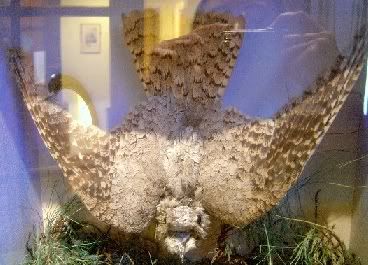
After reading in the bible of British birding, Birds Britannica (by Mark Cocker, Richard Mabey), that the stuffed remains of the nation's first ever Egyptian Nightjar were still on display in our local museum 120 years after it was shot, a short pilgrimage felt necessary.

Okay so it's no great feat in taxidermy, but there is an interesting story attached, here's an excerpt from the book;

A Nottinghamshire gamekeeper, Albert Spinks, flushed a bird from its resting spot while he was shooting rabbits and, thinking it looked unusual, brought it down with his second barrel. A day later when it started to smell he threw it on to the ashpit near his cottage, only for his ornithologist employer, J. Whitaker, to notice and retrieve the skin. Whitaker sent it to his taxidermist and subsequently had its identity confirmed as an Egyptian Nightjar, then he honoured 'his' find by erecting a monument at the site of discovery (Thieves Wood, near Mansfield). The inscription, in which the largest letters spell his own name, was intended to read: 'This stone was placed here by J. Whitaker, of Rainworth Lodge, to mark the spot where the first British specimen of the Egyptian Nightjar was shot by A. Spinks, on June 23rd, 1883, this is only the second occurrence of this bird in Europe'. In fact 'occurrence' was misspelt and the date appears to have been wrongly given as 1882.

Apparently this was almost unique for being memorial for an individual wild bird in Britain, and probably the only one since the last British breeding pairs of Great Auk were killed in the Orkneys during the early 19thC. Alas it has since been removed from the site, replaced by a simple post etched with the momentus date and a figure of the bird.

So far there has only been one other record of the Egyptian Nightjar in Britain so it seems very likely this will be the closest of come to ticking off the species, short of a trip to Africa.

Reading back through the history of the way our ancestors interacted with the wild bird populations they found can often be deeply saddening exercise, where you'll learn about centuries of exploitation, superstition and casual disregard, so it's truly heartening to think we live in more enlightened times, with a renowned organisation like the RSPB, with its million strong membership passionate about conserving and enjoying our natural avian heritage.