Showing posts with label Budby Common. Show all posts

Tuesday, 16 February 2010

Old Moor, Budby, Birds


Paid a visit to Old Moor at the weekend, good birds, good shop, good times. No stellar species around, Ringed Plover was about the best of it, lots of courting Goosanders, bountiful Lapwing flocks, and an entertaining female Kestrel (pictured) in the car park that dropped down after prey right beside our car. The Yellowhammer comes from the Tree Sparrow Farm area of the reserve where long-staying Brambling weren't playing ball.
Wath Ings hide had a Common Snipe several birdwatchers were convincing themselves was the Jack report a day before, it's one of the pitfalls of reading the sightings news that I'm pretty sure was susceptible to once upon a time.

Also been Budby way, as always nice views of several Green Woodpecker, a handful of Crossbills went over, otherwise hardly a dicky around. Better was Carburton were ploughed fields have proved magnetic for numbers of Greylags I've just never seen there before, and among them there be scarcer geese. Four Pinkies, and I found a surprise lifer in a White-front (#229), it looked dark to me but other guys with more experience we're happy it was a Russian race bird. We simply don't get many of either in the East Midlands, although a few birds were seen in North Notts not long after mine.

Tuesday, 9 June 2009

Nightjar!


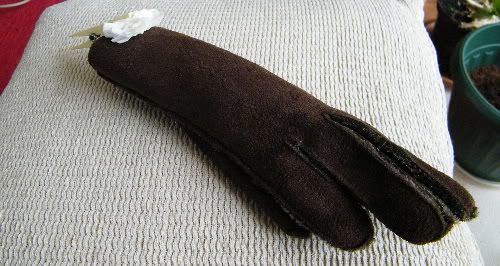
Check out the picture, if it looks like a glove with a tissue pegged to it you're only partially right. What you actually see is our successful Nightjar mimic.

It all began on Saturday night with the Nightjar Walk the delightful rangers at Sherwood Forest Country Park put on at the start of every June. This was our second time on that walk and wow, we had decent views of the Nightjar, Cuckoo, Woodcock and some Tawny fledglings dazzled by our torches at the end of the night. We also got some top tips for a return visit, on how to get our own close encounters with Nightjars (without attracting them with recordings which by the way is illegal). Hence the glove. As they patrol at dusk males see the white spot and in the gloom it looks to them like the markings on a potential rival, and in they come for a closer inspection.
Well, this we tried last night not long after sunset, this time just the girlfriend and me there, and WOW. With the glove sat on a fence post in came the male, we had it circling within 10 feet of us, 10 feet! Wafting by in that strange floating flight action, it seemed to be looking at us looking at it. Better yet when we began to leave in he sailed again and landed on a fencepost not very much further away and sat there chirring. By now it was getting late so we ultimately did head for home, but not without first pegging that tissue to the back of my hat, and wouldn't you know it, another male gave us a couple of passes back out in the middle of the common.

These are magical, half-mythical birds, near impossible to photograph or film during flight so encounters with them tend to be private and personal, related only through story. All of that only makes this odd frog-mouthed, insect voiced, bark feathered bird even more enigmatic.

Here's a video of the chirring from the walk, you'll also hear the ranger trying to attract one in and listen carefully for the hiccup of a roding Woodcock.


I've been birdwatching most of my life and I can't think of a more thrilling encounter than we had last night. I'm still buzzed.

Sad therefore that the Nightjar is declining in number, particularly in the Sherwood Forest/Budby Common area, now they have only two chirring males left these days. Why? Well there is an apparent conflict between local expertise on how the National Nature Reserve should be managed and what the rangers are dictated to do by Natural England's bureaucracy. I don't know the whole story but I hope they sort it all out because these birds are clearly suffering.

Tuesday, 26 May 2009

First Lady


Did Budby Common at the weekend, had promised the girlfriend a Cuckoo. Plenty heard of them and one of the two calling males gave a couple of fleeting views. We've done better there before, but these are always skittish birds. The usual suspects were also around, loads of Tree Pipit, although surprisingly saw only one Woodlark.
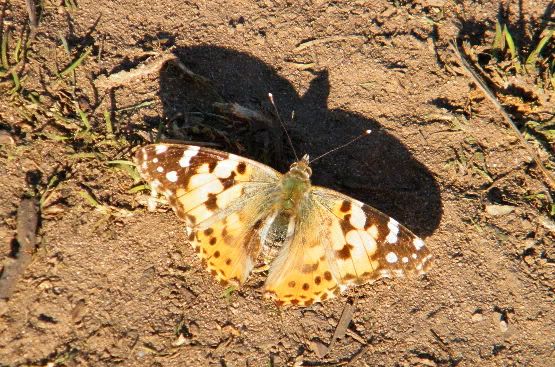
Had our first Painted Lady of the year, a real faint one. Ours was ahead of a big influx that has hit the UK over the past couple of days.

Elsewhere Barn Owls are back for another season of train dodging on one of my local patches, and I'm seeing more Red-legged Partridge on my way to work (which may be bad news for any local Grey Partridge left around here).

Monday, 20 April 2009

Across the Border


This past Saturday we had some time at the end of the day to head into Notts, so we did the Carburton - Budby Common double bill. Buzzards entertained from the pull-in at Great Lake and a small flock of Mandarins clattered around the trees. Give it a month or so for Honey Buzzards and perhaps last summer's Osprey will return too.
The Nuthatch vid comes from Carburton.

To Budby before sunset, again a little early in the season for the best action there, Tree Pipits with that go-bezerk trill at the end of their song were the big feature, Linnet and Yellowhammer among them. Late May to early June we'll definitely return for the Cuckoos, Woodcock and Nightjars, Woodlark ought to be singing too.

Wednesday, 11 June 2008

Flying Entry

Big update soon about my holiday away in NW Wales, but for now just a few local notes. Seems a while ago now (three weeks) that I scored with Black Tern back on the local patch at King's Mill Reservoir. This year they've been just about everywhere and seen by just about everyone, so I'm glad I got mine!
Lovely, elegant birds in summer plumage, and very graceful they are too hawking for insects at the surface waters. Their dark tones, relative small size, I don't mind admitting it took a minute or two of sifting through the large hirundine flock to pick out our bird.
It scored well with the girlfriend test, she was well impressed.

Last night we had a unsuccessful forray to Budby Common in search of Nightjar. We heard them all right, at least two, probably three chirring after 10pm, that was the extent of it though. What did show were Woodcock, we more than a dozen sightings of them roding above the treelines with that strange croaking and hiccupping display call. Can't say I'm disappointed after that!
We shall return though, possibly for Nottinghamshire Birdwatchers' Nightjar walk on June 20th.

So stories and pictures from Wales next time...

Monday, 19 May 2008

Budby Common, but its Birds Aren't

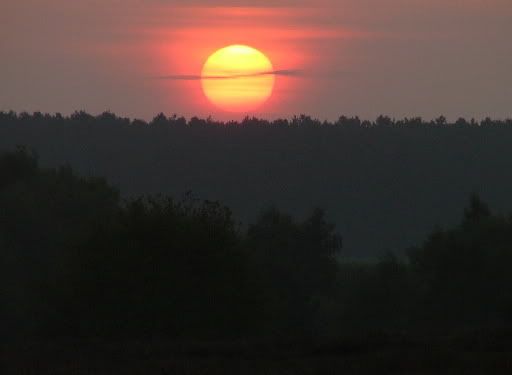
Quick update. My last decent birding foray was an evening stroll around Budby Common/Sherwood Forest Country Park. It's a National Nature Reserve up there, and the wildlife richly deserves that great distinction. Over the expanse of open heathland we saw 3 Cuckoos, several Woodlark, Tree Pipits, a Hobby screamed through, Yellowhammer, Green Woodpecker and Jays were about too, plus Red-legged Partridge and Yellow Wagtail in the farmland nearby. Wasn't all birds either, we spotted a fox, a couple of hares and a stunning sunset too.
The reserve could be the finest wildlife destination in the whole of the county.

In a couple of weeks when the bird are more active the rangers do a guided Nightjar walk, I went on last year's and it was just brilliant. Be sure to give it a go if you can get there.

Saturday, 5 January 2008

Shrike One!

Budby Common

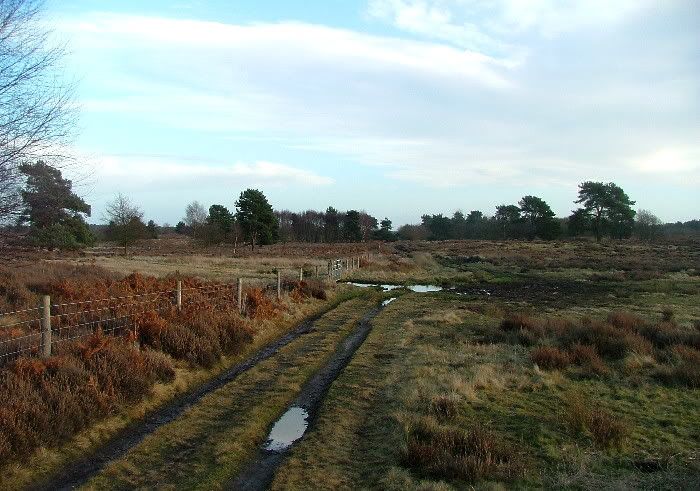
Another successful local rarity tracked down today. Budby Common, an area of sandy heathland immediately north of Sherwood Forest Country Park NNR, has been a traditional site for Great Grey Shrike for years now. This winter has been no different, with at least one being reported since early December. It can go up to a week without apparently being seen, but you can generally be sure there's a shrike out there.

A short walk from Budby village brought us to the heath and almost immediately the GGS showed up, pearching atop a scattering of several small trees. It had obviously read the ID literature because this bird showed textbook behaviour, standing on guard on the highest, most exposed branches and even hovering before swooping down on prey hidden deep in the heather. It was just a completely different story to the aloof Shrike we saw only very at Ogston Reservoir last winter. Perhaps the close proximity of the road at the Derbyshire site influenced the very shy behaviour of that bird.

Back to Budby, and there's a two bird theory among some of the locals, although I'm not so sure myself. We watched our shrike for about an hour and saw it wander quite widely between the two areas it has most commonly been sighted. This movements makes sense as their winter territories can reach 50 ha, and that's pretty damn big.


Here's another murky digi-video-scope for the birdtrail record. Hey it was windy all right? And it's the middle of winter out there!

For a better video try this delightful YouTube offering of a Great Grey Shrike in Israel dispatching a mouse. These birds are hardly the size of a Song Thrush, but ferocious enough to deal with all kinds of prey, birds up to the size of Fieldfare and mammals as large as Stoats! Just a real marauder of bird species, making the black highwayman's mask very fitting plumage.

In Britain the Great Grey Shrike is strictly a winter and passage visitor, most of ours probably coming from Scandinavia or possibly Russia. Perhaps 50 or so are present in the UK each year, with a tendency to turn up practically anywhere there is suitable habitat - including but not exclusive to heathland, peat bogs, the edges of pine woodland, and coastal dunes. Basically wherever they are, it's a top notch species, always special.

Elsewhere on the common were Jay, Green Woodpecker, Meadow Pipit, Kestrel and in adjoining farmland a Skylark warbled and a Buzzard cried as it sailed into woodland. A birder who walked from the Sherwood direction noted a pair of Stonechat.
Otherwise, Budby Common is best in spring/summer, as during a July afternoon you have better than not chances of see Nightjar, Cuckoo, Woodcock, Woodlark and Tree Pipit (blog entry from last year). If you can give it a day, you could scarcely find a more rewarding site in the whole of the East Midlands, and they have ice cream at Sherwood Country Park visitor centre!

Monday, 4 June 2007

Sherwood Forest Country Park NNR

Note the pale-dark-pale leading edge to the wing, classic Woodlark.

So we found a gem of a place, our only National Nature Reserve in the county - Sherwood Forest Country Park, a spacious mixture of ancient broadleaf woodland, conifer plantations and open heathland, all on the sort of sandy soil favoured by some pretty remarkable birds - not least of all Nightjar.

We began on Friday night with a guided walk led by one of the park rangers. It's a real treat when a chap like that shares specialist knowledge of his working patch - like showing us a Great Spotted Woodpecker nest that would be difficult to find during any regular visit. The walk started at 8:30. Above half a dozen Woodcock were roding throughout, meanwhile Tawny Owl chicks were branching although well hidden in the foliage, and from one of the plantations a Long-eared Owl chick begged and begged... and begged and begged for food with that distinctive 'squeaky gate' call.

Top of the bill was Nightjar and around 9:30 we edged onto the heathland where their chirring came to ear. We stopped overlooking a known territory and waited for action. That call was certainly loud enough but no bird yet visible, so the ranger used a nifty little trick. He slapped the back of his hand three times in quick succession which apparently imitates the wing-slapping part of the male's display flight. This obviously piqued the Nightjar and soon it was up against the skyline, the wafting butterfly flight and all. By now it was getting very dark and the walk headed back across the heath. Happily I spotted another Nightjar for the group, a swiftly flying female that had such strange head-long proportions in direct flight.
Some locals watching from a gate-post told us that there aren't as many Nightjar these days, which would be a shame if true.

Impressed by all of this the girlfriend and I couldn't stay away and made a visit the next day to retrace our steps and orientate a route for ourselves. The reserve is only 10 miles from home so we could make the place a regular spot.
In the daytime the birdlife was very different, a change from the nightshift species, some specialists too. Tree Pipit was very numerous, my first. Previously I'd always carefully listened to Meadow Pipits hoping to hear something different, but when a Tree Pipit does give you its splendiferous chorus you can't really mistake it for anything else. Cuckoos called throughout the day and we followed a male down a bridleway, jumping out of our skin when we flushed it from undergrowth beside the path only 5 yards ahead.
The other distinctly notable bird was the Woodlark, pictured above, again flushed from a path and very bold it was too, sitting for several minutes in the tree above us.

Again we heard the Nightjar's chirr though much earlier in the day, around 6:30 in the afternoon, still in fairly strong daylight at this time of the year. It was seemingly responding to our hand-slapping. Yes, it really works!
What else? Jay, Yellowhammer and Linnet, were nice birds.
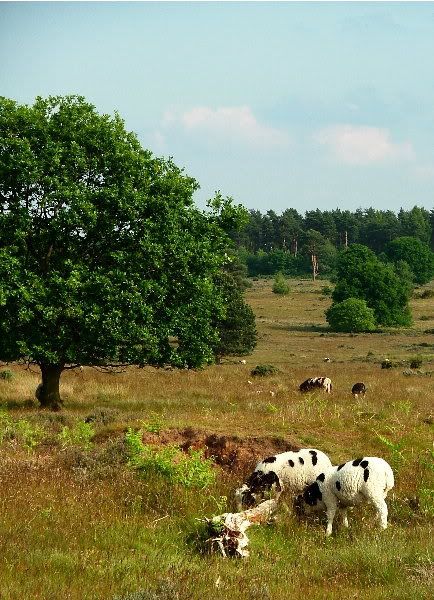
The Common.