Showing posts with label Aren't Birds Brilliant. Show all posts

Wednesday, 13 May 2009

Reterns and what's that Stint?


Nice day ABBing at Carsington yesterday, nice to see visitors excited by the antics of the Common Terns. Whether they manage to remove the Black-headed Gulls from the newly deployed raft and get a chance to nest looks like big story for the next few weeks. Just not sure they're quite feisty enough to do it. I think the word soap opera writers use for the interest inspired by this sort of thing is jeopardy.
3 Common Sandpipers were a charming addition too. The Garden Warbler video comes from the Sheepwash end of the water.

Can beat that all though, this afternoon I checked Birdguides and there it was a report of Little Stint up at the pit. Good birds, but I've seen them before, even in Derbyshire, better stay in and get some work done in the house. A couple of hours later I check again and jeepers, there's been an upgrade, they're Temminck's Stint! - a lifer for me and probably the first in Derbyshire for many a year. Admittedly the difference is slight between the two species (and the mistake easy to make), basically Temminck's have pale legs, but they are a good deal rarer than Little Stint, both birds notable for being so flaming tiny, like unbelievably small for waders.
So Pleasley scores again, I really do like having the pit just a short walk away.

Here are a couple of strictly dodgy digiscope efforts, taken from a windswept video too shaky to dare post, glad they were still there...

Friday, 24 April 2009

Carsi


(Willow Warbler)

Was back at Carsington this week for the Tuesday ABB. Stunning weather, anybody who's been on holiday has got to have used up all their good luck for the year. 2 Great Northern Diver remain on the reservoir and look likely to tease us with mere hints of summer plumage before disappearing in the next week or so.
The best of the rest were a couple of pristine White Wagtails. You can spend hours checking every Pied Wagtail umming and ahhing over their identity but when you actually find a White one you really know it. Shelduck was a nice record for Carsington, Little Ringed Plovers are around, plus the regular waders and warblers. Mallard ducklings are already out and about.

The House Martins have begun work on nest cups up around the visitor centre and the RSPB volunteers will spend a bit more time this year featuring them on event days, which ought to be lots of fun. Like all hirundine they're fascinating birds.

Monday, 6 April 2009

In Confirmation of Spring


Did another Carsington ABB last week, that's where the Chiffchaff came from there. The Great Northern Divers are still around but shouldn't be there for very much longer. Always a tease to have them disappear just before summer plumage kicks in. My first Swallows and Sand Martins of the year were scooting along the dam, plus the Redshanks and Oystercatchers look frisky and ready to begin nestwork.

Another first for the year was a Willow Warbler right on time at Kings Mill Reservoir.

Scenes from Carsington...

Wednesday, 26 November 2008

Tail Spin

Shall be moving house fairly soon with my new home closely neighouring the nature reserve at Pleasley. The garden is full with established trees and potentially poses a squirrel problem for my bird feeders. Not a worry though, the solution is out there, and it's highly amusing...


...or perhaps not. Better advice may come from the RSPB - put chilli powder in your seed mix.

Speaking of mixes, a nice mix of birds during yesterday's Carsington ABB where we hit 40 different species from the Wildlife Centre for the first time for quite a while. A Kingfisher was the star for most visitors, plus the Great Northern Diver - these winters Carsington wouldn't be Carsington without one of those.

Wednesday, 25 June 2008

Daddy Long-legs

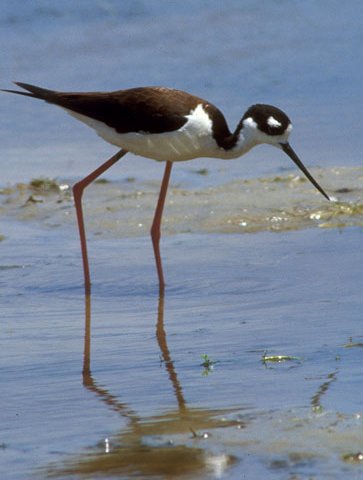
A quick post to wrap up the Wales trip. On the way across we bisected Cheshire, very close to a nature reserve were Black-winged Stilts were still nesting. Didn't expect us to pass that by without taking a look, did you?
This was only the 7th known occurrence of nesting in Britain for this species (found more usually around the Mediterranean coasts), unusually two or possibly three pairs breed in Nottinghamshire in 1945, with a handful of other records since then. Cue the RSPB and their Aren't Birds Brilliant team to watch over the birds and show them to the public. You couldn't miss them...


Ridiculous and beautiful looking birds really, my girlfriend labelled the male bird 'daddy long-legs' and you can easily see why - indeed proportional to body size they have the longest legs of any bird in the world. Not only strange by appearance, the parent bird had the habit of carrying the chick around under its wing, so you'd see the adult stood with two legs poking from its armpit and know where the chick was.
Sadly it was only one chick. The clutch hatched during a stormy night which the rest of the brood failed to survive, and now regrettably I have read that the one chick has been taken by a predator since our visit to the site. Just 1 week away from fully fledgling too.

So for this year, that particular spectacle is over. Let's see if the Stilts pop up anywhere next Spring. Keep an eye out for ridiculous birds, all right?

Maybe you'll find a long-stayer worthy of naming, like Sammy, a remarkable bird that took residence at the RSPB's Titchwell Reserve for 12 years from the mid-90's. Thought at the time to be the most photographed bird in the UK, beat that Kate Moss!

Friday, 20 June 2008

GOP


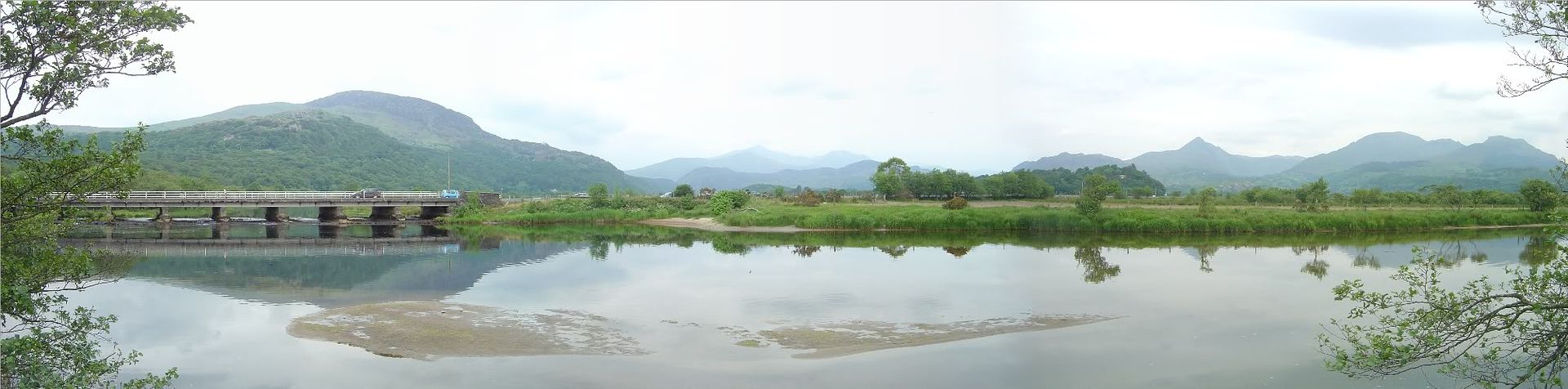
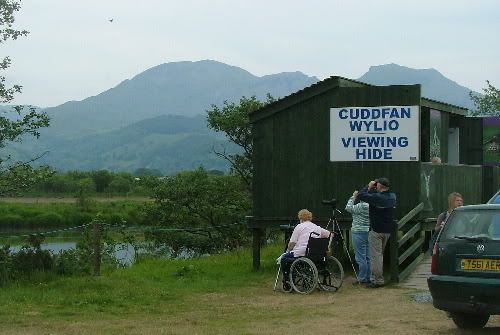
Wales again, another ABB, the Glaslyn Osprey Project in Snowdonia. If you're in the region it's the perfect diversion, and though the nest is over a mile away from the viewing area the RSPB's scopes give great sights of these majestic birds that can't fail to thrill. The project has its own blog, check it out here.
Yes, that is Snowdon in the background there, the pointy peak centre left.

More intimate views available at the ABB site through the CCTV set up above the nest.

Top stuff.

Thursday, 19 June 2008

Aren't Kites Brilliant!

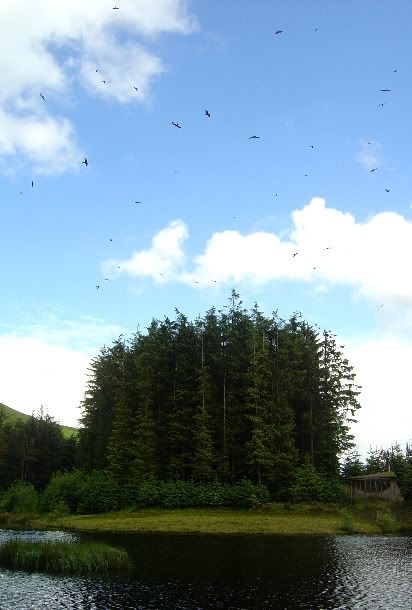
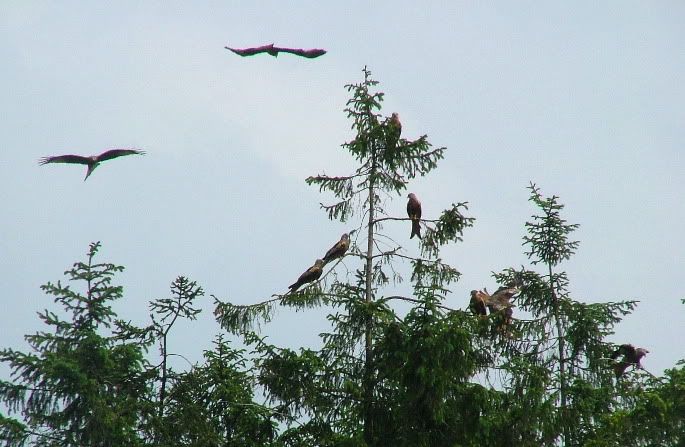
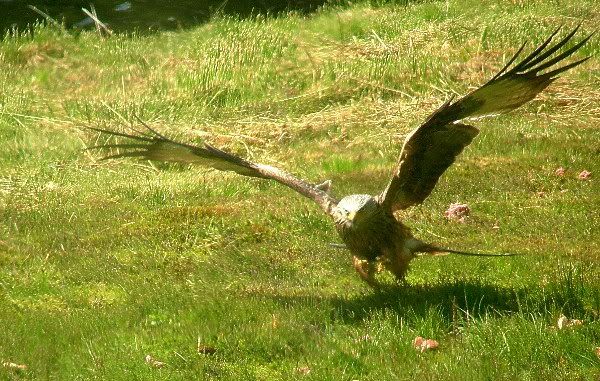
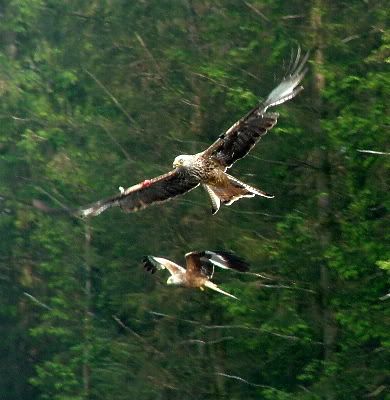
Continuing the birding story of my holiday in Wales, the next feathery target were the Red Kites at the Forestry Commission's feeding station at Nant-yr-Arian, in central Wales about 9 miles east of Aberystwyth, where an ABB project runs most days through the year. Around 100 birds arrive everyday at three in the afternoon to snatch a quick easy meal, swooping down with great dramatic poise to pick up their prize, usually chicken we're told, tossed to them by the rangers. This apparently helps improve breeding success, especially during dry spells when parent birds find difficulty in digging up their main prey item - worms.

Here's the video...


(another video here)

The hide is 20 yards from the feeding area, so you can view the Kites at very close quarters indeed.

Now truth be told, the profusion of Red Kites there lasts most of the afternoon, you really can't miss them in your anywhere around the site, and after an hour or two you begin to take them for granted. This has to be a marvellous thing, to be tired of Red Kites! After the entire Welsh (and therefore British population) at one point came down to just a handful of pairs, indeed research into their genetics tells that all Welsh kites are descended from just one female, these numbers indicate the most amazing recovery for the species.
There are up to 400 pairs now in Wales, and without hyperbole their survival has to be one of the great stories in nature conservation anywhere in the world. What a remarkable achievement! So even if the feeding stations feel a little like Red Kite theme parks, all is forgiven.

Of course you don't have to go to Wales for Red Kites anymore, there are birds from reintroduction schemes around much of England now, and some fairing a little less well in Scotland. The Welsh will tell you these are 'non-native' Red Kites since they came from European populations and perhaps they have a point. Truth be told, there is an argument that the RSPB jumped to quickly to reintroduce Red Kites to the UK from other countries. It's a cautionary tale.

Other birds around the site included Buzzards, Ravens, Siskin, and practically in the car park you have Tree Pipit.

Back to the Kites, and more pictures...


The valley to the west.

Friday, 23 May 2008

Carry On Doving


A video of the Turtle Dove that graced the bird table at Carsington this week. Apologies for the poor image quality, but at least you get some comparison with the Collared Dove in front there.

Thursday, 22 May 2008

Dove Me Do

Had a surprise during our ABB event this week; a Turtle Dove arrived at the bird table, so far as I'm told making it only the second record for Carsington and the first in around 12 years. Great news as this is, sadly it looks like they are set to get even scarcer than that with intensive farming methods, loss of set aside and the eagerness of Maltese hunters to fill their bags, all impacting on this red listed species.
Charming bird, distinguishable for being slightly smaller than a Collared Dove, as well the obvious plumage differences.

The good news is the European Commission is to begin dealing with the Maltese government's failure to crack down on the illegal shooting, although that's little use if the doves have nowhere to feed or nest when they do get to the UK. More about that here

In case you were wondering the species' name 'turtle' comes from the French word for the dove, tourterelle, which is said to be closely onomatopoeic of the bird's purring song. So don't say I never post anything interesting!

Other birds for the day included a family of Raven playing along the hillsides, and a probable pair of Curlew bathed by the wildlife centre about 30 minutes apart in the morning. The male has a slightly shorter bill than the female, which is about the only way of telling them apart.

Most popular among our visitors however were the Lapwing chicks, best described as fluffy balls on stilts. Just two so far, but surely more to come. Well done Severn Trent Water for their management of the islands!

Turtle Dove

Friday, 9 May 2008

Success!


Another post that will have to be brief.

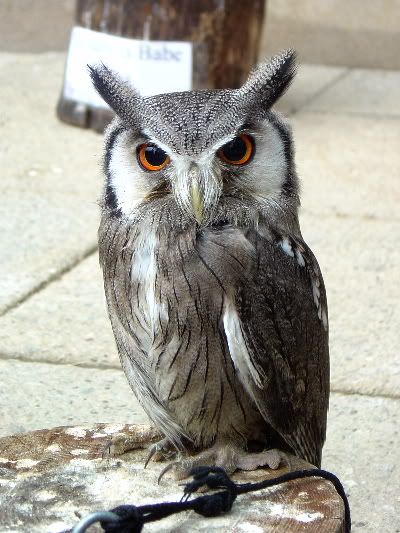
Firstly, say hello to one of the stars of Carsington ABB's Bird of Prey Day, this utterly gorgeous White-faced Scops Owl. His native region is around the fringes of the Sahara, so not a common bird for Derbyshire. I could kick myself for having to be work during the event . Anyway, between the local owl club, kids' activities and the resident birds of the reservoir, the day went marvellously. We really do have a good thing going on there.
The event took place to raise awareness of the RSPB's new Bird of Prey campaign. We are looking for 100,000 pledges of support against the continuing persecution which, despite being illegal for decades, still leaves our countryside impoverished of some of the most dramatic bird species in Britain, such as Hen Harrier, Goshawk and Peregrine.

FIND OUT MORE HERE AND SIGN THE PLEDGE.

In other news, I was thrilled this week to watch a pair of Little Ringed Plover mating at one of my local sites. Moments earlier the female gave the impression of already brooding eggs, but then the male arrived. Up she stood, literally giving him the nod, and well, he didn't need to be told twice.
Lovely to see these birds because they are still rare breeders for the region, though colonisation quite quickly these days.

Later folks!

Friday, 18 April 2008

Conversations overheard in car parks

"The RSPB are in the bird observation hide, it's fantastic!", said the well impressed member of the public to her friend as I passed on my way to the loo.

She was talking about this week's mid-week ABB event, and what more is there for me to say about it? Well, being the school holidays in some counties we had plenty of families through the centre, with plenty of very cool kids and their wonderful descriptions of the birds they saw through our scopes. For one girl Chaffinches were a particular favourite, and she may be onto something - with the splash of colour on the male bird, perhaps we undervalue them.

The bird life was varied enough to supply plenty of interest. Willow Warblers and their descending songs are the latest arrivals to promise that warmer weather can't be far away now, and Blackcaps twittered in similar hope of milder skies.
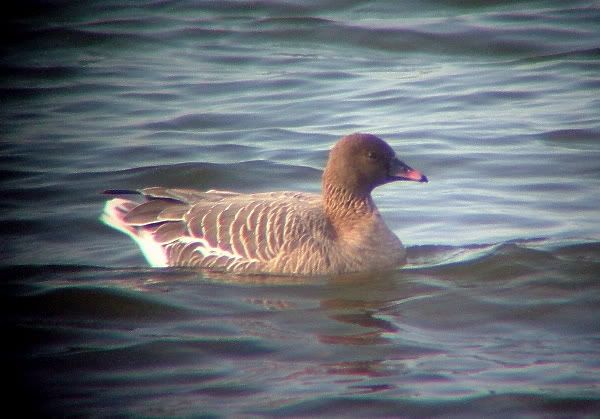
The glamourous Great Northern Diver showed well during the event, as did our Little Owl, and elsewhere around the water a lingering, lonely, lost Pink-footed Goose associated itself with a small gathering of Canadas (it's a long way to its Greenland summering grounds for that bird). On the migrant hot-spot of Stones Island 3 Yellow Wagtails were a colourful addition to the black, grey and white of the Pieds, so intense is that yellow hue the birds might have been crafted our of mounds of lemon rind.

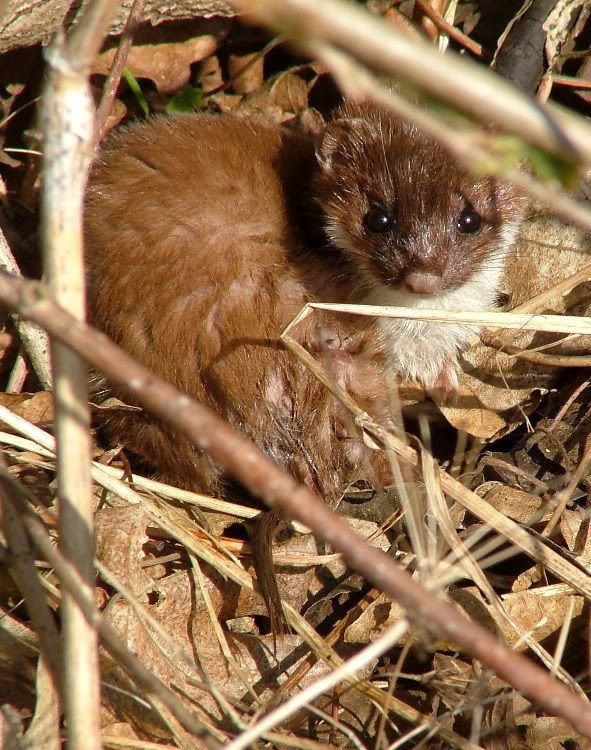
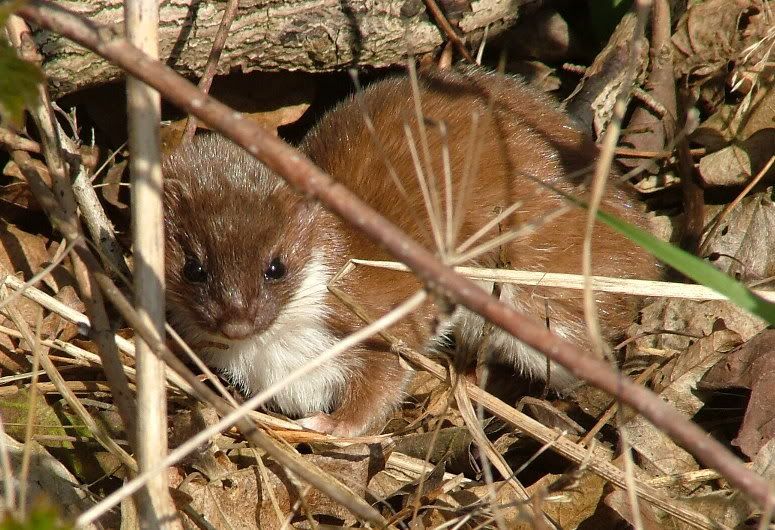
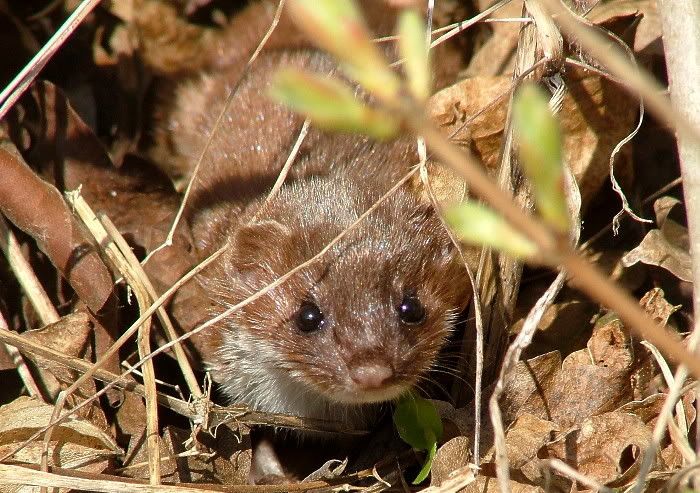
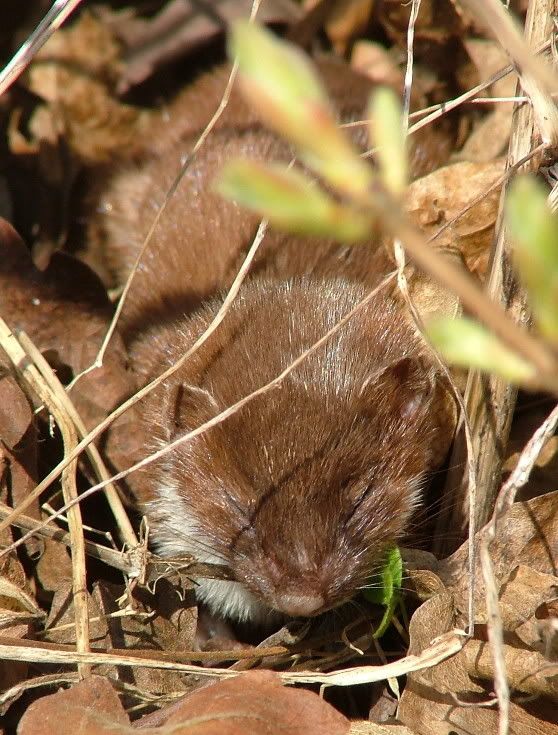
And then there is one more character to make note of, a Weasel, and a particularly fearless one that I discovered sunbathing in the leaf litter beside a path. I approach slowly, with high caution, but really I needn't have because it soon became apparent this small mustelid was as interesting in me as I was in it, as the creature repeatedly popped its head out from the undergrowth to watch me watching it. By the end of the interaction the weasel was within arm's reach and I was rustling, dare I say playing with, the leaves in front of me in game with this curious animal that I didn't quite understand the rules to. After 15 minutes I had to break away as I was already late for the ABB event, leaving the little dude behind.
No regrets though, it was a truly memorable encounter for me, and I think if there is a moral to this story of countryside and wildlife it is this, get out there because you can get so so lucky!

The pictures from the day...


The Pink-foot.

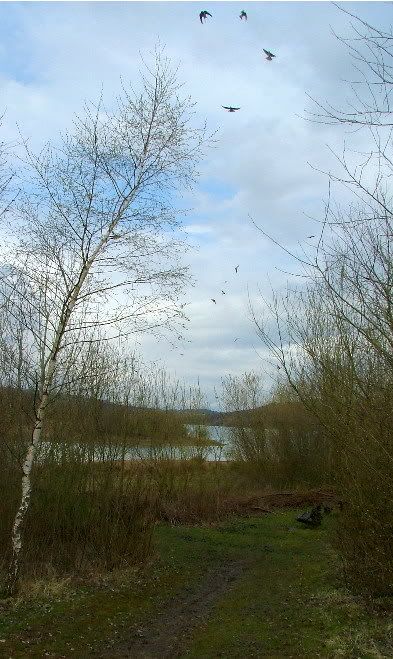
Swallows around Stones Island.

Happy birdwatching everybody!

Thursday, 10 April 2008

Great Greenshanks Batman!

Well folks, I think we can call this spring and the bird life confirms it. Chiffchaffs are everywhere, and those zipping flocks of hirundines can't be argued against. Birds do it once again, this time enriching us with the hope that very soon it'll be so much warmer outside.

I had another fabulous ABB day this week, in mostly fabulous weather, and I'll use that word again, we had some fabulous birds coming in, almost a wader bonanza in Carsington terms. Bird of the day was an unbeatable Greenshank, the site's first for a good long while. Their traditional migration route toward their breeding grounds on the moors and peatland of NW Scotland is coastal, hence the rarity in Derbyshire. Most will winter in Africa, though many also spend the cold months around the SW coast of the UK.
If one thing strikes me when I sight a Greenshank it is their beautiful daintiness, how the bird is almost too delicate. Nearest species we have to stilts, at present.

Other birds for the day included Common Sandpiper, Common Scoter (marine ducks that migrate overland between the Irish Sea and Scandinavian breeding areas at this time of year), Little Ringed Plover, the regulation pair of Little Owl, Wheatear (on the dam - real hot-spot for migrant passerines), and White Wagtail (the continental race of Pied Wagtail - look for birds with pale grey backs and very clean white flanks below the line of the wing). Almost goes without saying the Great Northern Diver remains, and now shows a hint of summer plumage on the back. Hopes are high it will turn fully before it departs - into something like this - handsome or what?

Icing on the cake, and the whole point we do the events at Carsington, was a bumper crop of membership sign-ups for the RSPB. That's win-win for everybody, for birds, for people, forever.

I have news to report that isn't so sportive. My previous entry reported on the return of the King's Mill Barn Owls, which is great, but alas I learn today their territory is imperilled. Already an area of superb hunting habitat south of their nest site has been ploughed up for commerical development, which will doubtless include the construction of a new road. The local RSPB group therefore views the long-term future for Barn Owls at the reservoir in very pessimistic terms.
My hopes rest on remembering how they surprised us by turning up, surprised is in their bizarre choice of nest site, surprised us with their breeding success, and I look forward to them surprising us again. I watched one of the birds sat on a post a yard or two from the railway tracks the other night, and for a heart-stopping moment it scarcely flinched as two trains thundered by it. Again, after all the noise had died down it was a surprise to see it calmly perched with the same simple ease it had been before the trains passed. Blaze is the word that springs to mind.

Got five mintes, why not look at the RSPB's campaigns website?
Thursday, 20 March 2008

A Right Poser


I had another ABB! day at Carsington this week. Pretty average event by our standards, by which I mean GREAT! Plenty of excited schoolchildren through, although many of them were dangerously obsessed with ticking off the birds on their list. It's a ragged road to go down kids, believe me!

Our bird list for the event included the Great Northern Diver (surely this bird has earned itself a pet name by now - 5 months into this year's stay and probably 6 last winter too!), Buzzard, Raven, Kingfisher, Oystercatcher, Redshank, Lapwing, Little Owl (the pair cosying up together, aww...), Kestrel, Bullfinch and notably a lost Pink-footed Goose with the resident feral Canadas and Barnacles, among the regular characters. Reports of Sand Martin arrivals also came in with a reliable recording of 2 birds, and I enjoyed a nifty Chiffchaff giving himself away with an unmistakable call that really jolly well announces the beginning of spring.
Those first few Sand Martins may provide that unlikely possibility this weekend of the sight of hirundines skimming over fields of snow, weather which should push them back south again.

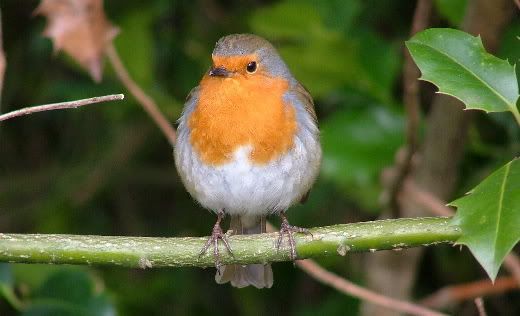
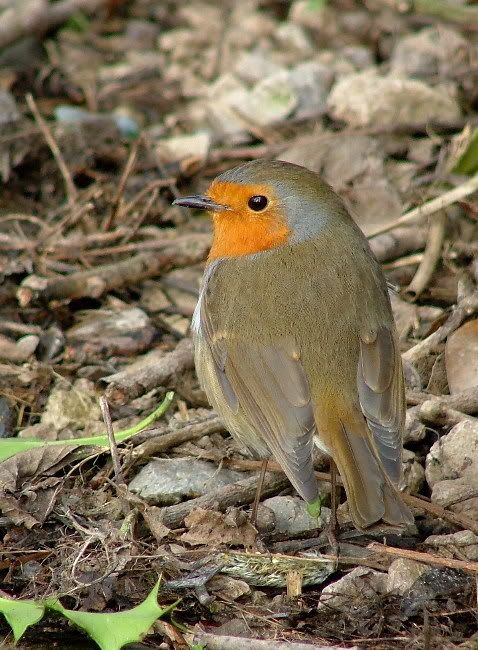
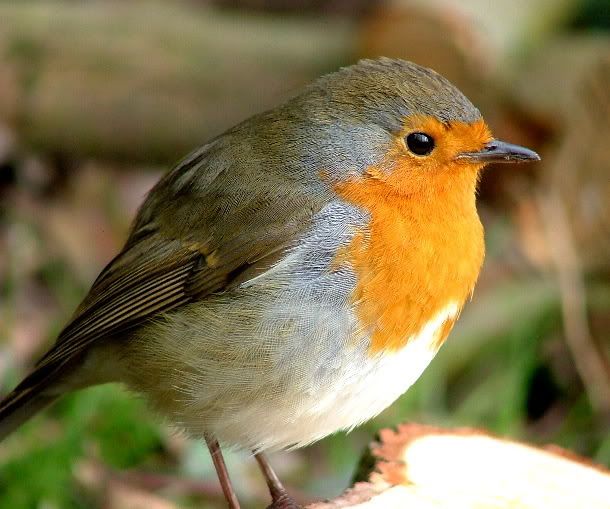
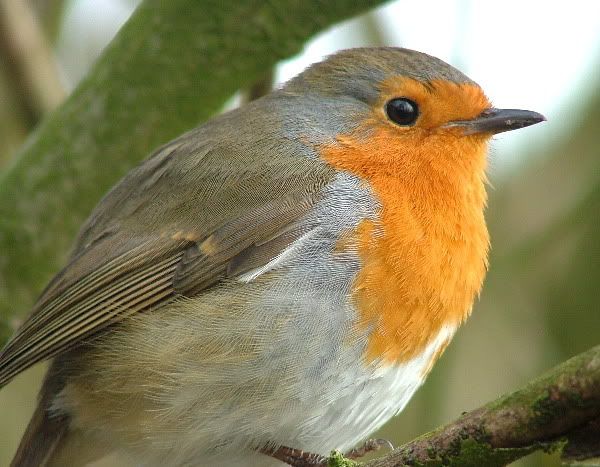
Special mention goes to the Robin (pictured), so disregarding of my presence I could flip to the macro function on my camera.
I was reading recently that catholic as the Robin's diet is, with a great range of berries, seed and kitchen scraps taken in winter, they still require invertebrates during the season and would perish without them. So in harsh weather, offering mealworms to your garden Robin could make all the difference. After all, you try searching out insects and spiders during the harshest weather of winter and discover how easy it is!

Some thumbnails of the red-breast...


Happy birding folks!

Wednesday, 12 March 2008

Aren't ABB Days Brilliant?

It's been a while since I had the time to update, so in no particular order I'll attempt a few posts to recap the past month, starting with...


...another Carsington ABB(!) event day.
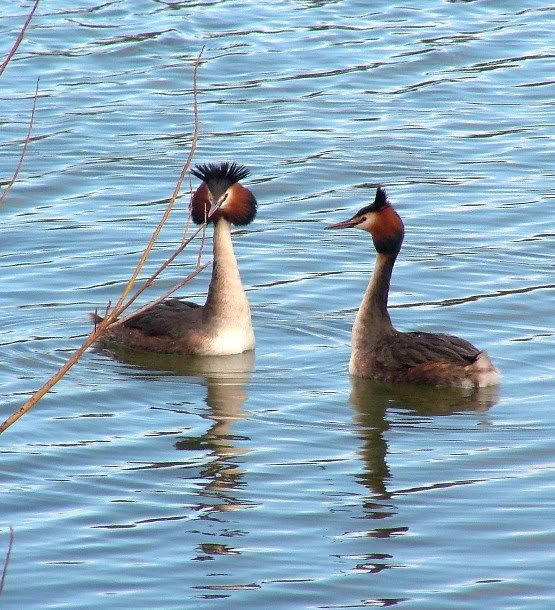
Forget the Great Northern Diver, Raven, Little Owl and Curlews, stunning as they are they made for second billing yesterday, for in front of the wildlife centre - a mere handful of yards from our big window - we had Great Crested Grebes deep in courtship, head flicking and weed* waving, the whole divine, unimaginable, shebang which they repeated throughout most of the day.

Our visitors, those who came despite a nigh hysterically bad weather forecast, were truly thrilled. With luck these birds shall nest in the willow to the left of picture (above), however there are complications. After such a beautiful display the pair were chased from the area by a feisty lone individual grebe of their own species, a real spoilsport by any measure - who wasn't above diving beneath the water to nip at the feet of our star couple. The day ended with the one bird snoozing in their place.
So what next for these grebes? Will they reclaim the willow? Can the villain of the peace attract a mate of its own? Will the Coot have the final say on who nests there? The story, as they say, is to be continued...


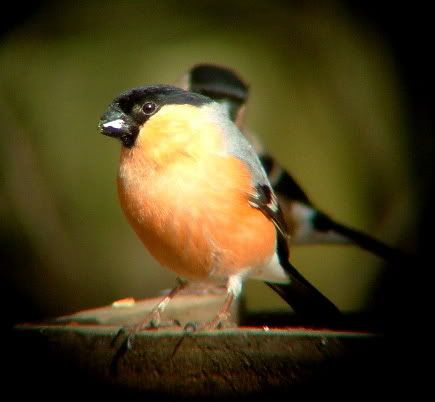
Elsewhere on the day Bullfinches queued in resplendent pink costumes at the feeding station near Lane End hide, and beside Paul Stanley hide I saw my first Chiffchaff of the season. Spring is whispering around the reservoir. Our Tawny Owl remains resident in its tree, one wing again curiously drooped as it naps the day away - it's a real sloucher of an owl we have up there.

During a previous ABB(!) event day, a charming couple told me about the foxes they'd become firm friends with. As they described feeding the animals, the couple themselves recognised the relationship was turning more toward owner/pet than watcher/wildlife, and asked for my advice. I told them that feeding is fine within reason, but failed to be more specific. Well, if you're out there I did a little reading (referring mostly to Chris Packham's excellent book 'Back Garden Nature Reserve') and if you do want to feed your suburban foxes the best practice is to make sure whatever you give them is a bonus and not a replacement for their usual diet. Do it no more than three times a week, putting the food in different places, any kitchen scraps will do. Above all enjoy watching them!


(* it should be understood that an offer of filthy pond weed equals true romance in the grebe world!)

Wednesday, 6 February 2008

Somewhere Up There

Spot it yet?

Another ABB day as Carsington has gone by, with moderate numbers of visitors through for a windy day in February. I'm pleased that our team continues to grow, and that I can also report we are exceeding our membership target. Pure joy for all of us involved.
So you tell me you're a birdwatcher? You say you aren't yet volunteering with the RSPB or local wildlife groups? Oh heavens, you are missing out!

The birdlife is beginning to alter with the early change of seasons. The Oystercatchers have returned from their winter break on the coast. They look for all the world like painted clockwork toys, so are always a winner with visitors. Redshank, Snipe, and a couple of elusive Dunlin hint that good times for wader enthusiasts are just around the corner.

Our Peregrines failed to show, though one was noted mantling a Coot at the weekend. These raptors will now be returning to their breeding territories, indeed the Derby Cathedral female is already prospecting her nest ledge, so Carsington may lose this bird's regular presence quite soon, unless a pair take to one of the nearby quarries. We can only hope!

Our Great Northern Diver remains on site, yesterday being the occasion I've seen this most enigmatic and elusive individual for several weeks. Since the girlfriend described its shark-like features I haven't been able to shake the comparison from my head. It must be worse for the fish.

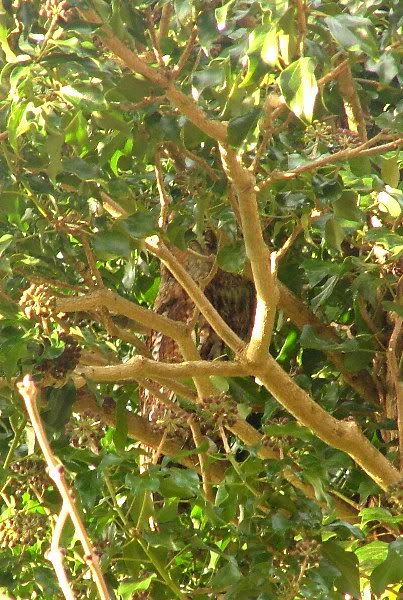
My treat for the day was taking time to pick out a Tawny Owl from the foliage of their traditional roosting tree. You can be sure they are creatures of the night because only a nocturnal species could have such a groggy appearance in the daylight, it's nothing short of comical.
The tip to finding them on a suitable a tree is to consider the time of day and the weather. In winer these birds will follow the sunlight around the tree trunk, or otherwise choose the side sheltering them from the wind. My other piece of advice; never stop searching.


So tired.

Thursday, 10 January 2008

Best of 2007

It occurred to me that I failed to make an end of year appraisal for 2007, so here's a quick best of round-up...

Best birding site visited... difficult to choose, it'd have to be the North Norfolk Coast, and those magical dawn moments of thousands of roosting Knot, thousands more commuting Pink-feet, Shore Lark below the dunes and Barn Owl quartering closer than you'd dare imagine.

Best bird seen... for rarity value, the juvenile Night Heron at Fairbun Ings in July. Rumour has it this may have been the first true wild bird of the species hatched in the UK.

Best bird photograph...

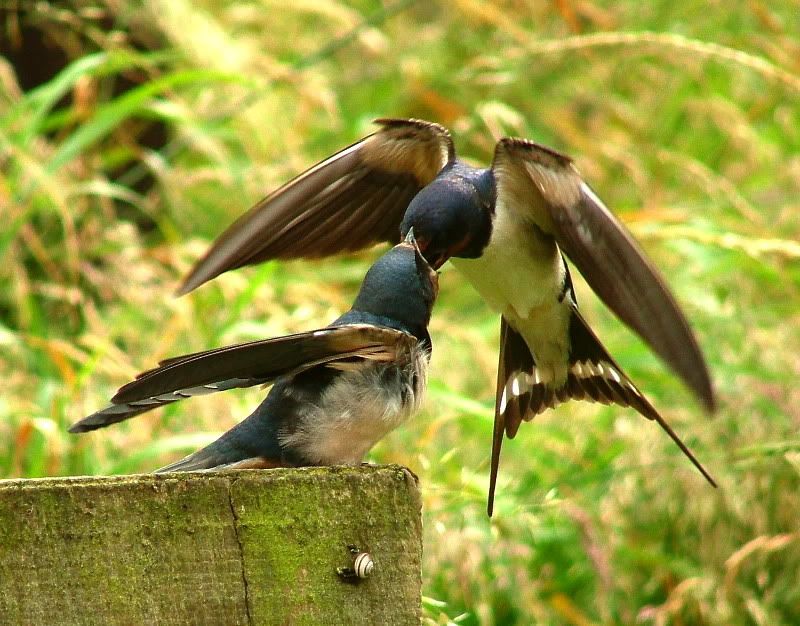
This Swallow fledgling feed at Bempton Cliffs RSPB, also in July.

Best bird video...

Barn Owl at Holkham NNR, late August.

Best local find... not a classic year, but a pair of Whinchat at Brierley Forest Park stirred interest in the place during April. They would probably breed were it not for the dogwalkers. According to BirdTrack these were earliest birds reported in my region for the year.

Best memories... too many to mention, a shortlist list would include the Starling roost near Carsington, wintry days and rare ducks at Hoveringham, Osprey days at Rutland, magical Montagu's Harrier in Lincolnshire, the Nightjars of Sherwood Forest, 3 lifers in one day with Long-tailed Skua/Sabine's Gull/Red-necked Grebe, picking up a stranded Little Auk at Snettisham, and really I could go on and on.

Best decision... getting involved with the RSPB, volunteering at their Aren't Birds Brilliant(!) events at Carsington Water in Derbyshire, where I educate the public about the RSPB, conservation and birds in general. A genuinely worthy cause, I get to watch and talk about birds all day long, and it's a great crew down there too. That moment when you see it click within a kid, the gasp and dazzle of discovery when they realise how amazing the birdlife is out there, it'll never get old.

The numbers:

190
species on the year list
18 lifers

For the foreseeable future my prediction is 2007 will be my best year for sheer numbers of birds seen. Between moving house, rising petrol prices, and the intention of greenifying my birdwatching activities, I should be cutting back on the travel for 2008/9.

Wednesday, 9 January 2008

Old Green Eyes


The sound of happy visitors!

The Carsington Aren't Birds Brilliant events continue their success, and I was on duty twice this week.
We had some pleasant weekend winter sunshine on the Sunday and how the crowds flocked in. Somewhere in the region of 600! Plenty of adults and delightfully plenty of kids too, several very eager to use our scopes. The technique I've developed is to encourage the children to describe the bird they're viewing so that I might identify the species. 'It's a big goose like bird, lots of black on its head and neck, and a bit of white on its face', that sort of procedure. They're usually very good at it, and happy to be told so!

Tuesday was quieter due to the horrendous weather and the onset of the new school term. Walkers and a handful of caravan enthusiasts made up the visitor numbers, both arriving at the centre for the indoor heating more than the birds, but I'll wager they were warmed by both.

As for the birdlife, the Great Northern Diver is still an enigmatic and elusive presence, while the regular Peregrine sets pulses racing. We're low on waders with odd Redshanks joining the skittish flock of 200-300 Lapwing. The treat of the week was the very quiet afternoon when we volunteers were able to scoot down the opposite reaches of the reservoir to view a pair of roosting Tawny Owls. Talk about childlike excitement, I found myself saying, "I saw it blink!". Oh you really can't beat a good view of a true wild owl.

The girlfriend shot the above video at the end of Sunday's event. We'd lately had a conversation over whether any of the British species of birds are ugly, and I confess, I nominated the Cormorant. That prehistoric appearance they have, they're closer to be to dinosaurs than Blue Tits, as if evolution scarcely finished the job on these birds. Sure the green shine of their plumage can be attractive in good light, but really, where was nature's artistic flair? With that said they are fascinating birds, skilled hunters of fish that will coordinate in teams of a dozen or more, and their always entertaining, if clumsy, courtship dance owes something to David Brent
Do they devastate fish numbers on inland waters? Sometimes, in isolated cases, but not at all often. Ask a fisherman and they will tell you Cormorant eat 1 kilo of fish per day, ask a birdwatcher and their answer will be half that. The truth? It probably lies somewhere in between. Therein begins an argument any conservationist would be brave to venture into. Instead, here's another marvellous Youtube video, this time we're watching the famous Li River fishermen, who've found a mutually agreeable coexistence with their Cormorants. Beautiful stuff.

Back at Carsington, in front of the Wildlife Centre Mallards were mating, while Coots built a nest and fiercely defending a territory. Roll on spring, the birds are ready!

Wednesday, 19 December 2007

Sleek Bird


Just a brief update on yesterday's ABB event at Carsington. Top bird had to be the Great Northern Diver (which has been around since November 10th). That makes this the second successive year we've had the species present. Last winter 2 or possibly even 3 birds stayed, with GND present from November through to May. Pretty neat to have this bulky marine species. It'll have come from Iceland and in the cold half of the year really belongs around our northern coasts.
Otherwise notable were two Peregrine, as usual best seen perched on the towering electricity pylons.

Visitor numbers weren't great, but should hopefully rise at the weekend with the arrival of Christmas holidays. Memorable person of the day was the lady utterly in love with Wigeon, her genuine favourite she said. There's a Simon Barnes piece in today's Times about the duck which must go someway toward explaining why - read here.

Monday, 26 November 2007

General Update

It may be cold outside at the moment, still the ABB days go well at Carsington. Tuesday was all about the schools really, with three classes through and genuine wide-eyed excitement from plenty of them. Who knew primary school aged girls could get so excited about Lapwings? It's great!
If you're a birder, go on, give volunteering a go!

43 species from the Wildlife Centre on Tuesday, then a slightly above average 50 on Sunday, means we always have something to show people. Highlights have perhaps been the Siskin with at least ten birds around. Two Dunlin, Snipe and Redshank keep things interesting wader-wise, and for the raptors Peregrine, Buzzard, Sparrowhawk and Kestrel do well for the side. A few other species moving around too, Great Spotted Woodpecker and Treecreeper notable visitors at our end of the big water.
Duck (mainly Tufted and Wigeon) and Lapwing numbers are down though, more than halved in the last few weeks. Perhaps they are dispersing to smaller local sites.

The only personal disappointment is not being able to reach the other end of the reservoir before dark once the hubbub has died down. A Ring-billed Gull is regularly coming in to roost on one specific island, reported at 15:30 practically everyday, a sure thing all the way from North America.
Ah well, stumbling down the paths in the twilight I did pick up a Tawny Owl swooping down onto the prey in a field nearby a known roosting tree. Rare sight of a common, if secretive, bird, so I'm happy.

Monday, 1 October 2007

Another ABB Day


Female Stonechat digi-video-scoped by the girlfriend.
Another briefer video.

Another fine day at Carsington, really fine actually. Is it my imagination or does weather that good normally lead to a scarcity of top birds?
The Little Owls showed for much of the ABB event, a Red-crested Pochard knocked around, beyond that Snipe were the best of it. Fortunately the bird club recently did a count and I could prattle on about the big birdtastic number of Coots (1500+ is always going to be impressive) and where they came from .

Earlier in the morning the cooler-than-cool Severn Trent rangers gave us volunteers a boat ride around the reservoir. You get a different impression of the place from the water and it was interesting to learn new things. For example, I hadn't really considered the role big reservoirs can play in flood defence, and thanks to the extensive weed and invasive non-native (but otherwise benign) mussels, the water is crystal clear!
From the boat we picked up juvenile Water Rail at the Northern tip of the reservoir, the bird bathing in shallows nearby the nascent reedbed. Now there's a big thumbs up from the avifauna for the site management if ever there was one. Also a Peregrine powered low over the water from the islands in the front of the Wildlife Centre and they are always ALWAYS enigmatic birds.

Finally, at the end of the day a quick half hour to ourselves found a Stonechat in front of the Paul Stanley Hide. It had been mis-identified as a Spotted Flycatcher by the folks already there, which I can understand as I watched it chasing flying insects from a perch atop a bush. Happily I could tell them that if anything, Stonechat are a rarer sight at Carsington as they don't breed here.

All in all, a good weekend had.