Showing posts with label yellow-legged gull. Show all posts

Sunday, 28 October 2007

Feed the Birds Day

The Jackdaw Roost?

Yesterday's events went well, Carsington again, this time Aren't Birds Brilliant x Feed the Birds Day, so all very busy and records broken for the number of names and addresses going into our visitor book. The girlfriend did a spot on job catching folks before they could leave the Wildlife Centre. She's the friendliest person in the world, you'd be a cold cold person to tell her you're not interested.

Bird-wise, highlight of the day had to be the Red-necked Grebe early on. It showed well for a while, even sailed close to a Dabchick for the ultimate comparsion and confirmation. Shame then that it was pushed away so early by a fisherman's boat, as it was never again seen for the rest of the day. Later I read a peeved comment in the log book of a hide further around the water noting how a number of fisherman had forced everything up the other end of the water. I'd feel uncomfortable about complaining though, the Severn Trent rangers do such a good job otherwise. It is the way of life that we should share reservoirs with other interests.

The other top notch bird was the Peregrine, with a spectacular display in front of the centre. First it sat sedately atop a distant electricity pylon, surveying the scene, and then action, the hunt. Off it took, all wildfowl scattered for dear life, and in came the Peregrine all muscle and streamlines, first stoop for a Lapwing - a miss, second for a Coot on the water - another miss, and back to the pylon. I kick myself now, but it was lunch break and I needed the loo. Of course, I come back later and learn it took a probable Teal right off the island in front. Damn!
Again, back to the pylon went the Peregrine to devour its catch, where we could show visitors the grizzly aftermath. The falcon is a steady show, at the moment you'll see one most days, and I'm glad because it's a good bird to talk to visitors about - fastest animal on earth and all that. One boy utterly agog at the 200mph stuff.

At the end of the day and in pouring rain, we drove to the Sheepwash car park to check up on a reported Black-necked Grebe, thinking how neat it is to say you saw 4 species of grebe in the day. To no avail (although I read one has been reported today) though, and instead we scored a Yellow-legged Gull, a 3rd-year bird - looks almost adult except it still has dirty pink legs and the black wing-tips are very large in flight - pictures below and very dark video here. Very languid it was too, lazy flight in amongst the busy flapping Black-headeds.

And the last to come in were at least 500 Jackdaw, perhaps many more, as big a flock as have ever seen, noisily commuting over Hall Wood.

Yellow-leg...

...with cormorant.

Edited to add: Seems there has been some confusion with the grebe. To confirm on my part, I'm confident we had a Red-neck in the morning - the only question was over the fairly dark bill - which could suggest an autumn Slavonian, although bird club member with us confirmed Red-neck as suggested by the heavy bill and build of the grebe. Later in the day, we also had a visitor requesting ID help on a probable Black-necked Grebe he saw at the other end of the water, which he seemed certain had no reddish/warm at all, unlike the earlier bird. Then today, we have reports of a Slav Grebe!
So how many birds at we talking about here? 1, 2 or 3? Who knows? Seems unusual for all three to turn up like that. Two? Maybe. I may now get down to the ABB event on Tuesday, check for my own peace of mind the reported Slav, should it stay, isn't the bird we had on Saturday. Moulting autumn grebes, bigger headache than you'd think!

Thursday, 13 September 2007

Carsington, Pleasley and the Green Lagoon

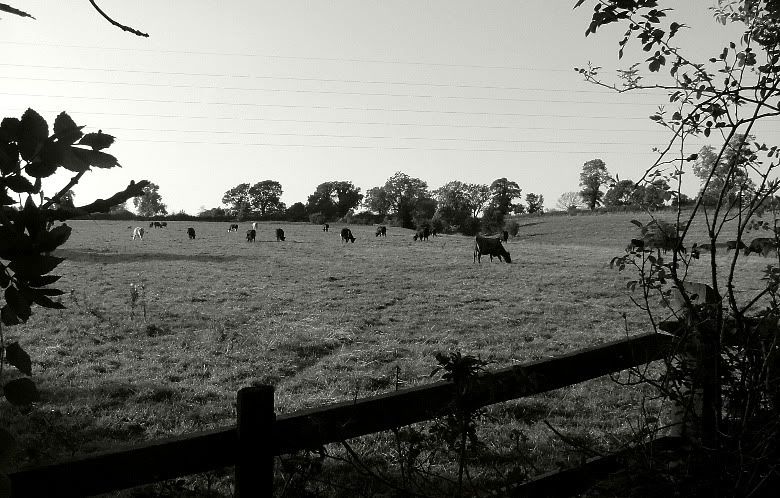
Fields beside Carsington Water

Things are settling down for me at the Carsington ABB events, a routine neatly developing. The vibe was pretty good this week, a quieter day so we could spend more time on each visitor and impress on them all things wonderful about the birds. I didn't stick around to wait for the actual figure, but it's clearly we had a fair number of people signing up not only for the RSPB newsletter, they were going for full membership too. What to say other than, SCORE!

The water level is very low at Carsington which seems at odds with the summer we've had, especially since her sister reservoir at Ogston is absolutely brim full. No complaining from us though, low levels means more exposed mud, and autumn winds permitting a plentiful area for passage waders to feed. That said, the only waders we had on Tuesday were Lapwing and one elusive Green Sandpiper.
Up on the hillside the Little Owls dutifully showed well through a scope, a cosy threesome of eclipse Red-crested Pochard kept in broad view (with at least two more males spread elsewhere), a juvie Common Tern briefly passed through, a pair of Raven showed over distant woodland and a female Shoveller was a blink and you missed it bird for the day list. We ended with 42 species from the Wildlife Centre, which is a about par.


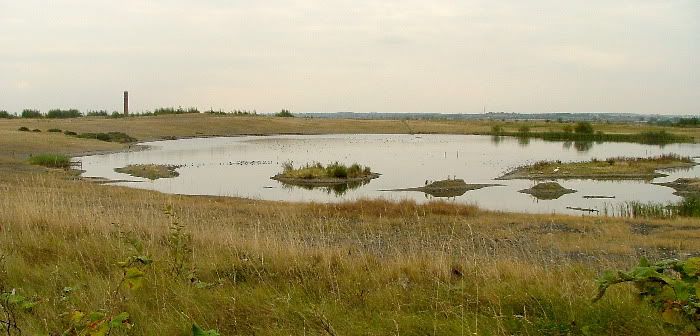
Pleasley Pit

Back at home the local rounds on my bike turned up a Yellow-legged Gull at Pleasley Colliery Nature Reserve. The small lake up there has always been a hotspot for local rarities, although these days with increased visitor numbers - mostly dog-walkers - the nearby birding fraternity seems to have rather turned interests away from it, many grumbling of the constant disturbance. For me it's a pleasant bike ride and at the site I've picked up Ruff, Wheatear, Yellow Wagtail and Little Ringed Plover, so it's clear to my mind it's still worth a regular look, and I think quite under-watched. For the two years I've been visiting I could count on the fingers of one hand how many occasions somebody has been in the members-only bird-hide.


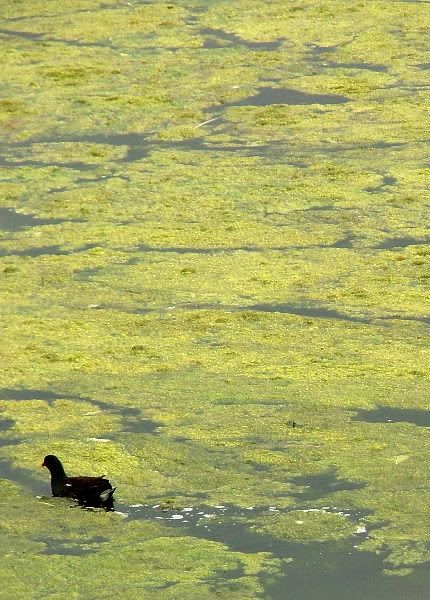
On the other side of town King's Mill Reservoir looks in poor health with another summer bloom of algae. I'll let some minutes from a local council meeting explain the problem:

'Ashfield is not noted for having many large bodies of water, which makes it all the more important that we conserve and protect those few that we have. In Northern Ashfield the past few years have seen a massive problem arising due to repeated seasonal growth of algae, in Kings Mill Reservoir for example, and this problem has repeatedly to be coped with.

The problem arises because of an upset to the very delicate balance between algae, fish, and bacteria in the water. These three denizens of natural water depend upon each other in a triangular relationship which can be upset by pollution.

Algae -- a collection of microscopic plants -- use sunlight to photosynthesise food from nutrients. These nutrients are provided by the bacteria in the water which act upon the waste products from fish, converting them into a form which the algae can use as food. In turn the algae provide food for the fish, and they also serve both the fish and the bacteria by oxygenating the water as a by-product of their photosynthesis.

THE IMBALANCE

What causes the upset is that additional nutrients get into water through pollution, and this causes massive growth of the algae, producing what is often called an algae bloom. This can spread over the surface of the water, and can be made worse by the growth other surface plant life.

It might be thought that this is actually a good thing, for after all it provides more food for the fish, which might therefore be expected to thrive. Such is indeed the immediate effect, but it does not last. The algae grows to such an extent that there is too much of it, with layers of algae growing below other layers. The upper layers of algae shelter the lower layers from sunlight, and the latter cannot therefore photosynthesise their food. They they die. The bacteria in the water then act upon the dead algae, and in the process they use up masses of oxygen from the water.

This de-oxygenation caused by the action of bacteria upon the dead algae obviously results in the death of the fish, which needs that oxygen. The dead fish sink to the bottom, where further bacterial action changes the dead matter into sludge, and further depletes the water of oxygen.

This sludge can, in extreme cases, turn what was once a living pond or lake into actual swampland.'


Periodically new aerating rafts have been placed in areas where road run-off and other sources of pollution reach the reservoir, though clearly that measure just doesn't work well enough. Looks like there are no easy answers to this problem.

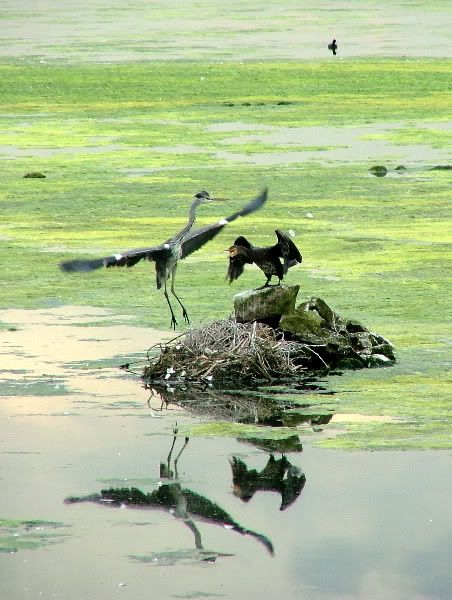
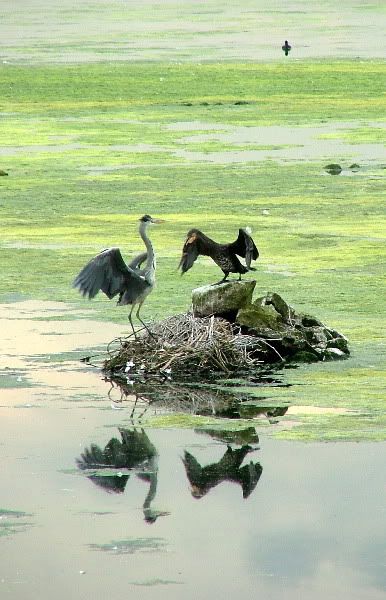
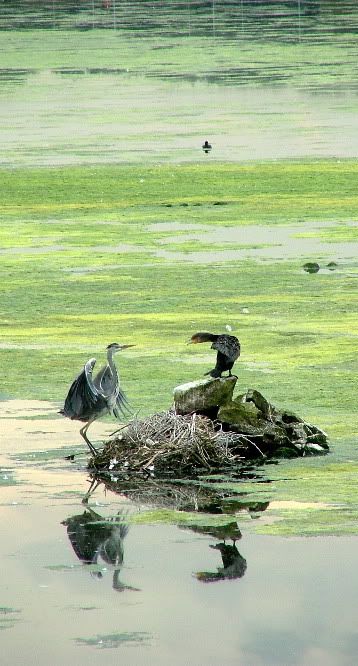
For now the bird life can tolerate the algae, although it has been quiet this week. The best bird yesterday was a Snipe for example. Still if you have birds you're never short of action, and the highlight was a meeting of minds between a Cormorant and a Heron...


In the end, the Cormorant won.

Wednesday, 22 August 2007

The ABB Diaries

Aren't Birds... great?

They are and I'm on bird high after two marvellous days volunteering at Carsington Water. It's difficult to put a number on how many people we showed the birds to, probably over 200 on both days (we'd have many more with nicer weather), and as ever the Little Owls were a hit.

During the quiet times I was thinking about the word wonder, and settled my mind that one defintion must surely be 'that something which we would never be able to imagine for ourselves'.
If you didn't know about very much of the Little Owl, would you ever imagine that owls could chill out in open all day long, or imagine a wild creature could bear such uncanny resemblance to a fluffy toy, or even imagine you'd see one of these fantastic creatures today?
For me, that's one dimension to wonder, and I think it's why the people go 'wow'.

Back to yesterday, and something special dropped in to the island in front of the Wildlife Centre. After brief rumination with other volunteers I made the call, one Dunlin and as companion, one Little Stint, which jizz-wise is how they struck me first. Very small, black legs, plumage on the back that always gives me the impression of a tortoise shell, otherwise very light, and it's August, all amount for a bird fairly obvious on immediate sight. The partnering Dunlin helped IDing too, indeed I think all passage waders should be required one!
Later in the day I met the recorder for Carsington Bird Club, and he told me this was the first Little Stint found on the reservoir for 3 years. I was surprised, and then he explained they formerly had many more before that, but that with water levels generally higher now the muddy fringes aren't what they used to be.

Other best birds were a juvie Sparrowhawk, looking somewhat bewildered stood on a rocky mound on one of the wader islands - a great bird to show visitors, and in one of the reservoir's several creeks a family of four Spotted Flycatcher. My first for the year (#175), and there I was thinking I might not see any this summer. Apparently they breed up in the hillside woodlands around the water.
Finally, a Yellow-legged Gull, probably a 3rd-year bird judging by some untidiness in the plumage and a slight dullness to those famous legs. Carsington has a small number of the species coming in each evening at present, they follow other gulls into the mainly Lesser Black-backed roost.

And for anybody reading this, if anybody reads this, the Aren't Birds Brilliant(!) event days at Carsington (run by the RSPB and Severn Trent Water) continue throughout the year on Sundays and Tuesday. Come and drop in one day!


One for the Distinctly Dodgy Digiscoping DVD? That's the Yellow-leg late on, and at least gives you something to look.