Showing posts with label Ogston. Show all posts

Friday, 25 January 2008

BGBW Reminder

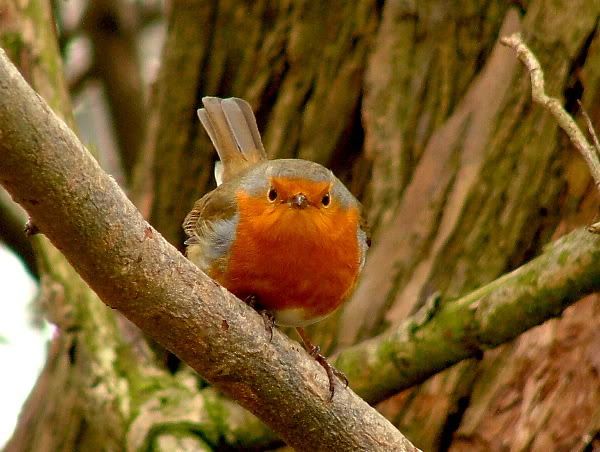
Take part because the testy Robin says so!

Just a reminder to everybody that this weekend (26th-27th Jan) is the RSPB's Big Garden Birdwatch - your chance to participate in the huge national bird census the conservation charity organises annually. Check out the website for more - an hour is all it takes and time spent enjoying the undervalued wildlife we all have out there the other side of the kitchen window, all of it contributing to the RSPB's understanding of the influences affecting bird populations.
I'll post my results on Monday.

In other news, my birding activities have taken a backseat to the house-hunt for now. As a reward for last weekend's endeavours the girlfriend gave me 30 minutes at the Ogston Reservoir gull roost. Time well spent as one of those lovely mottled marble 1st-winter Glaucous Gulls (like this one) settled in the ranks.
He'll be an inland wanderer spending the winter feeding at local rubbish dumps, and hatched last year probably somewhere in Greenland. Isn't it wonderful what faraway birds turn up Britain?

Interestingly, a chap told me the Iceland Gull I saw on the 1st of the month, is potentially a Kumlien's Gull, the Canadian subspecies and a much rarer vagrant to Britain (1 or 2 per year in my region). The ID differences are small (these gulls have faint markings on their wingtips rather than pure white), and it's a fine judgment I couldn't make for myself with adequate confidence. The reappraisal came from club members at Ogston.
For me, perhaps it's bad birding to dismiss worries over the exact identification but I can live by just letting these things go from time to time. Among all the regular gulls, it sure was a shimmering stunner.

Wednesday, 2 January 2008

Derbyshire Does It Again

Happy New Year!
It's be grand old start to 2008 for me. With a little local knowledge and the defiant will to ignore a particularly groggy head and get up early on the Bank Holiday, I scored with 2 lifers yesterday.
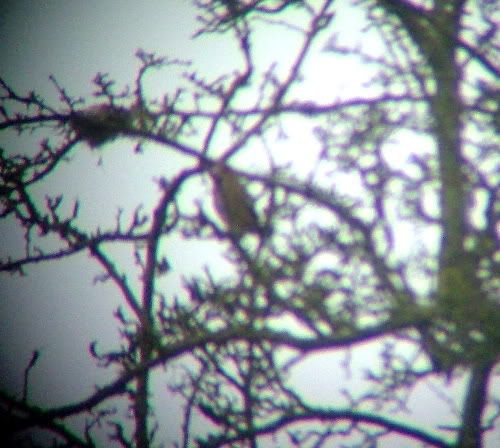
Click the image to enlarge and trust me, it's a Hawfinch.
View a real photographer's effort here.

I should be ashamed posting such a poor picture. I swear, if I take a worse bird photograph all year long I should be very surprised. It's a Hawfinch down by Cromford Canal. That's been a traditional location for this impressive and elusive finch for a number of years now, news which has clearly spread as more than a dozen birders where searching for them on New Years Day. Every one of them, I believe, left having had good views too.
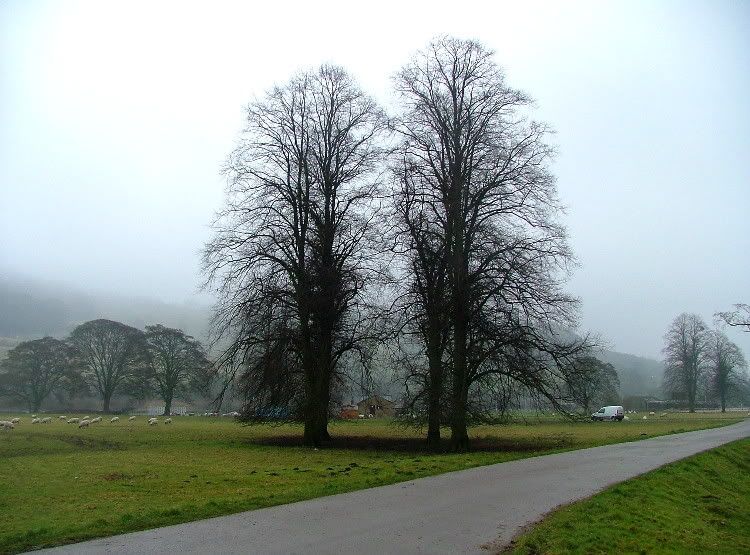

The best spot for them were these tall beech trees nearby the car park, with 3-5 birds staying mainly in the higher branches, though the Hawfinches were occasionally enticed to the ground by the bolder Chaffinches already feeding down there. These sights only occur in winter as you would so well to see Hawfinch come to earth at any other time of the year. Spring, summer and into autumn, they feed high in the canopy and are hidden by foliage.

Overall the conservation status of Hawfinches is very positive in Europe, recent analysis suggesting a boom, indeed an increase of 658% across the continent between 1980 and 2005. Wow!
Yet the news in the UK seems less positive, with a decline in most breeding areas.

The bird itself is unmistakable once you find it, and beyond the obvious - that enormous nutcracking bill, the bulky size and peachy tones, it was the black mask that struck me. There's something almost Dick Whittington about the way it looks.

Elsewhere along the canal, 14 Dabchicks along a couple of miles afforded very close viewing, with one quite bizarrely eager to take the bread visitors were throwing to the ducks. Surely this cannot be healthy for a species evolved to feed on aquatic insects and small fish?

Other bird species along the canal included Jay, Great Spotted Woodpecker, Goldcrest, Nuthatch, Grey Wagtail (around the water treatment works) and Coal Tit. So far as other wildlife goes, Cromford is most famous for Water Vole, and I very clearly remember how easy they were to see chugging along the canal when I was a child. Now in 2008, we only saw a dead one drowned on a steep banked length of the canal (I'll save you the photograph), and I hear that they've dropped in number big time in the last several years. It's very sad for me, because I'm still young and yet I can already say I remember when...

My other lifer of the day was an Iceland Gull at Ogston Reservoir. Again, a traditional site, with upto 15,000 gulls roosting in the winter on those waters, a few of the rarer species are always going to turn up. So with the Black-headed, Lesser and Great Black-backeds, Herrings and Commons, in came a superb 2nd-winter Iceland Gull. A beautiful, largely white bird, with warm brown speckles, gull species just don't get anymore attractive.
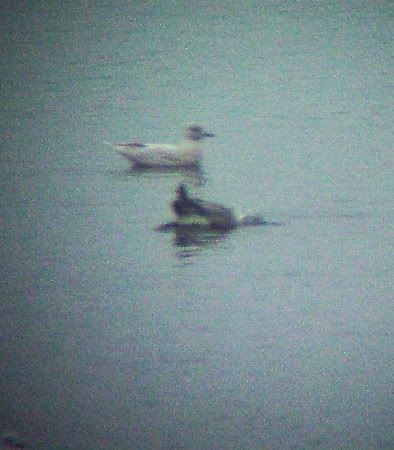

A murky video of a gull not from Iceland!

Check out the white wingtips on the bird at the back - always means something a bit special in the UK.


Ironically, Iceland Gulls do not breed in the country that gave them their name. Instead most seen in the UK will originate from Greenland. They rare inland and are most numerous on the coasts of NW Scotland, but a few dozen birds will always turn up on reservoirs in the midlands, just like Ogston.
The girlfriend was tired so we left while more gulls were heading in, apparently Glaucous and Mediterranean Gull arrived later on. However we did see a pair of Pink-footed Geese, associating with the Canadas in the surrounding fields.

So that's two new UK species for me, in one day, within hardly 30 miles of driving. I'm a happy birder!

Video 1 - Dabchick eating bread
Wednesday, 17 October 2007

Pinkies

Just booked a weekend away in Norfolk for mid-November, staying at a place right on the doorstep of the RSPB's reserve at Snettisham. The B&B was a bit steep, but you gotta do the wader roost sooner or later.

Quiet times otherwise, the ABB events are going nicely at Carsington. The Little Owls failed to show at the weekend, however a Kestrel blessed us with about two hours spent sat on the camera pole in front of the wildlife centre. That meant I could prattle on about how the Kestrel's ability to see ultraviolet light allows them to track the urine scented trails of the small rodents they prey on (more on that here), which seemed to particularly impress the visitors I spoke to.

Bird of the day, or birds shall we say, was the 150+ Pink-feet that flew over around one in the afternoon, heading SE. This is apparently a little late, as the bird club report for September explains, "southward records are usually 2hrs after first light, which is the flight time from the Lancashire feeding grounds of Marshside and Martin Mere. Their northward journey is usually at least 4hrs after first light Jan-Mar, reflecting the hundred miles from Norfolk".

Later still, on the way home the girlfriend and I stopped off for a quick scan of Ogston Reservoir. It was there at 17:35 came a lone grey/brown goose, not a Greylag, another Pinky! Must have been a straggler. Isolated and nervous, it made several low passes over the water though never with the confidence to land, and bizarrely made three attempts to merge with 200 airborne Lapwing, presumably such was the bird's instinct to flock.
Eventually, I lost sight of it as the gloom of the autumn evening set in.

Can hardly wait now for Norfolk, it'll be the same geese, but by the tens of thousands.

ETA: Incidentally, the Gannet mentioned in my last post, the one I missed by half an hour or so at Carsington. I read that on Monday this week a juvenile Gannet (surely the same bird this far inland), was discovered and taken into care in Mansfield, less than a couple of miles from my home. What a tease that bird has been for me!
Good to know it'll be looked after now.

Tuesday, 4 September 2007

Brief Roundup

It's a been a quiet week, the highlight was a Raven being mobbed by a pair of Sparrowhawks at Ogston Reservoir. Doubly exciting for me because I cycled out there, making the big crow #108 for my carbon neutral list.
You know it sure is fun to be keeping a new lifelong list I can regularly add to, well, at least for now.

As part of their eastward spread, that area of central Derbyshire is a great spot for Raven, just enough upland and just wild enough too for a thin breeding population. It has to be thin really, Raven territories are BIG and they keenly exclude all others of their own species.

Otherwise, like I say, very quiet, so I'll direct you to an interesting blog entry about Blue Tits feeding their chicks brain food - spiders containing an amino acid called taurine, which helps to develop the mental faculties of the young. Read more here, it's one of those, who'd of thought(?) pieces of research.

Saturday, 31 March 2007

Shrike it Lucky!

A good couple of days for us, best bird undoubtedly being the Great Grey Shrike at Ogston Reservoir, Derbys. Whatever the books might say about Shrikes perching atop bushes is wrong! Elusive is hardly the word, skulking barely covers it any better, nonetheless we did get two decent views of the bird in flight. It looked a little smaller than one might expect, but otherwise unmistakable.
Our sympathies went out to an older couple of local bird club members, they arrived two minutes after the Shrike gave the only half hour showing of the day, and promptly thereafter searched hard, so hard they tired and retreated to their car for a nap. As you might imagine, this was when the bird was again visible. There's a moral in that somewhere.
Seemed like plenty of other birders attracted by reports of the Shrike missed out too as for much of the day it remained deeply in a thicket. It is perhaps very telling that for a regional mega that's been around for a couple of weeks now the only photograph of it is very distant indeed. If that doesn't impress, I'm happily quoting the local bird news websites that say it's the first Shrike on site since 1978, so perhaps you'll forgive my boasting?

Also got my first Little Ringed Plover of the year, to go with the Wheatear I found at the old pit yesterday. Good time to be out and about anywhere.
