Tuesday, 12 February 2008

Lathkill Dale

What unseasonal warmth! Did we sleep away the winter so quickly?

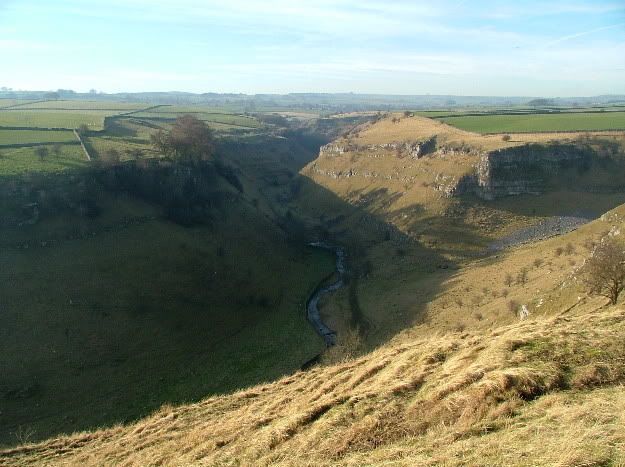
Well, I can tell you, it remains chilly of a morning down in the Derbyshire Dales. With my free weekends rapidly running out, the girlfriend and I chose a walk new to us, up and back down Lathkill Dale in the heart of the Peak. For a Sunday it was hardly busy, so the scarcity of birds was somewhere toward surprising. Two pairs of Dipper were skittish dazzlers, and the odd languid Buzzard sailed over late morning, beyond that Great Tits, Robins, Goldcrest and Song Thrush added birdsong to the atmospheric mists. Something about the acoustics up there, the slightest twitter is so rich!
Grey Wagtail were a notable absence, I suppose still huddling for warmth down on the broader reaches of the river where the sunshine can find them.

And now for something completely different... walking my niece to the park yesterday I observed behaviour from a pair of Carrion Crows quite new to me. One of the birds was eagerly pecking under the guttering of a house along the street, making me half-wonder whether it was searching for the eggs of early nesting sparrows. No, that wasn't it. Peck, peck, the crow grabbed and pulled out an enormous cob sandwich! Almost immediately thereafter in came the second bird, chasing away what was evidently an intruder raiding the food stash of the resident pair. It must have been watching them store the items there.
Of course I never have my camera when I really need it.
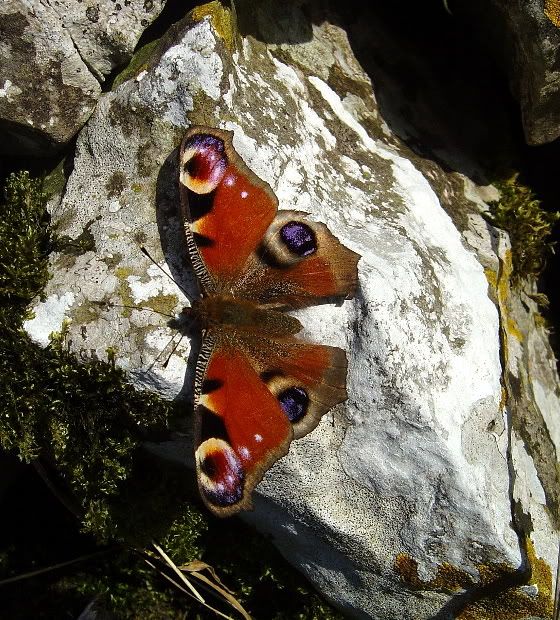
Back up Lathkill Dale, along the ridge above the valley, my first butterfly of the year, a stately Peacock for the Peaks.

Friday, 8 February 2008

Fudge Duck

I forgot to mention the Ferruginous Duck from last week (Fudge Duck for those unwilling to risk the pronunciation). The bird was found on the lake at the old American Adventure Theme Park, near Ilkeston. The site is fenced off these days and patrolled by heavies from a security firm which I'm told erected signs reading "NO BIRDWATCHING". To say the least it wouldn't be on my hit parade of birding destinations, but this duck is special, and a smashing find.

Closely related to Pochard and Tufted Duck (species they closely associate with), Ferruginous Ducks breed chiefly in wetlands north of the Black Sea and winter in north Africa or areas south and west of the Sahara, with smaller populations in France and Spain. Their numbers are crashing as their breeding habitats are drained for farming, so they are set to become an even rarer sight for UK birders. Up to 10 birds a winter reach Britain now, but in the future, who knows?

There is one other thing I should mention; Ferruginous Ducks are popular among wildfowl collections and birds from zoos, bird sanctuaries, etc, do go a-wandering wild in the UK. This means birdwatchers are always likely to discuss the natural origins when an individual turns up. Now this Derbyshire bird arrived in winter, is notably shy, exhibiting all the behaviours of a wild duck, so a 'true' vagrant it is.

They are best identified by their white bottoms as no other wild duck in the UK has anything to confuse it by. Beyond that Ferruginous Duck males like this one have a wonderfully rich colour, a chestnut brown that shines purple in the sun. Even at 200 yards, it was gorgeous. A picture can be seen here.

I bet that duck is still drawing in many a birder, relocated as it has to the smaller waters of Loscoe Dam.

In other news, the home patch I've been neglecting still harbours results. At King's Mill Reservoir a Water Rail was showing well, always smaller than you think, and the electric blue flash Kingfisher shot by me. The only sad news I have to report is the probable loss of a Barn Owl, the lifeless white lump seen lying on the surface of the dual carriageway under which a pair had successfully nested last year. The truth is, this tragedy always seemed likely.

Wednesday, 6 February 2008

Somewhere Up There

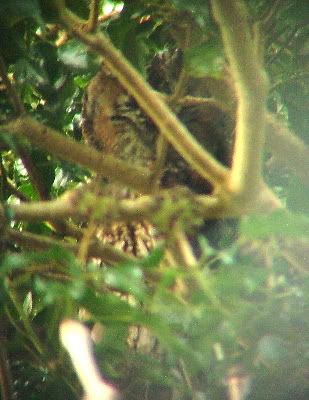
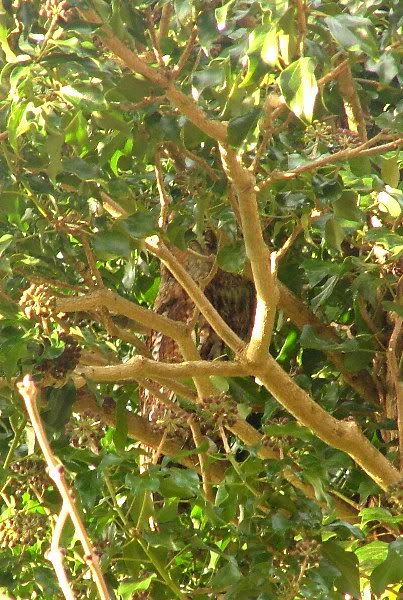
Spot it yet?

Another ABB day as Carsington has gone by, with moderate numbers of visitors through for a windy day in February. I'm pleased that our team continues to grow, and that I can also report we are exceeding our membership target. Pure joy for all of us involved.
So you tell me you're a birdwatcher? You say you aren't yet volunteering with the RSPB or local wildlife groups? Oh heavens, you are missing out!

The birdlife is beginning to alter with the early change of seasons. The Oystercatchers have returned from their winter break on the coast. They look for all the world like painted clockwork toys, so are always a winner with visitors. Redshank, Snipe, and a couple of elusive Dunlin hint that good times for wader enthusiasts are just around the corner.

Our Peregrines failed to show, though one was noted mantling a Coot at the weekend. These raptors will now be returning to their breeding territories, indeed the Derby Cathedral female is already prospecting her nest ledge, so Carsington may lose this bird's regular presence quite soon, unless a pair take to one of the nearby quarries. We can only hope!

Our Great Northern Diver remains on site, yesterday being the occasion I've seen this most enigmatic and elusive individual for several weeks. Since the girlfriend described its shark-like features I haven't been able to shake the comparison from my head. It must be worse for the fish.

My treat for the day was taking time to pick out a Tawny Owl from the foliage of their traditional roosting tree. You can be sure they are creatures of the night because only a nocturnal species could have such a groggy appearance in the daylight, it's nothing short of comical.
The tip to finding them on a suitable a tree is to consider the time of day and the weather. In winer these birds will follow the sunlight around the tree trunk, or otherwise choose the side sheltering them from the wind. My other piece of advice; never stop searching.


So tired.

Monday, 4 February 2008

The Great Survivor

Ever hear the one about the timid Blackbird? So scared of cats he went completely...

White!

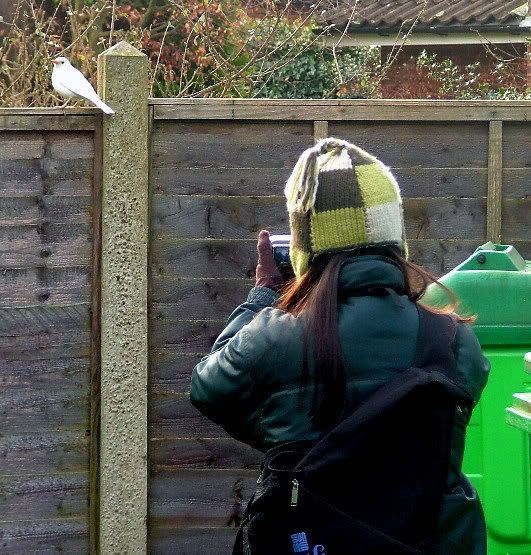
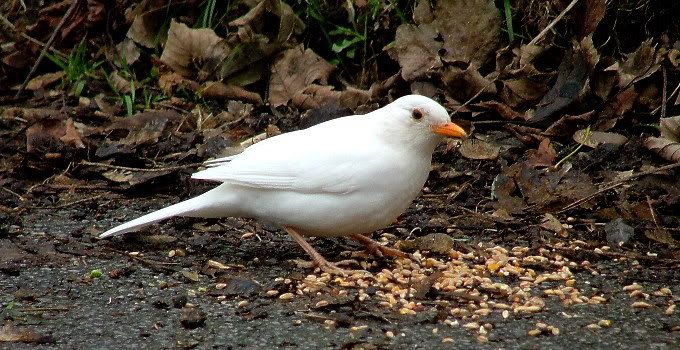
Okay, not really. He's what the experts call an 'albinistic' Blackbird, a partial albino to the rest of us (complete albinos have bizarre pink eyes - like this fledgling sparrow). Some family of mine noticed him last week during a non-birding visit to Rufford Country Park. I knew there had been infrequent reports of a 'Whitebird' at the site since it was discovered in Feb '06 - that makes him at least 3 years old - so quite the survivor. Conventional birdwatching wisdom suggests these eye-catching birds are a more conspicuous target for predators such as Sparrowhawk, a theory which makes his continued presence all the more remarkable.

Here's a brief explanation on how albinism occurs in birds...

Pure albino birds lack pigmentation and because feathers are made from keratin, which is naturally whitish in colour, their plumage is white. The absence of pigmentation also affects eye, leg and bill colour - the eye and legs appear pink owing to the blood vessels showing through, and the bill will be whitish. As well as pure albinos there are partial albinos which simply have a few white patches on their plumage or have white plumage but retain their proper eye or leg colour.

Albinism is usually a genetic condition that causes the absence of pigment, but may also be caused through malnutrition, parasites or injuries. A common belief was that too much white bread was the cause of albinism, but this is not the case. Albinism of varying degrees is quite common in Blackbirds.

from garden-bird.co.uk

In addition, I wonder if these birds are perceived as an unattractive partner by other Blackbirds. Perhaps he therefore avoids the stress, dangers and energy expense of raising a brood each year. Pure speculation on my part, I really have yet to read any research on the matter.

The bird itself is a real show off, posing almost as if aware of his glamour...

The girlfriend takes a picture.

A little donation to his upkeep.


The video: An everyday bird made glorious by the great lottery of life - genetics.

Rufford is itself a pleasant birding destination. True enough that genuine rarities are unlikely to turn up, but Hawfinches can be a notable presence in the car park during winter mornings, and during our visit all the regular woodland species showed, Nuthatch, Chaffinch, a small number of Siskin, many affording very close views. On the lake Great Crested Grebe and Tufted Duck, while Buzzard have also spread to this part of the county and can be seen overhead.

A couple of thumbnails from the day...
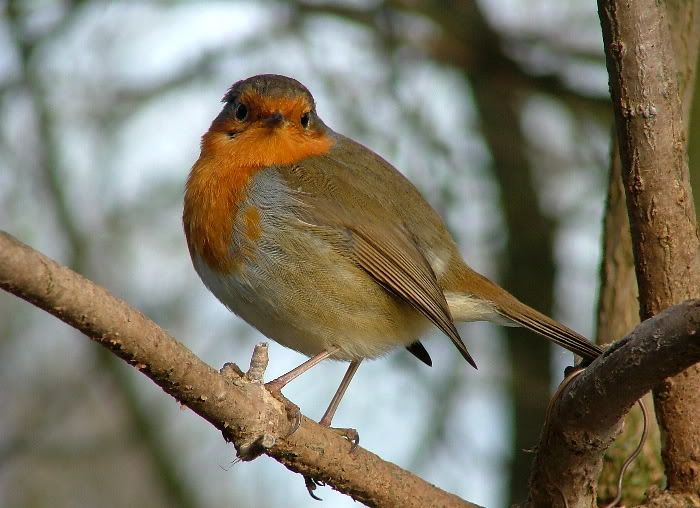
Robin

Rufty Tufty


Happy birding everybody!

Friday, 25 January 2008

BGBW Reminder

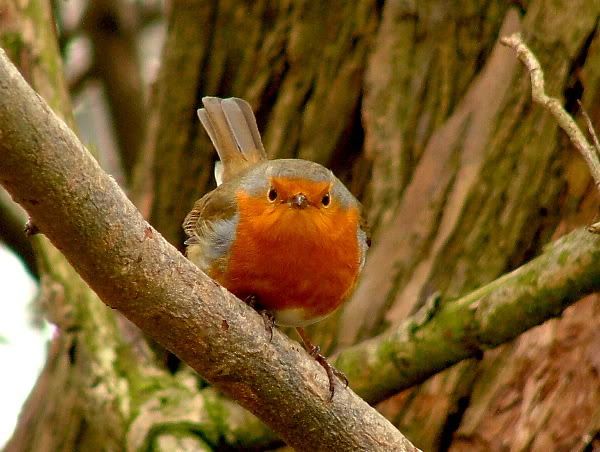
Take part because the testy Robin says so!

Just a reminder to everybody that this weekend (26th-27th Jan) is the RSPB's Big Garden Birdwatch - your chance to participate in the huge national bird census the conservation charity organises annually. Check out the website for more - an hour is all it takes and time spent enjoying the undervalued wildlife we all have out there the other side of the kitchen window, all of it contributing to the RSPB's understanding of the influences affecting bird populations.
I'll post my results on Monday.

In other news, my birding activities have taken a backseat to the house-hunt for now. As a reward for last weekend's endeavours the girlfriend gave me 30 minutes at the Ogston Reservoir gull roost. Time well spent as one of those lovely mottled marble 1st-winter Glaucous Gulls (like this one) settled in the ranks.
He'll be an inland wanderer spending the winter feeding at local rubbish dumps, and hatched last year probably somewhere in Greenland. Isn't it wonderful what faraway birds turn up Britain?

Interestingly, a chap told me the Iceland Gull I saw on the 1st of the month, is potentially a Kumlien's Gull, the Canadian subspecies and a much rarer vagrant to Britain (1 or 2 per year in my region). The ID differences are small (these gulls have faint markings on their wingtips rather than pure white), and it's a fine judgment I couldn't make for myself with adequate confidence. The reappraisal came from club members at Ogston.
For me, perhaps it's bad birding to dismiss worries over the exact identification but I can live by just letting these things go from time to time. Among all the regular gulls, it sure was a shimmering stunner.

Friday, 11 January 2008

Is Birding Bad for the Environment?

Here's an interesting article from The Times...

A lungful of carbon delusion

How are we to deal with climate change? If you had asked that question 10 years ago the answer would have been simple: plant lots of trees.

If, however, you had asked that same question four years ago you would have been told that nuclear energy and wind farms were the solution. More recently still you might have got yet a third set of answers: biofuels, carbon capture and trading.

...continued


Give it a chance as it goes on to explain the fashionable five minute answers to climate change, carbon sequestration, nuclear energy, etc, for the fallacies they are. It also has harsh words for conservation groups, indeed it mentions the RSPB by name, and I'm vexed because its criticisms are entirely valid. The society does encourage car travel, its magazine is dependably full of advertisements for long-haul birdwatching holidays, while inside in the news pages the dangers of climate change could form an omnipresent headline.

Closer to home I think about all the birdwatchers I know. Most weekends they will be travelling by car, often to sites flung across all regions of the UK, and I begin to wonder, is birdwatching as an activity really such good news for wildlife conservation? We commonly use private transport far more than people who could scarcely give a damn about wildlife, the of which irony sticks out like a saw thumb, and a particularly unwelcome saw thumb at that.

It is abundantly clear to most of us now that carbon emissions influenced climate change has to be the greatest concern for all conservationists. Saving those coastal lagoons today may mean very little when the sea has claimed them in 50 years time, rainforests in South America are already suffering severe drought as weather patterns change, we know the list of conservation projects imperilled by climate change has the potential to be endless. This is why in certain quarters expeditions like The Biggest Twitch can receive such unquiet derision. During 2008 a former RSPB warden plus partner shall fly all over the globe, carbon footprint and all, hoping to break the record for number of species seen in a calendar year, and they do this in the name raising 'awareness' for conservation issues (that bang you just heard was your jaw dropping on your desk).

Clearly we're not all quite as deluded as the Biggest Twitchers, and yet, so many of us will think nothing of regularly driving 50 miles to see some admittedly charming birdlife. With a million RSPB members, maybe 3 million more people birdwatching every year, this all adds up. Fearing that they are a growing influence on carbon emissions and climate change George Monbiot uses the term 'love miles' to describe the flights and car journeys we undertake to see friends and relatives . In a similar capacity, the phrase ethical birdwatchers may need to begin thinking about is 'bird miles'.

Surely this makes it time to reined in our bird miles, and enjoy our local birds for the beautiful natural heritage they are. What is the other option? To continue down the path we're on, encouraging mass transit to top bird sites, ultimately beckoning closer potential oblivion for simply countless numbers of species in the UK and around the world.

'Bird miles' may be a drop in the ocean, infinitesimally insignificant in the face of India's new model car or China's new model coal-fired power stations. But where do we make a stand? There could be no more idea place to begin that with our choice of leisure, should we find it pollutes beyond reason, even if that includes birding. This does not mean the end birding, we all still have kitchen windows.

This month the RSPB heavily promotes the Big Garden Birdwatch, a great exercise indeed. It campaigns to save the albatross, the Sumatran rainforest, the Aquatic Warbler in Poland and fights the expansion of Lydd airport.
Is it time for the RSPB to begin encouraging away from our cars, to make more of our local areas, dare I say, limit our travel?

I can hardly imagine a message members would want to hear less. What to do folks?

Thursday, 10 January 2008

Best of 2007

It occurred to me that I failed to make an end of year appraisal for 2007, so here's a quick best of round-up...

Best birding site visited... difficult to choose, it'd have to be the North Norfolk Coast, and those magical dawn moments of thousands of roosting Knot, thousands more commuting Pink-feet, Shore Lark below the dunes and Barn Owl quartering closer than you'd dare imagine.

Best bird seen... for rarity value, the juvenile Night Heron at Fairbun Ings in July. Rumour has it this may have been the first true wild bird of the species hatched in the UK.

Best bird photograph...

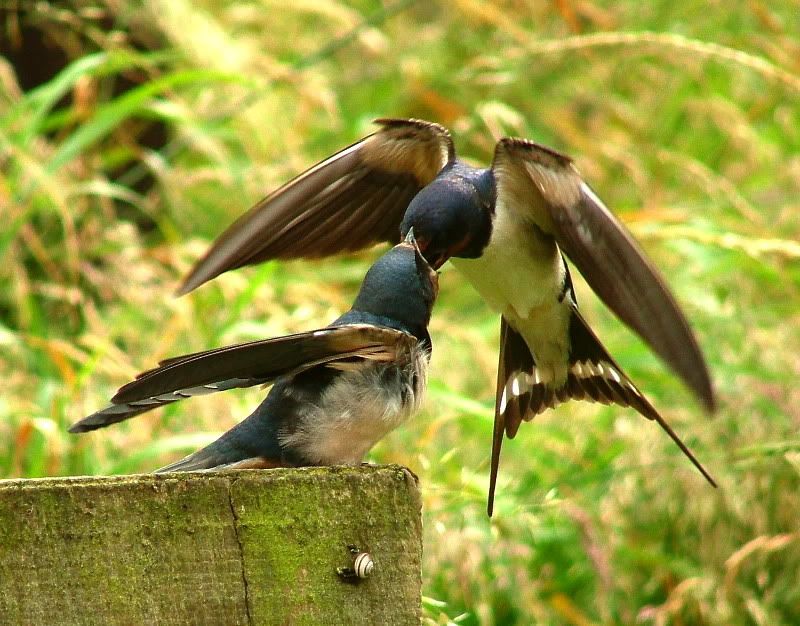
This Swallow fledgling feed at Bempton Cliffs RSPB, also in July.

Best bird video...

Barn Owl at Holkham NNR, late August.

Best local find... not a classic year, but a pair of Whinchat at Brierley Forest Park stirred interest in the place during April. They would probably breed were it not for the dogwalkers. According to BirdTrack these were earliest birds reported in my region for the year.

Best memories... too many to mention, a shortlist list would include the Starling roost near Carsington, wintry days and rare ducks at Hoveringham, Osprey days at Rutland, magical Montagu's Harrier in Lincolnshire, the Nightjars of Sherwood Forest, 3 lifers in one day with Long-tailed Skua/Sabine's Gull/Red-necked Grebe, picking up a stranded Little Auk at Snettisham, and really I could go on and on.

Best decision... getting involved with the RSPB, volunteering at their Aren't Birds Brilliant(!) events at Carsington Water in Derbyshire, where I educate the public about the RSPB, conservation and birds in general. A genuinely worthy cause, I get to watch and talk about birds all day long, and it's a great crew down there too. That moment when you see it click within a kid, the gasp and dazzle of discovery when they realise how amazing the birdlife is out there, it'll never get old.

The numbers:

190
species on the year list
18 lifers

For the foreseeable future my prediction is 2007 will be my best year for sheer numbers of birds seen. Between moving house, rising petrol prices, and the intention of greenifying my birdwatching activities, I should be cutting back on the travel for 2008/9.