Showing posts with label conservation. Show all posts

Friday, 11 April 2008

In the news...

There's no bad time for good news, and here's some of the best...

The miracle in Madagascar – a blueprint for saving species By Steve Connor, Science Editor

Friday, 11 April 2008

The Independent

A study aimed at preventing the continued destruction of wildlife in Madagascar is being heralded as a scientific triumph that could act as a blueprint to save many other species from mass extinction.

continued...


The gist of it is that protecting the world's great biodiversity hot spots may now include comprehensive techniques which include action plans for the ecosystem rather than a handful of popular species (as has been the modus operandi in many situations). More than 2,000 different species were surveyed for the project and all that information fed into a computer model which alerted the conservationists to where their resources would have the greatest consequence. And it worked!

How cool is that?

Friday, 11 January 2008

Is Birding Bad for the Environment?

Here's an interesting article from The Times...

A lungful of carbon delusion

How are we to deal with climate change? If you had asked that question 10 years ago the answer would have been simple: plant lots of trees.

If, however, you had asked that same question four years ago you would have been told that nuclear energy and wind farms were the solution. More recently still you might have got yet a third set of answers: biofuels, carbon capture and trading.

...continued


Give it a chance as it goes on to explain the fashionable five minute answers to climate change, carbon sequestration, nuclear energy, etc, for the fallacies they are. It also has harsh words for conservation groups, indeed it mentions the RSPB by name, and I'm vexed because its criticisms are entirely valid. The society does encourage car travel, its magazine is dependably full of advertisements for long-haul birdwatching holidays, while inside in the news pages the dangers of climate change could form an omnipresent headline.

Closer to home I think about all the birdwatchers I know. Most weekends they will be travelling by car, often to sites flung across all regions of the UK, and I begin to wonder, is birdwatching as an activity really such good news for wildlife conservation? We commonly use private transport far more than people who could scarcely give a damn about wildlife, the of which irony sticks out like a saw thumb, and a particularly unwelcome saw thumb at that.

It is abundantly clear to most of us now that carbon emissions influenced climate change has to be the greatest concern for all conservationists. Saving those coastal lagoons today may mean very little when the sea has claimed them in 50 years time, rainforests in South America are already suffering severe drought as weather patterns change, we know the list of conservation projects imperilled by climate change has the potential to be endless. This is why in certain quarters expeditions like The Biggest Twitch can receive such unquiet derision. During 2008 a former RSPB warden plus partner shall fly all over the globe, carbon footprint and all, hoping to break the record for number of species seen in a calendar year, and they do this in the name raising 'awareness' for conservation issues (that bang you just heard was your jaw dropping on your desk).

Clearly we're not all quite as deluded as the Biggest Twitchers, and yet, so many of us will think nothing of regularly driving 50 miles to see some admittedly charming birdlife. With a million RSPB members, maybe 3 million more people birdwatching every year, this all adds up. Fearing that they are a growing influence on carbon emissions and climate change George Monbiot uses the term 'love miles' to describe the flights and car journeys we undertake to see friends and relatives . In a similar capacity, the phrase ethical birdwatchers may need to begin thinking about is 'bird miles'.

Surely this makes it time to reined in our bird miles, and enjoy our local birds for the beautiful natural heritage they are. What is the other option? To continue down the path we're on, encouraging mass transit to top bird sites, ultimately beckoning closer potential oblivion for simply countless numbers of species in the UK and around the world.

'Bird miles' may be a drop in the ocean, infinitesimally insignificant in the face of India's new model car or China's new model coal-fired power stations. But where do we make a stand? There could be no more idea place to begin that with our choice of leisure, should we find it pollutes beyond reason, even if that includes birding. This does not mean the end birding, we all still have kitchen windows.

This month the RSPB heavily promotes the Big Garden Birdwatch, a great exercise indeed. It campaigns to save the albatross, the Sumatran rainforest, the Aquatic Warbler in Poland and fights the expansion of Lydd airport.
Is it time for the RSPB to begin encouraging away from our cars, to make more of our local areas, dare I say, limit our travel?

I can hardly imagine a message members would want to hear less. What to do folks?

Monday, 17 December 2007

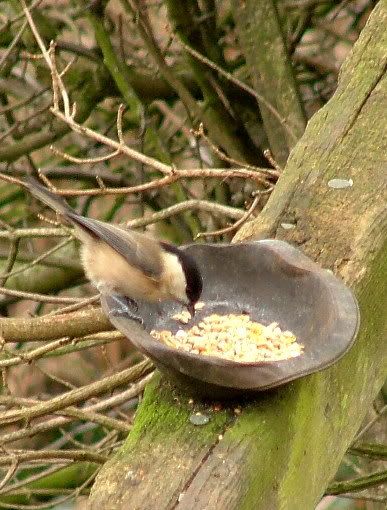
Willow Tits: On The Brink

Quite a cold snap at the moment, so a good time to get out around my alternative local patch Brierley Forest Park and make sure the feeding stations are well stocked.

Plenty out and about there, although the transient winter finch flocks, Redpoll and Siskin have moved on. Blackbird numbers are notably high with loose gatherings of 20 birds in several areas. Most gratifying birds to see, however, were Willow Tits, with 4 or 5 individuals congregating around the seed pots and hanging fat feeders.

The recent story of the Willow Tit is shocking both for the extreme decline in their numbers and for the lack of awareness of it. Just take a look at what happened to them in Kent. In 1996 there was estimated to be 500-900 pairs in the county, and now, it's probably none. There's a similar story over most of the south-east, East Anglia, much of Wales, indeed few are the regions in which they are not crashing or already extinct- Nottinghamshire/Derbyshire probably being their stronghold these days.

It may be that the very similar Marsh Tit, declined significantly itself since 1960's although probably levelling off now, provide the sort of ID confusion that lead birders to think there are Willows present in areas where they have lately disappeared from. The best way to tell between them is their call ( try listening at the RSPB website) - although even those can vary enough to be confused, and the slight plumage details aren't always sure fire either. General advice is to look for a slight wing-bar on the Willow Tit.

The national figures say it all really, a decline of 72% in the years 1994-2002, nearly three quarters gone in only eight years! Little wonder it was recently added to the Red List of species of greatest conservation concern.

There is still much debate over the cause of this catastrophic dip. The Willow Tit's weakness is its choosiness, only very wet young plantations of willow, birch and alder scrub, and occasionally pine, will do, so on sites where plantations are maturing, drying up or are being cleared of scrub, Willow Tits suffer quite badly. One influence on this change is the national boom in deer populations, Roe and Muntjac in particular will nibble away the undergrowth these birds rely upon. Coupled with general habitat loss to development and urban sprawl, and Willow Tits are running out of breeding sites.

The other theory that's given a lot of credence proves how difficult biodiversity can be to manage. Despite having an abominable 2007 when the heavy rains washed away all their caterpillar food, Blue Tits are generally on the increase in areas where Willow Tits are losing out. The evidence suggests to some that Willow Tits, the only tit species in Britain to excavate its own nest cavity, are muscled out of their territories and nest sites by the other tits. Mainly Blue Tits, but also Marsh and Great Tit will do this. Great Spotted Woodpecker are another additional pressure, as they will raid nests for chicks.

Studies are ongoing and we don't really have any answers just yet, and I'd suppose there won't be just one reason for the crash. I tend to wonder about the future and climate change. With dryer summers degrading their habitat further, more competitor species making it through milder winters, the future looks bleak for the Willow Tit, real into oblivion stuff.

Thankfully we still have them locally, chiefly due to all the old colliery sites around here that have been returned to nature and planted up in the last 20 years, sites such as Brierley.
They are also present at Carsington, and I'm volunteering there tomorrow. I just might begin adding Willow Tit to the conservation spiel I give to visitors.

Friday, 23 March 2007

Parakeets, a changing tide?

The pair of Stock Dove are back in our garden again, very happy to have them too. Some days I'll wait half an hour to do any gardening if they've flown in for a feed.

Couldn't help noticing a BBC News feature about the burgeoning Ringed-necked (or Rose-ringed) Parakeet population in the south of England.
Generally I'm of the opinion that British conservation can no longer really settle on ignoring the issues surrounding invasive non-native species. If we've learnt nothing else from Grey Squirrel, American Signal Crayfish, etc, it's that introducing exotic species of animal (and indeed plant) very seldom has the ecologically neutral impact we might hope for.
Even if the parakeets don't clash with any one particular bird species, I don't see how we can welcome a new competitor for nest holes and bird tables when the pressures some British bird populations have already caused significant declines in the last several decades, and I'm not sure it sets a very good precedent if we encourage their continuing presence. After all, what foreign species comes next?

The birds themselves are a memorable spectacle, but I think if we're really honest we know they don't belong here.
What I'm less sure about is whether the Environment Agency, conservation groups or the public, have the stomach to do what would be needed to remove these most characterful birds from the wild in Britain.
