Tuesday, 30 January 2007

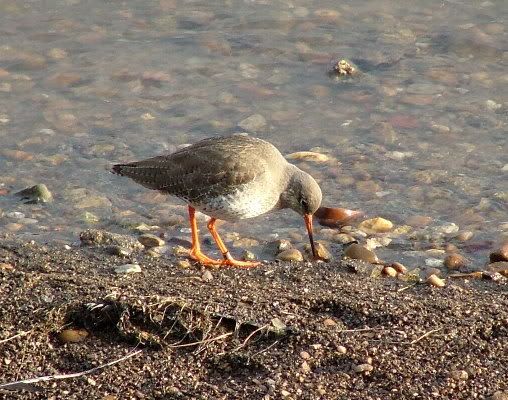
Great Legs


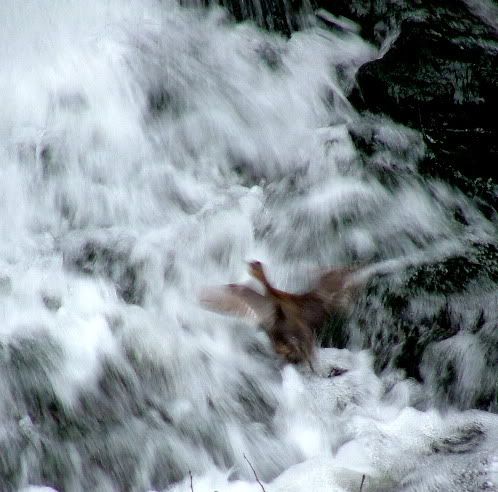
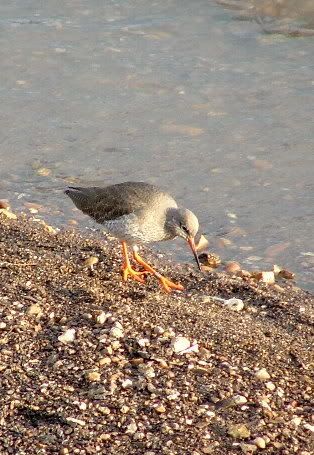
They're always special, those close encounters, those moments when a wild bird wonders almost beneath your nose in complete obliviousness to a threat that you don't actually pose. This Redshank toddled metres below a hide at our much visited patch of late, Carsington Reservoir.

Redshank will forever be on my list of probable favourite birds. I could never choose just one species, but the unassuming grace of these waders makes them a certain contender.

Sunday, 28 January 2007

Big Garden Birdwatch: My Results

We scored a pretty usual spread for our garden during our hour, although a surge in Blackbirds seems to have coincided with the berries on our pyracantha coming into maturity. Quite a relief really, as we rarely saw even one during the summer (around the same time the new neighbours next door brought their cat into our little ecosystem).
A Sparrowhawk circled over at one point and everything panicked. We sat for half an hour before any birds returned. If we do have a star bird, it's probably our pair of Stock Dove, although only the one showed up for our count.

Our results read:

6 Blackbird
5 Collard Dove
1 Feral Pigeon
1 Stock Dove
2 Blue Tit
10 House Sparrow
1 Dunnock

We'd surely have more if it weren't for the fact that our suburb is only 25 years old, so there are very few mature trees around.

(Big Garden Birdwatch)

Starling Roost!

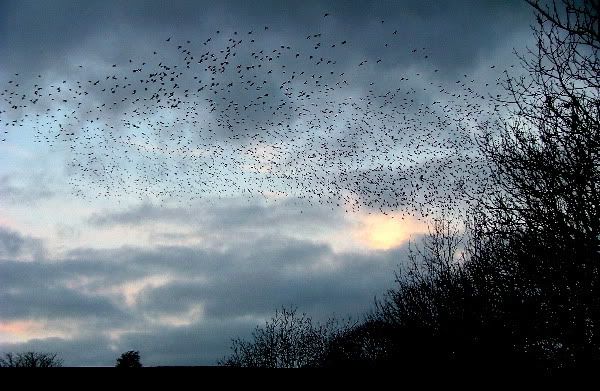
There are few more common garden birds in Britain than the Starling, so what's to get excited about? Try a flock somewhere in the 100,000 range, twisting and contorting in unimaginable formations as they gather to their roost. They begin in the hundreds, a few different flocks scurrying from different directions, and this continues for fifteen minutes until you suddenly begin to realise they've become not flocks but waves, not of hundreds or thousands, but tens of thousands of individuals all following the same enormous plan - to stay in amidst the writhing torrent of birds until at some predestined or perhaps telepathic point they decide to land en masse, thus evading any dazzled predators patrolling the vicinity.
Some of them came down into trees just 10 or 15 yards away from us, dropping like stones, sounding almost like rifle fire.

Video 1 - Kirk Ireton Starling Roost
Video 2 - Kirk Ireton Starling Roost
Video 3 - Kirk Ireton Starling Roost
Video 4 - Kirk Ireton Starling Roost

I'd always wanted to view this spectacle and I'm really truly thrilled to have actually found it. It's peaceful like waves crashing along the shore, it's artistic - an animated, emoting sculpture across the whole sky, and above all it's just bloody big nature!
Alas it's not easy to photograph or video, especially with mid-range digital cameras, so here's Bill Oddie's memorable version filmed for his BBC series. Well worth a view any day of the week.

Of course with these numbers of birds flying overhead, there's always likely to be one drawback.

Tuesday, 19 December 2006

The Bittern Trip Mk2

As the saying goes, if at first you don't succeed... so this was our second trip to find the Bittern at Potteric Carr NR, near Doncaster, and this time we weren't to be disappointed.
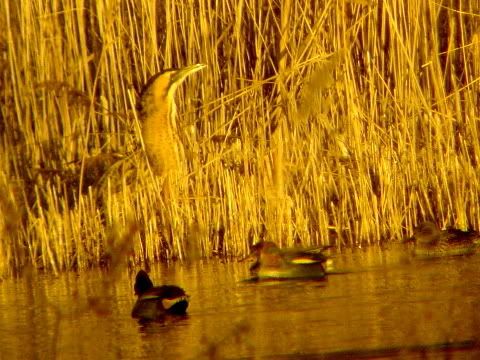

Perhaps it was the birds becoming more comfortable at their wintering site, the calmer brighter weather, or maybe we were just luckier this time, whatever the reason they showed well yesterday, with two different individuals from one very popular hide. A new lifer for me.
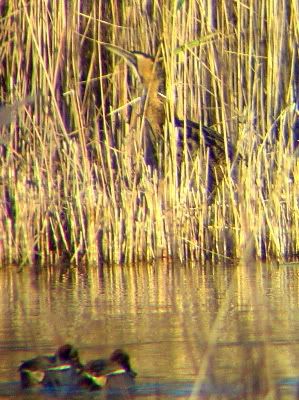
Their famed talent for transformation is well founded, and we watched these birds seamlessly move from streaky egg-shape to towering serpent. It's quite remarkable, and quite typical of this highly charismatic species.
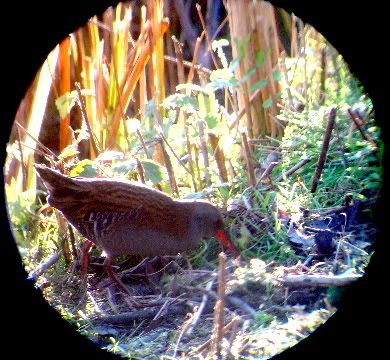
That other elusive bird of the reedbed Water Rail was similarly accommodating, indeed more so. I'd never previously heard of them coming to feeders, never mind seen it, but now I'm a believer. As the tits and finches scattered seed down onto the grass below, the Water Rail skulked and crept from the reeds, out into plain view to peck up the remnants, no more than ten yards from the hide.
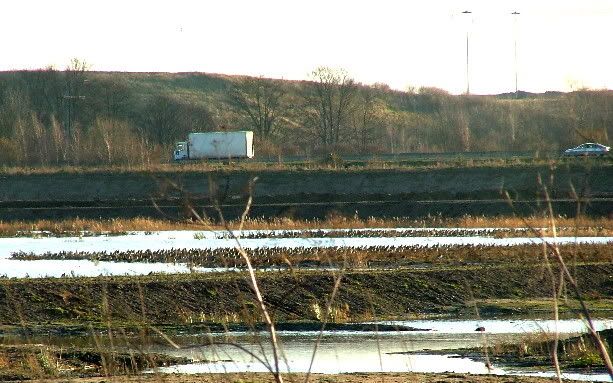
On the far side of the reserve beneath the main road into Doncaster, 2,000-3,000 Golden Plover roosted in the afternoon with smaller numbers of Lapwing.

All in all, a grand day out, and just reward for all that Christmas shopping I've had to do with my girlfriend.

Bittern in Winter, Black-necked Grebe breeding in the Spring/Summer, Potteric Carr is quickly becoming a must-do for the northern birder.
Thursday, 7 December 2006

Bitternly Disappointed


Potteric Carr, Doncaster, probably the best place in the North for Bittern. Five apparently on the reserve, and did we see one? Nada. Two hours in the number one hide, if they're showing they are there. Birders came and went, but Bittern didn't. Some people had been there all day and seen just as little as we did, whilst we were told early morning is the best time to see the birds.
At times of great frustration it's often helpful to philosophise, and we've decided that striking out today must mean we deserve outrageous luck elsewhere. Soon may it come.

Overall it was a quiet day bird-wise, but it's a relatively new reserve so it is bound to take time for word to get around the bird flocks.

Sunday, 3 December 2006

Another wild bird chase...

First of all let me say I am NOT a twitcher, work had dragged my partner down to Cambridgeshire and I hitched along for the ride in hopes of maybe ticking off a very special bird indeed - an inland Leach's Storm Petrel.

The story is covered here by timesonline, but briefly speaking the terrible and persistent southerly gales Britain has suffered in the past week have brought north great numbers of Leach's Storm Petrel that would otherwise be safely wintering in calmer, warmer areas of the Atlantic.
Most are turning up on the south and west coasts, areas like Morecambe and Cardiff Bay, but others are being blown further inland. Areas like Cambridgeshire, Derbyshire, even London. So if you've been at all nearby a recorded sighting, it's a chance not to be missed.

Alas, according to birdguides.com, the petrels had either gone or all died by the time we arrived at Grafham Water (where they'd been well reported earlier in the day), all there was were us and several other wet and disappointed birders. At least there is some solace in not seeing a species that wasn't there, rather than not seeing one that was.
The best bird of the day, a couple of flattered Goldeneye probably wondering what all the fuss was about.

Much worse luck for the petrels of course, once inland they seem terminally doomed. Even if they find a large body of water, it's fresh water and there just isn't the marine food for birds already tired, cold and wind battered. Sad really.

The gales still blow, so there's still a chance they could turn up almost anywhere in the UK.
This might be a once in ten or twenty year event.