Showing posts with label goldfinch. Show all posts

Monday, 16 June 2008

Ynys-hir

Another swift post to sum up the best of the birding enjoyed on my camping holiday to NW Wales.

Top spot had to be the RSPB reserve at Ynys-hir, never heard of it? Me either before I went, but I am quite comfortably confident it's the finest RSPB site I've ever been to. Where to begin describing the plethora of habitats? The oak woodlands? The mudflat estuary? The fresh water pools? Or how about the reed beds and open pasture? I could go on.
As you may imagine, this extraordinarily rich variety offers a true wish-list of summer birds in early June... maybe 10 pairs of Pied Flycatcher by our straw count, almost as many Redstart, and best of all a single Wood Warbler - a lifer for the girlfriend and I. May have been too late in the day for the bird's amazing stuttering trill song (listen here), however a plaintive 'tuh' contact call quite unlike anything I've heard from a Willow Warbler of Chiffchaff helped to confirm with our ears what we seeing with our eyes through the thick green foliage.

In at least three of the hides we found nesting pairs of Swallow, probably my girlfriend's favourite part of the whole holiday came in watching them toing and froing, watch out for the video at the bottom of this post.

Other top sights for the two days spent there (we simply had to go back after the first one!) were family groups of Raven and Stonechat, a single Whinchat, display flights from Common Sandpiper, overflights from Little Egret, Sedge/Reed/Grasshopper Warbler among the reeds, Oystercatchers and Lapwings, hovering Common Buzzards, Siskin and Great Spotted Woodpecker visiting the feeders by the visitor centre/shop, and a sunbathing Treecreeper - stubby wings outstretch against tree trunk, to name the highlights.
For me most memorable of all was a Goldfinch nest riding the strong winds in the outermost branches of an oak tree at eye level from one of the hides - rising and falling five to six feet after every gust. We couldn't have planned to see a Goldfinch feeding its day old chicks, which trust me is an extraordinarily privileged view into the precarious early days of those birds.

Some pictures to illustrate all this beauty...
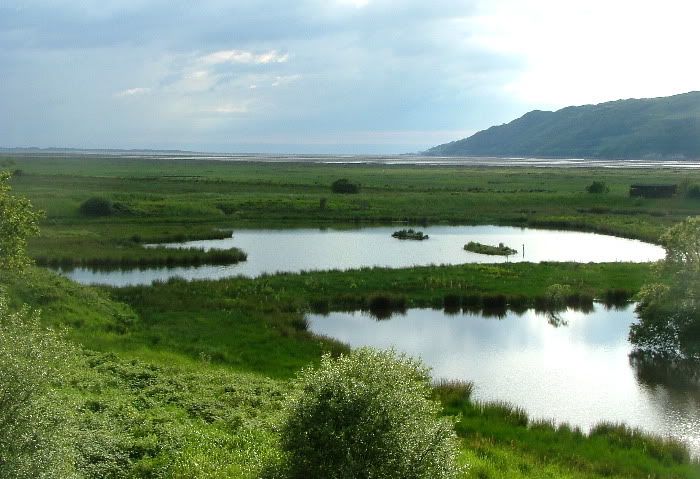
(Goldfinch nest just to right of picture.)
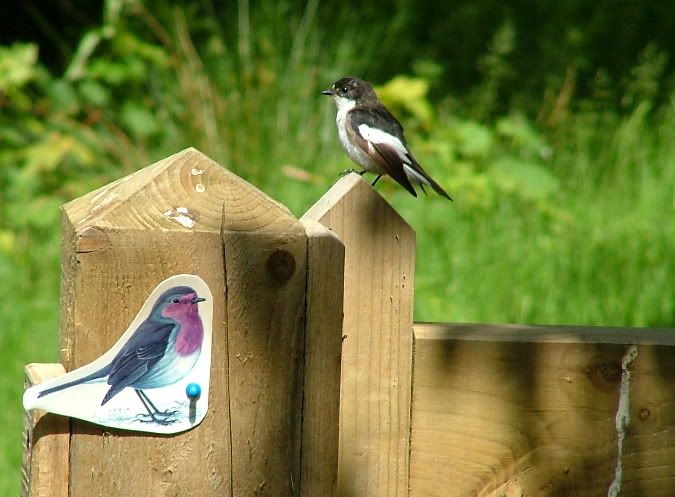
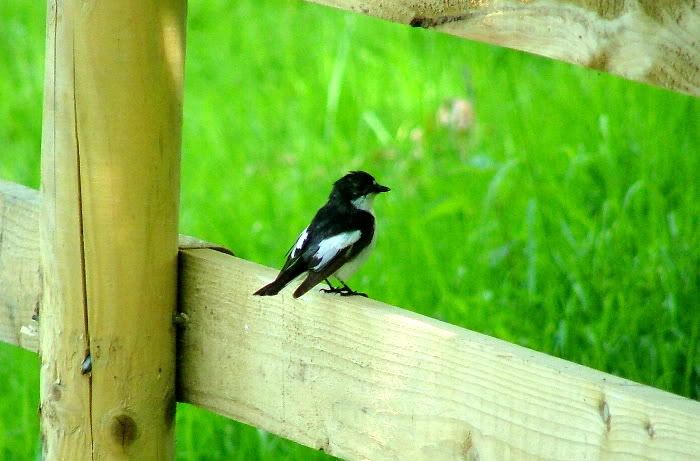
Perky Pied Flycatcher.


Those Swallows.

More Welsh birding to come.

Monday, 8 October 2007

Try the Quiet Road


Goldfinch at Rutland Water

Business took the girlfriend south this weekend, so I tagged along to scour bird site down there I've seldom visited.

She dropped me off at Little Paxton mid-morning, giving me just enough time to get around the northern half of the reserve there. The site is made up of a network of older flooded pits and the current sand and gravel workings. Unlike many destinations Autumn isn't really the time to go; in Spring/Summer Little Paxton is famed for its Nightingales (28 singing males in 2006) and in Winter its a good site for m
igrant ducks like Smew and Goldeneye. So on my visit it was 'quiet', precisely the word used by the chaps doing the WeBS count that morning. I could have saved them their time, Wigeon, Wigeon and more Wigeon, write that down!

I did pick up a few Redwing, Meadow Pipits, Pintail and a Herring Gull, for a list that hardly broke 30 species. There were better birds around, a Little Stint elsewhere on the southern side of the reserve, a place I'll know to look in future.


Time came to head back northward and we detoured to Rutland Water, keen chiefly to find better views of the juvie Red-necked Grebe from last weekend. True enough it was fishing along the same shore, almost doing circles around a paddling fisherman, still far off but in better light. It looked a touch smaller than I imagine, quite significant compared to the GCGs. Also out there was a pair of winter plumage Black-necked Grebe conducting what looked like partial courtship display - head-flicking and synchronised diving.
The sandpipers of last weekend were all gone, indicating what a small window o
f opportunity migration is for picking up species like Curlew Sandpiper, and otherwise the most notable presence were the 8 Little Egret gathered on an island in front of the Egleton visitor centre. Will they stay for the winter?

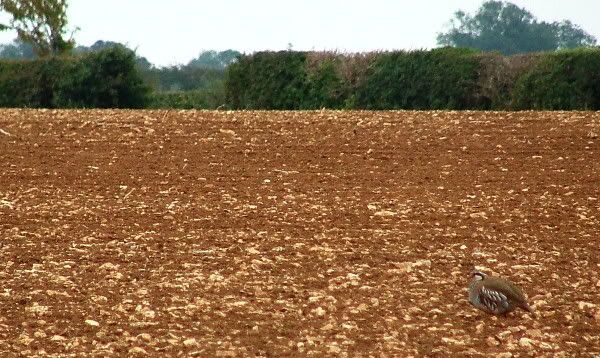
Finally on the drive home we meandered through minor farm roads back to the A1, hoping to spot something from the car on the way, and we did. In a freshly ploughed field just sou
th of the RAF base at Cottesmore a flock of 20+ Red-legged Partridge came into view.


Spot the Red-leg.

Video 1 - Run Partridge Run!
Video 2- Very distant fuzzy Black-necked Grebe

As for tomorrow, I'm at Carsington for another ABB! event and, lord, does the weather look awful. The weatherman, he talks about inches of rain.