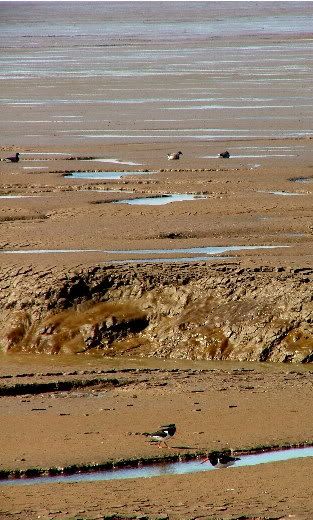
So the the saga of the Little Auk. I take you back to Monday before last, a cold and blustery wintry morning at Snettisham, masquerading as November 12th. The ongoing Little Auk wreck (following the deep North Sea depression that had battered if not quite lacerated through the North Norfolk coast with a strong tidal storm surge) was taking place further east, so we weren't quite expecting to find any. Oh but we did. First sighting came with four bobbing around in the high tide, only a few feet from the shore. Lovely squat birds, sort of bullet-shaped, and for all my bird knowledge they still looked like fresh chicks. Of course they weren't.
A nice lifer then, but onward back to the pub for the &B part of our bed and breakfast weekend.
The walk back to the car park at Snettisham takes anywhere between 30 and 50 minutes depending on how many times the birds stop you, and stopped we were by another Little Auk, this time on the lagoon behind the holiday huts. This time something was wrong, the bird paddled weakly and as we stood to watch, it slowly but inevitably floated into the horrible foam on the windblown side of the water.
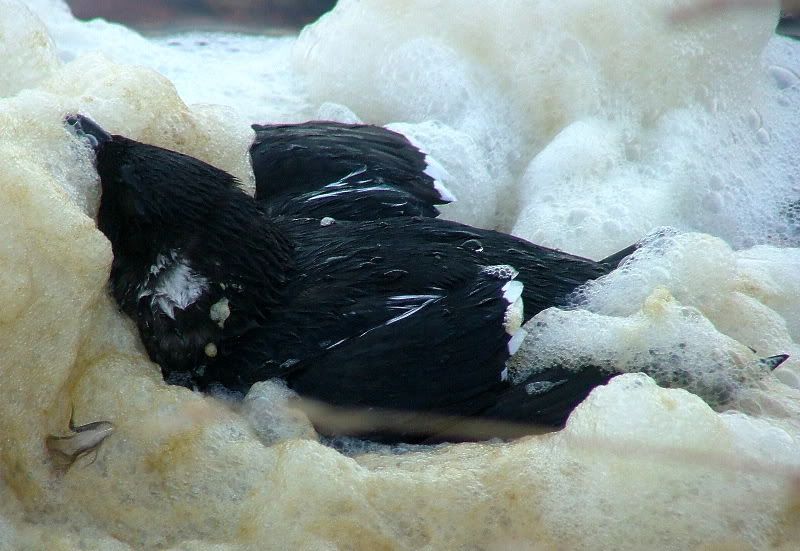
It was stranded, rolling in this froth, utterly stuck. Now usually I'm not one to intervene; Magpies I'm perfectly happy to have them as a garden visitor and when the Sparrowhawk takes one of my Blackbirds I'm actually quite thrilled - it's like a David Attenborough film outside your kitchen window. This time, clearly leaving things be wasn't going to be satisfactory, this birds, its dignity, it deserved better.
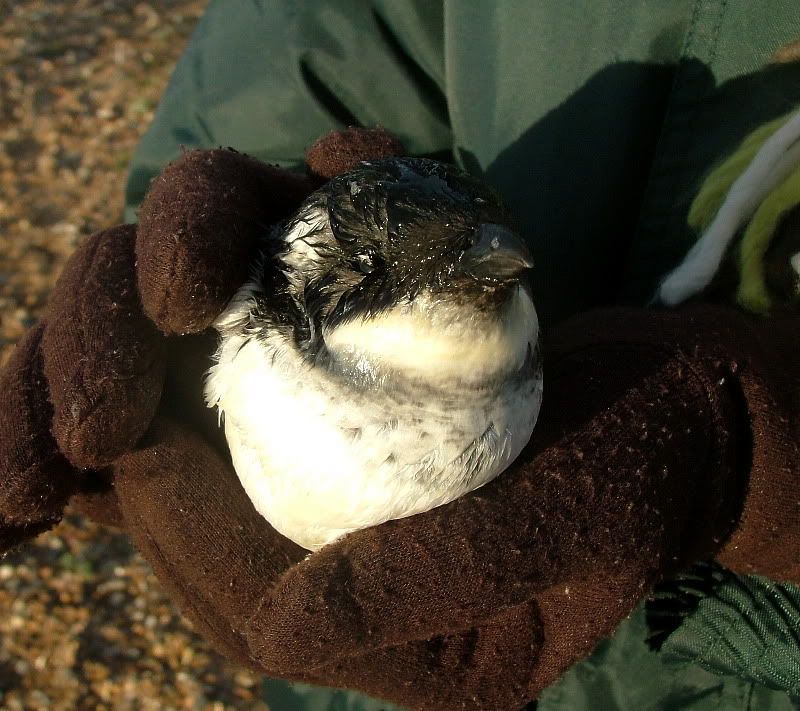
Glad for my gloves I scooped it up and rushed the damp fella back over the seawall to the beach, in hopes of refloating him. In retrospect it was never going to happen, and after a few feeble efforts the slosh of the sea's motion grounded the bird again.
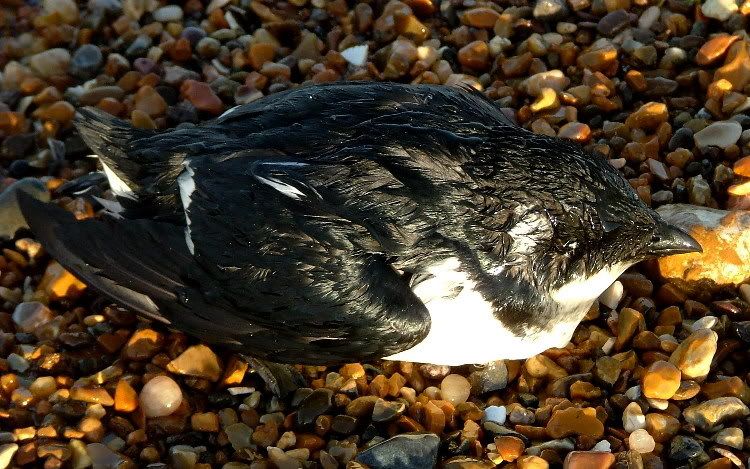
Settling on the conclusion that it was likely to die, we reasoned that the best thing to do would be to rest the bird back down on the bank of the lagoon, this time on the sheltered sunny side. If was to die at least it was somewhere quiet, and sadly die it did, as we discovered after returning from our breakfast. The bird was never very lively, in truth it wasn't only exhausted but water-logged too.
Elsewhere in the country I'm sure similar stories are being recited, with almost 30,000 Little Auks past the Farne Islands in one day, and individuals blown as far inland as Doncaster, it's clear this was quite the birding event of the autumn this year in Britain, a lot of birders happy for the tick and I'm sure plenty of grateful gulls were happy to gobble the weakened auks down whole.
There will be a lot of discussion over why this occurred, was it just the storm pattern that pushed the auks so far south or could it be something more worrying like climate change induced disturbance of their marine food source? Likely to be both I would suppose.
The smallest of the auks (about the size of a Starling but much heaiver - believe me!), this species does come closer to shore in winter than its larger cousins, although for the large part they'll stick to the open ocean, the North Sea, the Atlantic and as far north as the Arctic ice shelf. They live for upto 10 years, perhaps a good deal more, and feed chiefly on plankton, invertebrates and small fry.
A lifer for us then, a life diminished too, and a bird held in the hand that quite probably came from a Spitsbergen breeding colony, a good deal north of the Norwegian mainland, from one of the nests not plundered by a Polar Bear. Memorable stuff from our hobby yet again.
link - an article in the Independent about this Little Auk wreck