Wednesday, 1 August 2007

The King's Mill Owls

Summery evenings, we hardly knew ye, but now you're back we're determined to enjoy you.


My walk with the girlfriend to King's Mill Reservoir was lovely, and promised the possibility of a Barn Owl (more on that later). Surprising really that so few people were out there with us, it makes you want to knock on front doors and invite folks away from their television. Are you mad, it's beautiful out here?

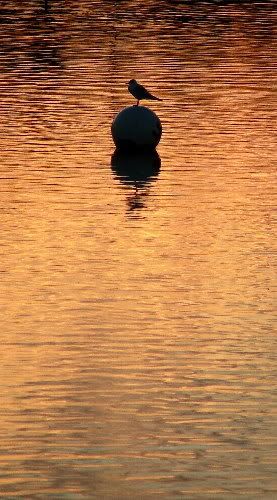
At the 'res', the bird roosts are already beginning to develop. Up to a couple of hundred Black-headed Gull commuted in late on, and by the reed bed 150+ Coot settled in for the night, with many more elsewhere around the fringes of the water.

Around the hedges an ever moving troop of 20 Long-tailed Tits chattered among each other. I confess I don't actually know that's the collective noun for Long-tailed Tit, I choose it because for me their behaviour always draws comparison with a troop of monkeys searching for fruit in the jungle canopy. Their breeding activities, whereby related non-breeders will help a pair raise their brood, bares more similarity to the forest apes too.

Now a Barn Owl family has drawn whispering attention to King's Mill since breeding was discovered there a couple of months ago. This is the first known record of nesting at the site and according to the reports it's been a great success, with at least 2 juveniles present at the moment. What makes this discovery more thrilling is this territory is relatively urban; you have a averagely large reservoir popular with walkers and water sports enthusiasts bordering on one side, the busy A617 to Newark road on another, and an 'adventure base' for children on yet another, and through all of that dissects a railway line. So this isn't some dirt quiet back road in the wilds of rural Lincolnshire. If only more people knew that Barn Owl could live so close to a large number of people, basically within our conurbation, how much prouder we'd all be of our oft derided and half forgotten district of Nottinghamshire?

Anyway, we watched in the last light of the evening for 5 minutes as an adult swooped along the railway and then off into the wheat field, while in front of us a late calling Reed Warbler sung in a small patch of reed bed near the car park.
That Barn Owl, by the way, is 107 for my carbon neutral list. The girlfriend loved seeing the bird, and it soon put at end to the complaints that I refused to let her stay sat by the ducks!

Speaking of Barn Owl, news today comes from the RSPB that the species has been voted Britain's favourite farmland bird, by the people who wrote in to them or visited their website. Who could possibly fail to agree?

And for more on Barn Owls in Nottinghamshire try reading the diaries of the Rushcliffe Barn Owl Project. Who knows? It may even have been the offspring from their successful efforts that have found a home at King's Mill, though with average young dispersal being around 7-8 miles, I freely admit we'd really be at the high end of their reach.
Wherever they came from, here's to the owls!
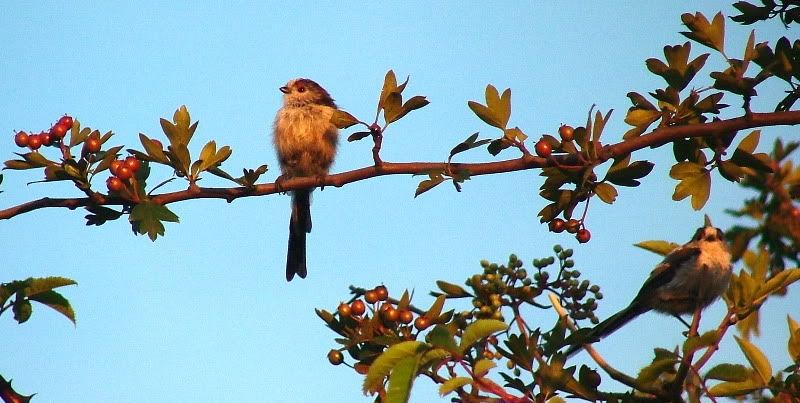

Those little monkeys.
Monday, 30 July 2007

Bempton Swallows

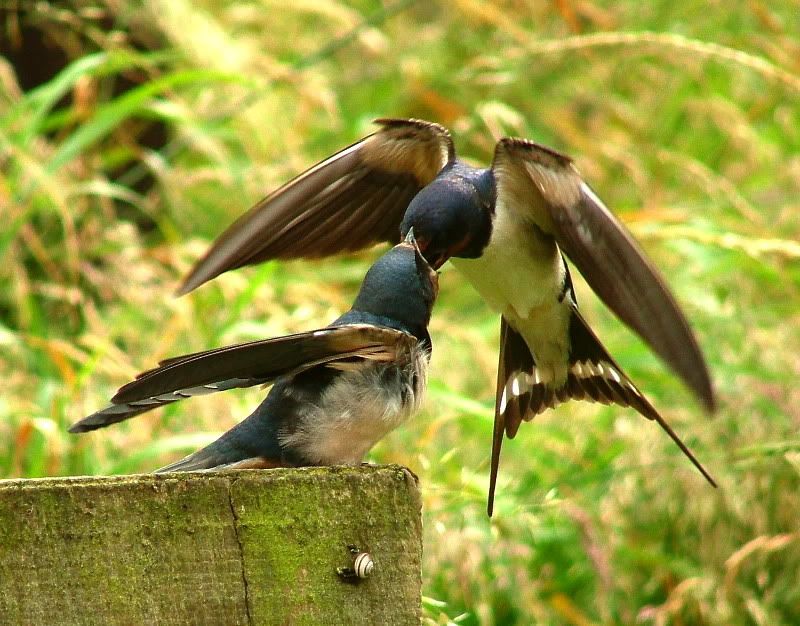
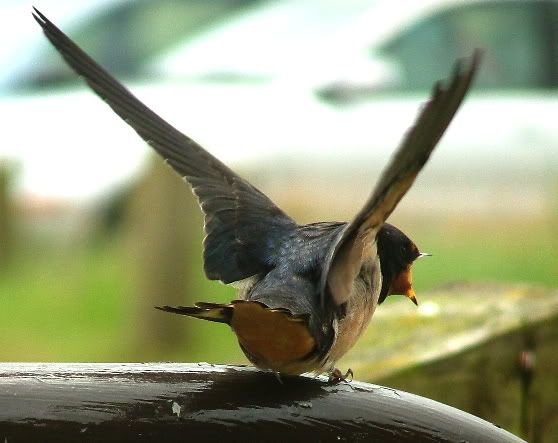
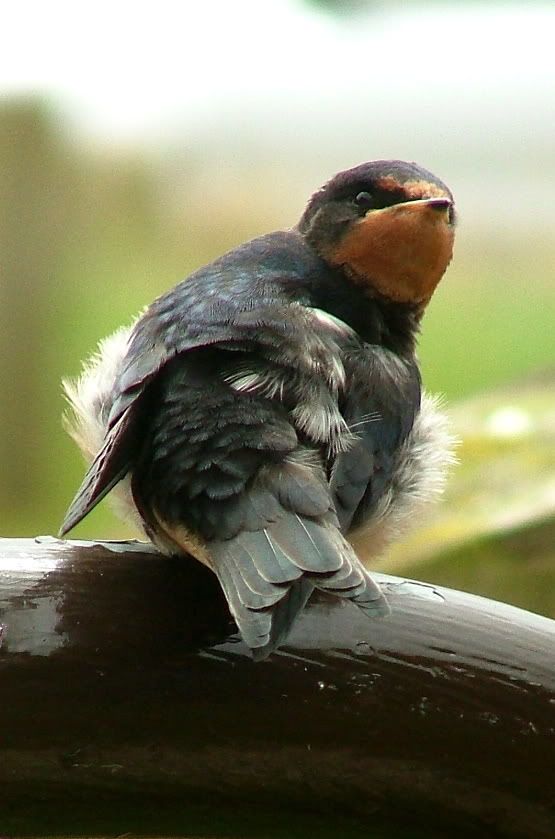
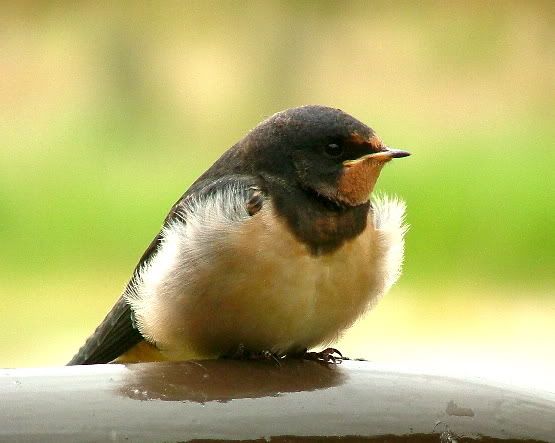
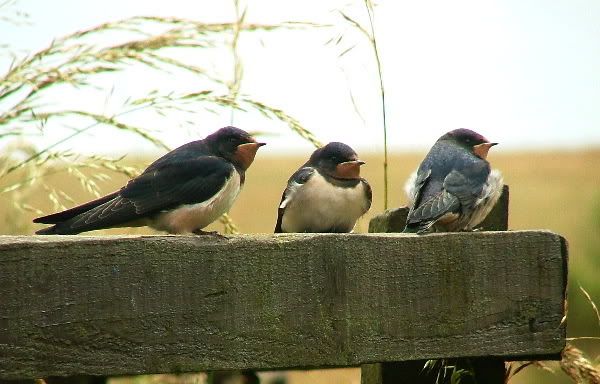
Of course at Bempton Cliffs there is more than just seabirds. On our final day there most visitors were enthralled by a busy family of Swallows feeding in the picnic area outside the centre. They were very bold and tolerated the closest of encounters...


Common bird, and amazing.

Sunday, 29 July 2007

Our Good Night Heron

What makes a twitcher? An hour's drive up the A1 to see one (or two) birds? Not quite, I hope.

The destination was Fairburn Ings RSPB Reserve, near Castleford in West Yorkshire. We had always meant to visit the place, but never before made it out there - until now. For over a week a pair of Night Heron had been showing really well at the site. Being the summer of exotic European herons this was our chance to bag one, and if the photographs at Birdguides.com were anything to go by, they posed a straight forward tick - sitting right out, over open water and in the daylight!

It's in the name; Night Heron. Their activities are normally restricted to the nocturnal hours, whilst in the daytime they roost in trees or reedbeds, and so are not always easily viewed. The natural range of these birds usually stretches no further than the Low Countries and their stronghold remains down in the Mediterranean. Yet, here we have two, an adult in beautiful three tone plumage, and a 1st-summer partner that are slightly muddier, making them one very attractive prospect. The reason they wandered into the UK is that they are migratory herons. Unlike our resident hardy Grey Heron, they retreat from the European winter down to tropical Africa, often as early as July. With that sort of large movement, they do turn up in England - perhaps half a dozen or more per year.

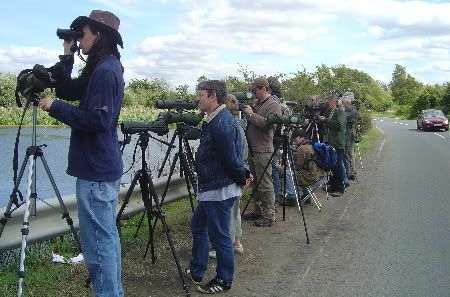
We arrived on site around 1pm, joining the ranks of 15 or so other birders, and we all saw nothing for over three hours. We stood and stared at a patch of reedbed and the trees behind, and nothing. Then an inspired find, through the wind-blown gaps of the reeds somebody had found a small feathery patch. Now you needed to find the perfect angle, almost like looking through the eye of a needle, and you could see small areas of the 1st-year bird. A shoulder here, the behind of the head, if lucky the eye or the beak, all of it 30 yards behind reeds already 50 yards away, where the bird was sitting very low in a willow. As a tick, I didn't mind calling it a disappointment. What I was impressed by was the ability of some of the other birders to pick it out, even knowing exactly where it was, locating a scope was far from easy. Oh yes, these guys are good!

After an hour of peeking at those feathery patches, the girlfriend and I decided to investigate the nearby areas of the reserve. Fairburn Ings is a relatively large area of lake and marshland, that looks a perfectly rich habitat for our breeding waders and wintering ducks. Indeed Lapwing, Oystercatcher and Redshank were in decent number, as was a notably large population of Gadwall. My only gripe was the hide, an uncomfortable metal hut that felt not unlike a prison unit. It had large pillars between the locked-open windows and no room to jam a tripod between the seat and the ledge for anybody without a hide clamp. Just a really poor design in comparison to the traditional wooden bird hide.

Back by the roadside, where unbelievably yobs in cars would yell and beep horns at us as they passed by, we were told the immature heron had flown a short distance. That seemed enough for most twitchers who packed up and left. Only a few more determined if less proficient birders remained, hopeful as we were of seeing something better, and we did. The bird was relocated in a creek, showing very well (with a Kingfisher too), to anybody who stood in eye-line through another break in the willows. That meant one viewer at a time, plus somebody tall enough to look over them, i.e. me.
Happily we managed to make sure everybody got a view, and best of all we had a casual birder who brought his smaller daughter to see the heron. She went 'Wow!'. That probably made the coolest moment of the day for me.

By now it was 8:30pm, over seven hours of waiting for this bird, and the elusive adult did not show at all. I read this morning on the sightings websites of 'not present' reports for the herons today recorded at 10:30am. Now come on boys, have a little patience!

Friday, 27 July 2007

Bempton Cliffs RSPB Reserve

Holidaying at Bridlington makes Bempton Cliffs RSPB a must do for any birder, it is after all home to almost a quarter of a million seabirds, the largest colony of any kind in England. They are mostly Kittiwake, Guillemot, Razorbill, Puffin and Gannet, the sheer number is a wildlife spectacle.
Here come the thumbnails...

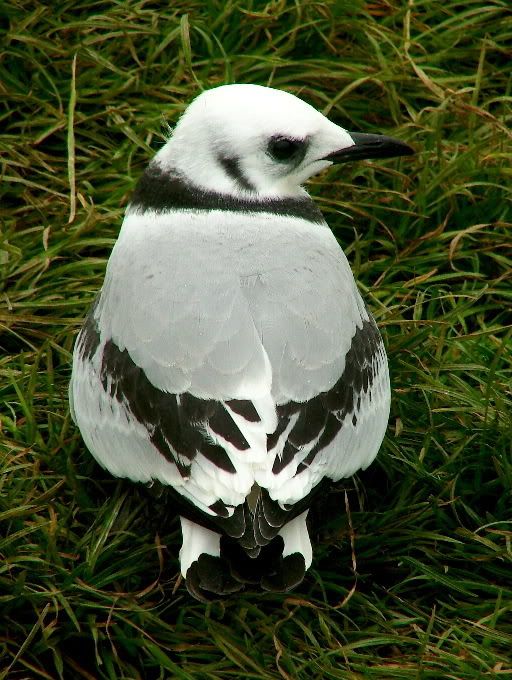
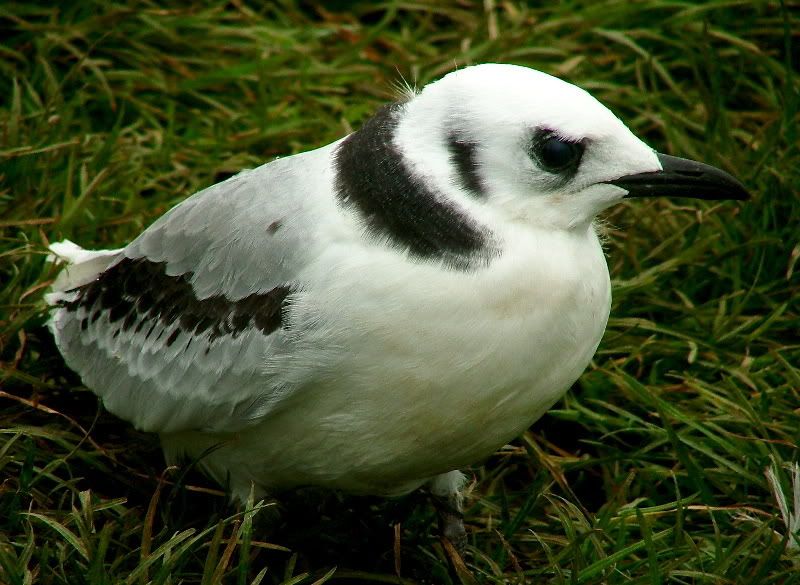
The most numerous species is far and way the Kittiwake, and with that eponymous call they endlessly shriek you sure know about it. We discovered this young bird on the path above the cliff. It seemed bewildered and a little lost, soon scuttling away into some long grass. I'm sure it soon found its own way to the sea.

Those dark markings, the wing bar, the collar and those weary black eyes, Kittiwake juveniles can a look a sorry bird in dull weather.

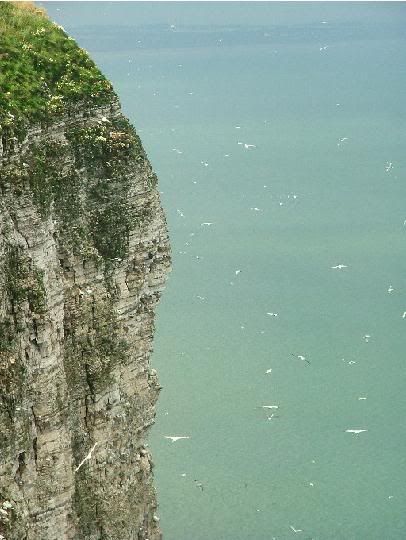
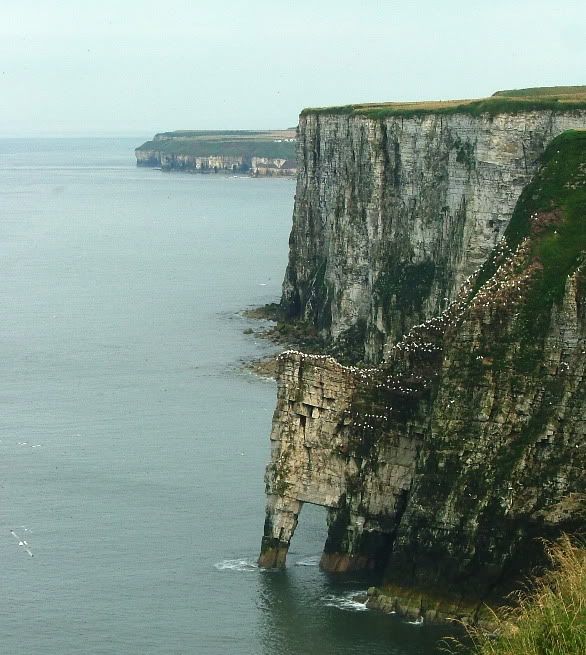
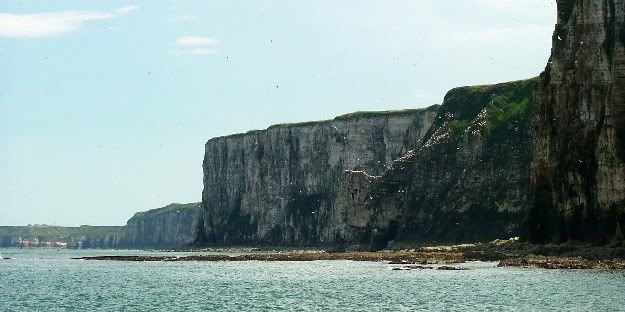
The view to the North.

And South.

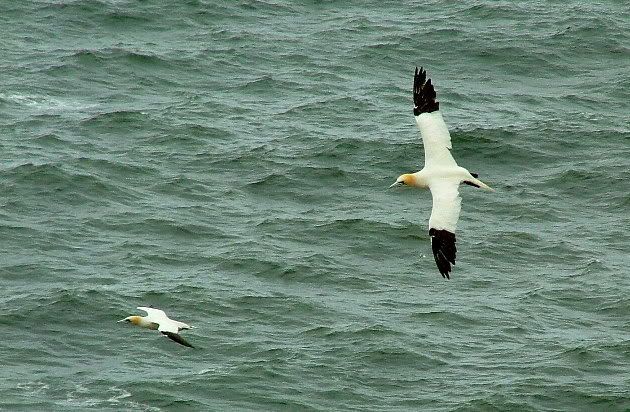
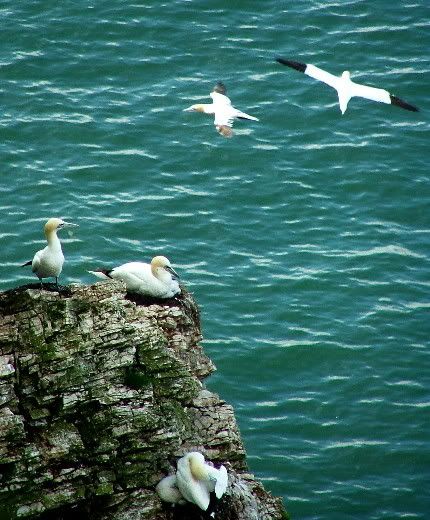
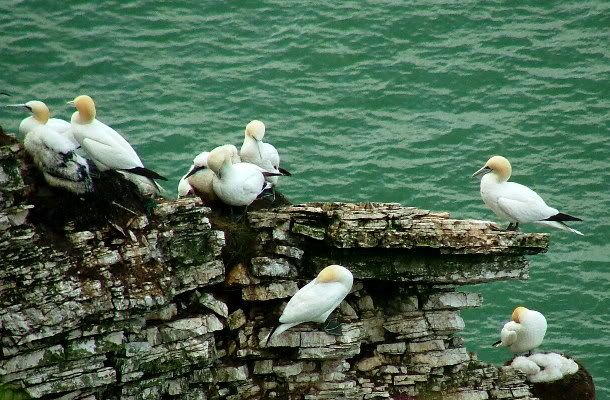
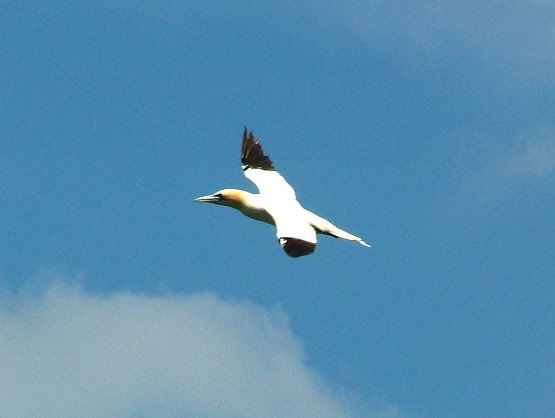
For me the most striking bird of the cliffs are easily the Gannet. Could it be their impressive size, or their airline markings? Maybe it's the strange dinosaur features of their heads, whichever way you choose to look at these birds we have nothing else in Britain quite like the 'Soland Goose'.

Note the fluffy youngsters on the left.


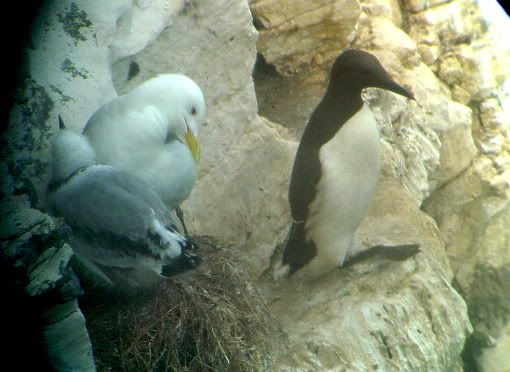
What there were much fewer of were the auks. Puffin, Guillemot and Razorbill only sparsely dotted areas of the cliffs. Hopefully that's not an indication of another bad year for them. They don't seem as able to bounce back from the lean years of the early 2000's in the way the Kittiwakes have managed. The sand eel fisheries may have closed on the east coast, providing time for these seabird's main prey item to restock, there are still problems to solve though. Quick fixes don't exist in nature conservation.

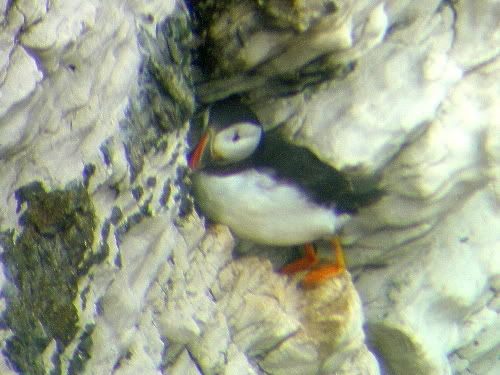
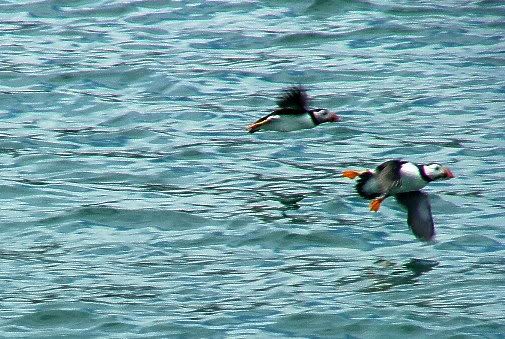
Unusually the Puffins at Bempton don't nest at the top of the cliffs in vacated rabbit burrows as they do elsewhere, instead they choose hidden crevices in the rock face. That makes viewing them trickier than might be imagined. With a keen eye and a scope, you can still get pretty good views of this most charming bird.

Taking to a boat, we chose the steady Yorkshire Belle, gives another perspective on the 300+ft high cliffs. Our choice was the three hour cruise from Bridlington harbour, as far as the RSPB reserve and then onto Filey Bay. Frankly, another time we'd opt for the 2 hour boat that turns back at Bempton, there wasn't much to see thereafter and the loud engine noise was far from pleasant.

You get closer to the Puffins though.

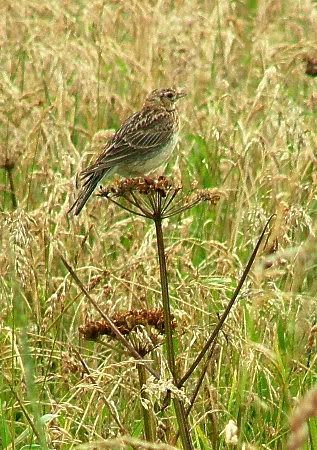
Back at the top of the cliffs the birding in the fields behind can potentially bring up remarkable migrants, but not during our visit, mid-July isn't really the time for passages. Meadow Pipit, Linnet, Reed Bunting and birds like this juvenile Skylark meant there was something worth scanning for.

Truth is we didn't see a great number of species, not even enough to bother counting, the odd Shag and Sandwich Tern, and what remains only a 'probable' and very distant Arctic Skua, was the best of the rest.
The reserve is all about spectacle. Birder or not, to spend time watching individuals busily ferrying into the cliffs among the many thousands of other birds, serves as some sort of reminder about our own lives, our own place in the world, our own importance in the grand scheme of things.
You'll have to go there to understand what I'm getting at. For all the squawking, guano and that relentless wind, it's very... peaceful.

The Return of the Honey Buzzard

Some picture posts on the birding I did on my summer break to Bridlington to come soon, first I should make mention of the new tick I picked up on the way north.

For many years Carburton/Wellbeck Raptor Watchpoint, near Clumber Park in Nottinghamshire, has been associated with Honey Buzzards. Since the 70's a small and infrequent population has been present on the vast private shooting estate of extensive mixed woodland. As antithetical as raptor conservation and shooting interests can be (sadly a matter of particular concern for Hen Harrier and Goshawk in Derbyshire at the moment), the arrangement at Carburton has always appeared fruitful.

However, since the early 2000's the migrant Honey Buzzard had been failing to return or stay, a change which some local birders attributed to the increasing population of Common Buzzard at the site creating unprecedented competition for territories. Of this I am dubious, the reasons for failed or successful Honey Buzzard migration is very poorly understood, it is unclear that two species do directly compete, and more indicatively, the Honey Buzzards are back!

Birdguides.com began getting regular reports again a couple of weeks ago and not wishing to miss what is aptly described as 'an
exotic breeding species', so close to my local patch, I made sure to give an hour to the site before heading for the seaside.

I saw the bird twice. First was when it appeared from nowhere very close to the lay-by, indeed it seemed startled and hastily soared back across the opposite hillside. The typical cream underwing and scarce barring was most noticeable (not in itself discerning the bird from a pale phase Common Buzzard), and then the extended head and long narrow tail confirmed it as a Honey. Can't say I noticed the tail barring described in the ID literature, but they say in the field it's seldom very obvious.
My second sighting was much more distant, yet much more spectacular. The bird lunged into great roller-coaster stoops, a typical display flight for the species. Chatting to another onlooker I was told a pair is present, and that is as much as anybody knows. Whatever conservation body is looking after the site remains highly secretive about the activity there, and quite rightly so.

With those sightings that makes #198 for my life list.

A couple of Osprey are also over-summering in the same area, although I sadly had no time for them on the day. Yes, that's two big and very rare migrant raptors at the same site. What are you waiting for?

During my vigil I picked up a lone wandering Raven, another top county bird - it's likely we don't have one breeding pair in Nottinghamshire.

Each of the three species I've mentioned here are on the increase. Whether it's global warming increasing insect/grub food items for the 'Bee Hawk' (up to maybe 200 UK pairs now), the successful reintroduction programme for Ospreys at Rutland, or reduced persecution for the Raven, there's genuine reason for great optimism for these birds. How refreshing is that?
Now all we need is a pair or two of Red Kite to join in the fun. I look forward to them.

Wednesday, 25 July 2007

RSPB: Getting In With the Kids

I've a real success to report - my first day of volunteering with the RSPB!

My duties at the Carsington Water ABB event consisted chiefly of inviting Joe Public to peer through at the Little Owls I'd, with a little luck, been able to centre to the scopes upon. I may also impress on them the conservation work the RSPB and Severn Trent Water (must never forget to include mentioning them both apparently) do at the site and even coax them to sign up for RSPB membership and newsletters. I'm not so hot on pushing that line, it's money and details and I'm all about the birds, fortunately the other volunteers - a little older than I am and less shy - are better in that regard and we sort of naturally organised between ourselves who does what and mucked through the day well. They're pretty cool like that, I guess when you all believe what you're doing is utterly worthwhile that team cohesion is easy to come by, and being volunteers we're all grateful for one another turning up for the event. And you'd be amazed the energy some of the older volunteers can muster!

At the wildlife centre we had around 600 people through in six hours, at least 25 at any one time, so it was always busy. Mostly these were holidaying families and retirees, and I'm sure I nabbed at least a quarter of them to look at the owls. To my enormous good fortune the Little Owls showed the entire day, variously sitting in the open on fence posts and exposed tree branches in their regular spot. They look like fluffy balls, almost toy-like, yet with those enormous raptor eyes they're full of an apex predator's charisma. With such a great bird to look at we got great reactions from all who viewed. Tell me who's going to say no when asked, do you want to see an owl?
Young and old, so many said 'wow!', etc. The resident RSPB staff told me she watched a small girl skipping back to the car park gleefully telling mum and dad about the owl she'd seen. That really makes me feel good inside, the light was sparked, you know?

I'm pencilled in for one day a month, possibly two should I choose, that's all the RSPB asks of volunteers.
It is tiring because there isn't a moment's peace from dealing with a public you must approach, and for a few days I'll be seeing Little Owls every time I close my eyes. I'm happy though.

We also picked up an occasional male Redstart flitting about in the same fence posts, a good bird for the county, a good bird for any county really.

How to conclude? Oh yes, Aren't Birds Brilliant!

Monday, 23 July 2007

More London Birds...

A thumbnail post, click on the pictures for a closer look...

A Jay in St James' Park, less shy than those at home, this fella was hawking for flying insects from a perch above a crowded path and the muttering of many different languages.

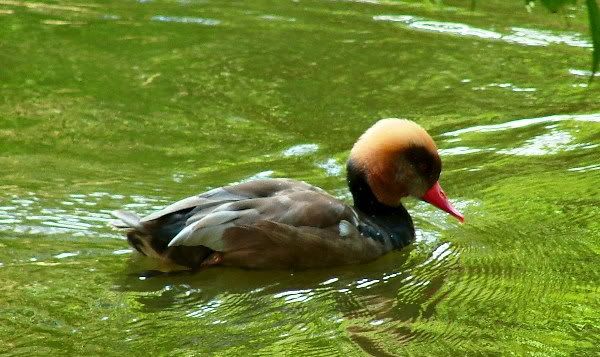
Red-crested Pochard, a semi-exotic, an escaped population of these sustains itself in parts of England. I saw my last 'wild' one in Cambridgeshire.

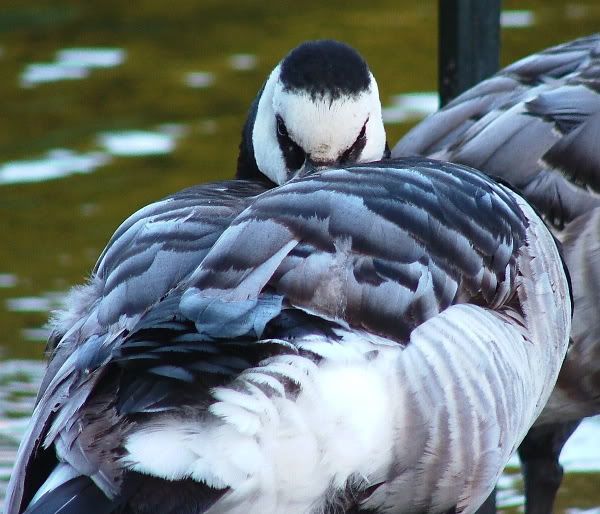
Barnacle Goose, there were also Nene, Snow, Bar-headed and Red-breasted geese to be found.

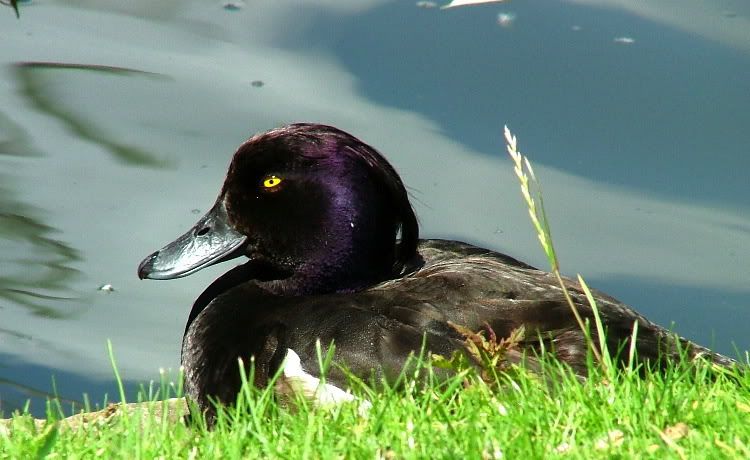
Tufted Duck.

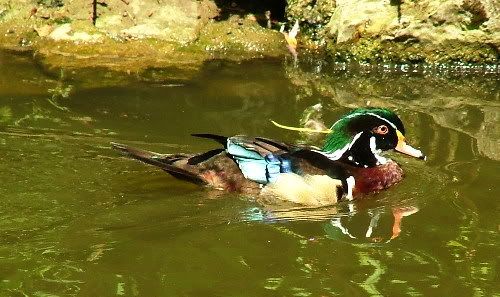
Wood Duck.

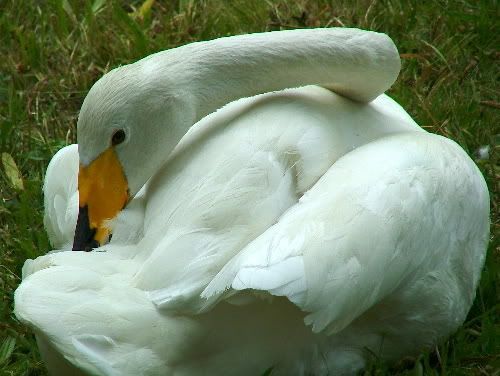
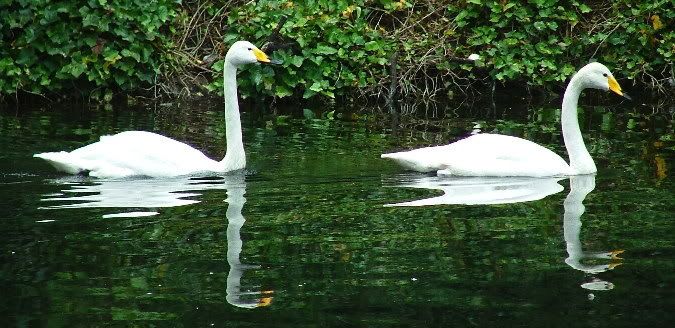
In Regent's Park, some tame and fabulously graceful Whooper Swan.

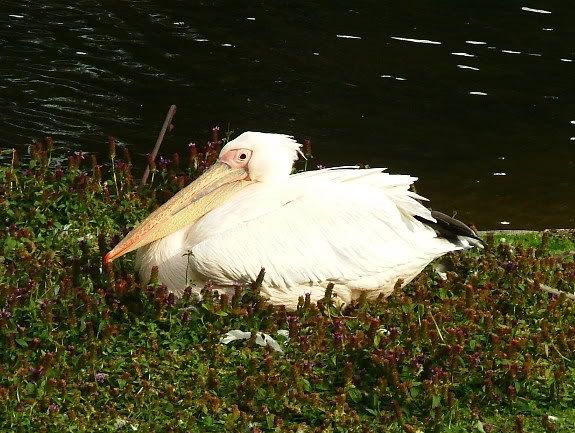
And famously, the St James' Park pelicans.

So okay, few of these may deserve a place on any serious birding list, they still made a pleasant post-Tour de France afternoon in the park. Merci London!