Our Bullfinches still seem to spur a great deal of excitement among visitors, I suppose it's the close proximity you can get to them. Probably helps the birds watch us scattering seed.
Quiet day otherwise, although Redwing are still around. About a 150 flew in from open farmland to the north of the park late in the day.
Off to Freiston Shore RSPB on Monday. Being so landlocked here in Notts it'll be my first visit to the coast during winter. With any luck it'll be loud with Brent Geese and rolling with flocks of Knot. I can hardly wait.
Video - Brierley Forest Park Bullfinch
Wednesday, 15 November 2006


Saturday, 11 November 2006
To find a Little Owl
Out on feeding station duties around the local nature reserve yesterday. We'd long heard reports of Little Owls up around the farm buildings on the northern boundary, yet hadn't actually seen them for ourselves. Being a warm afternoon on an otherwise cool day, hopes were high of spotting one of the small characters warming in the low sun, and we weren't to be disappointed.
Now it's well known that Little Owls pick prominent perches, but this bird seemed to have made an extra effort to stick out. Look at the pale dot near the centre of the big dark barn toward the right of shot...

 Okay, not a picture to grace the magazines, but enough to confirm ID, and how conspicuous the owl's notably bold behaviour can sometimes be.
Now it's well known that Little Owls pick prominent perches, but this bird seemed to have made an extra effort to stick out. Look at the pale dot near the centre of the big dark barn toward the right of shot...

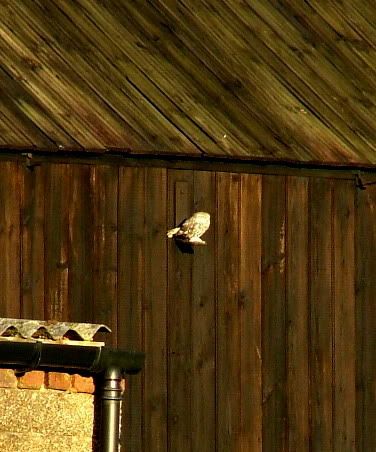 Okay, not a picture to grace the magazines, but enough to confirm ID, and how conspicuous the owl's notably bold behaviour can sometimes be.
They're sort of the emblem bird for the volunteer group at the reserve, and I couldn't think of a more suitable or perky choice.
Thursday, 9 November 2006
Not quite a tick
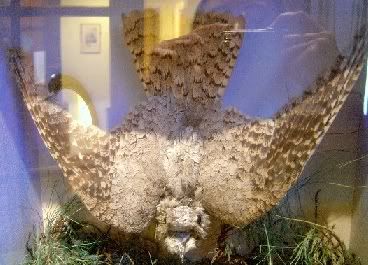
After reading in the bible of British birding, Birds Britannica (by Mark Cocker, Richard Mabey), that the stuffed remains of the nation's first ever Egyptian Nightjar were still on display in our local museum 120 years after it was shot, a short pilgrimage felt necessary.
Okay so it's no great feat in taxidermy, but there is an interesting story attached, here's an excerpt from the book;
A Nottinghamshire gamekeeper, Albert Spinks, flushed a bird from its resting spot while he was shooting rabbits and, thinking it looked unusual, brought it down with his second barrel. A day later when it started to smell he threw it on to the ashpit near his cottage, only for his ornithologist employer, J. Whitaker, to notice and retrieve the skin. Whitaker sent it to his taxidermist and subsequently had its identity confirmed as an Egyptian Nightjar, then he honoured 'his' find by erecting a monument at the site of discovery (Thieves Wood, near Mansfield). The inscription, in which the largest letters spell his own name, was intended to read: 'This stone was placed here by J. Whitaker, of Rainworth Lodge, to mark the spot where the first British specimen of the Egyptian Nightjar was shot by A. Spinks, on June 23rd, 1883, this is only the second occurrence of this bird in Europe'. In fact 'occurrence' was misspelt and the date appears to have been wrongly given as 1882.
Apparently this was almost unique for being memorial for an individual wild bird in Britain, and probably the only one since the last British breeding pairs of Great Auk were killed in the Orkneys during the early 19thC. Alas it has since been removed from the site, replaced by a simple post etched with the momentus date and a figure of the bird.
So far there has only been one other record of the Egyptian Nightjar in Britain so it seems very likely this will be the closest of come to ticking off the species, short of a trip to Africa.
Reading back through the history of the way our ancestors interacted with the wild bird populations they found can often be deeply saddening exercise, where you'll learn about centuries of exploitation, superstition and casual disregard, so it's truly heartening to think we live in more enlightened times, with a renowned organisation like the RSPB, with its million strong membership passionate about conserving and enjoying our natural avian heritage.
Monday, 6 November 2006
November at Carsington
It's still quite warm but the winter arrivals are winging their way into the south Derbyshire reservoir at Carsington. Wigeon number in the hundreds, Tufted Duck similarly, and among them the odd glamour bird, yesterday it was stunning male Goldeneye.
Little Owl were once again a tick for the day, and it seems they hang around a couple of large trees beside an electricity pylon, viewed from the left of the wildlife centre should you ever visit. Looks likely that a family group have made a home there.
Flocks of a hundred or so Redwing periodically scooted overhead, so far it seems like a good year for them.
In all we scored 43 species for the day, not bad for a site shared with human sporting interests. Every visit it impresses more and more, you could pick worse destinations for a birding trip.
Little Owl were once again a tick for the day, and it seems they hang around a couple of large trees beside an electricity pylon, viewed from the left of the wildlife centre should you ever visit. Looks likely that a family group have made a home there.
Flocks of a hundred or so Redwing periodically scooted overhead, so far it seems like a good year for them.
In all we scored 43 species for the day, not bad for a site shared with human sporting interests. Every visit it impresses more and more, you could pick worse destinations for a birding trip.
Friday, 3 November 2006
Whoopers..
...or Whopper Swans as The Sun called them when describing the BBC's Autumnwatch programmes. These were on my local patch today, a reservoir in the midst of the sprawling conurbation surrounding Mansfield.
 They probably won't stay the night so we rushed down to see them when we heard they were around. It's a new tick on our local list, a lifer for my girlfriend, and a very elegant one too.
Seems the haywire season we're experiencing means practically any species can turn up wherever you are.
We saw Kingfisher too, which have spread from their breeding waters as wintering individuals. They certainly add glamour.
 Cormorants are another species to arrive during the cold months, probably regional migrants from the reservoirs up in the Peak District. Welcome ones in mind, despite what the fisherman say.
Happy birding everybody.
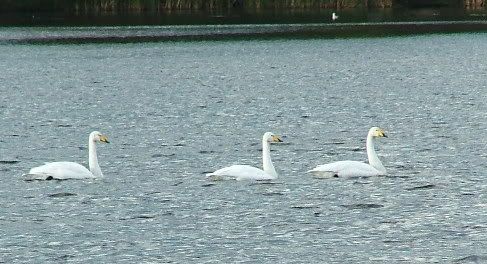 They probably won't stay the night so we rushed down to see them when we heard they were around. It's a new tick on our local list, a lifer for my girlfriend, and a very elegant one too.
Seems the haywire season we're experiencing means practically any species can turn up wherever you are.
We saw Kingfisher too, which have spread from their breeding waters as wintering individuals. They certainly add glamour.
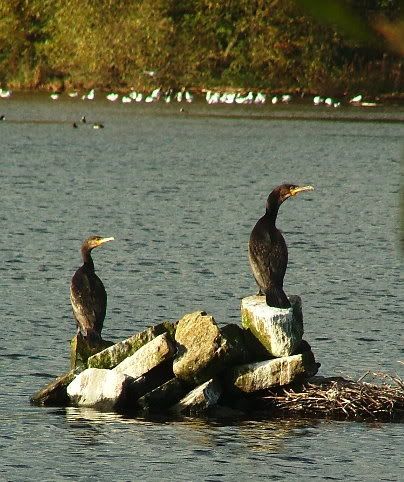 Cormorants are another species to arrive during the cold months, probably regional migrants from the reservoirs up in the Peak District. Welcome ones in mind, despite what the fisherman say.
Happy birding everybody.
Sunday, 15 October 2006
A sad demise...
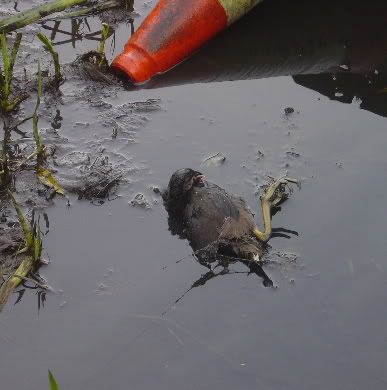 A misfortunate moorhen we found on the fringes of our local reservoir, tangled in discarded fishing line - as if the litter left by fishing parties isn't enough. I waded out to free the bird hoping there would be no lasting damage, hopes that were dashed when we discovered the line ran up into the moorhen's beak and down its throat. Doing what seemed best at the time we broke off the line to make it as short as possible, collected up the rest, and let the bird free to allow a private death without the stress of being in the open - it was very exhausted and clearly wasn't long for this world.
It's a real shame the interests of fisherman and birdwatchers must conflict so badly. We both must want a clean and healthy environment to pursue our hobby, it's what our respective game surely need.
Ah well...
Since birds are so highly prone to being affected for good and bad by human influences, I suppose it's up to those of us alert our of own impact, to make sure it's a good one.
Tuesday, 10 October 2006
Local Birding
A long time has passed since my last post here, primarily because we're not getting out to five-star birding sites at the moment. My girlfriend's broken bones are still recovering and of the two of us she's the only driver. So I'm left to concentrate on getting to destinations closer by on bike. I live in an area of Nottinghamshire dotted with land reclaimed from the mining industry, put to modern use as nature reserves and country parks to chase the tourist pound. They feature landscape verging on the desolate, where the soil is thick enough the trees are only young, elsewhere only highland grasses thrive, perfect habitat, it seems, for Green Woodpecker and Skylark. I ride four or five times a week and the bounding lime-green rump of a fleeing Green Woody is always a thrill - especially if you're riding fast enough to pursue!
As familiar as it has become to me, that bird never loses its exotic appeal.
Elsewhere on my local patch the return of half a dozen Teal have finally signalled the arrival of Autumn, as has the boom in the Lapwing flocks. Fair enough, it may not be 40,000 Pinkies or 10,000 Knot, put 600 or so Peewits erupting over your head is a spectacle in itself, and this one seems like ours.
If you get out there on your local patch often enough, it's not difficult to find inspiring sights. I bet there's somewhere at least five miles from any home in the UK.
As familiar as it has become to me, that bird never loses its exotic appeal.
Elsewhere on my local patch the return of half a dozen Teal have finally signalled the arrival of Autumn, as has the boom in the Lapwing flocks. Fair enough, it may not be 40,000 Pinkies or 10,000 Knot, put 600 or so Peewits erupting over your head is a spectacle in itself, and this one seems like ours.
If you get out there on your local patch often enough, it's not difficult to find inspiring sights. I bet there's somewhere at least five miles from any home in the UK.
Subscribe to:
Posts (Atom)


